
Listening is Hot - A Literature Review
Active listening increases conversational satisfaction, perceived understanding, and raises perceived attractiveness of the listener.
Greetings fellow professionals,
Let’s discuss a totally cool paper I found on active listening and what it means for us.
Listening is the beginning of learning, growth, reflection, and connection. It’s how we leverage diversity in background, thought, and opinion.
Listening is foundational to most emotional intelligence domains. It’s the beginning of empathy, and it’s also how we know Jerry from tech support slept with Darleen from custodial services.
We would all be boring, insufferable jack-asses if we didn’t listen.

So I found this fun paper on active listening where undergraduate students were paired with volunteers who modeled different listening techniques to see how these affected the students.
Reading this literature is a trip because intuitively we all know “active listening = good.” But none of us have data on that claim… we’re all just working off our own experiences. And measuring such claims is incredibly hard.
As humans we’ve made up our mind. We know listening is great. We have oceans of books on this. The scientific community agrees but is behind on getting the data and we’re wondering questions like “well just how great is it? and in what ways is it great? and what about advice? is it better than giving advice?”
And when we chase these answers we find fun little tidbits. Such as today’s tidbit.
Active listening makes the listener appear more attractive.
The comparison
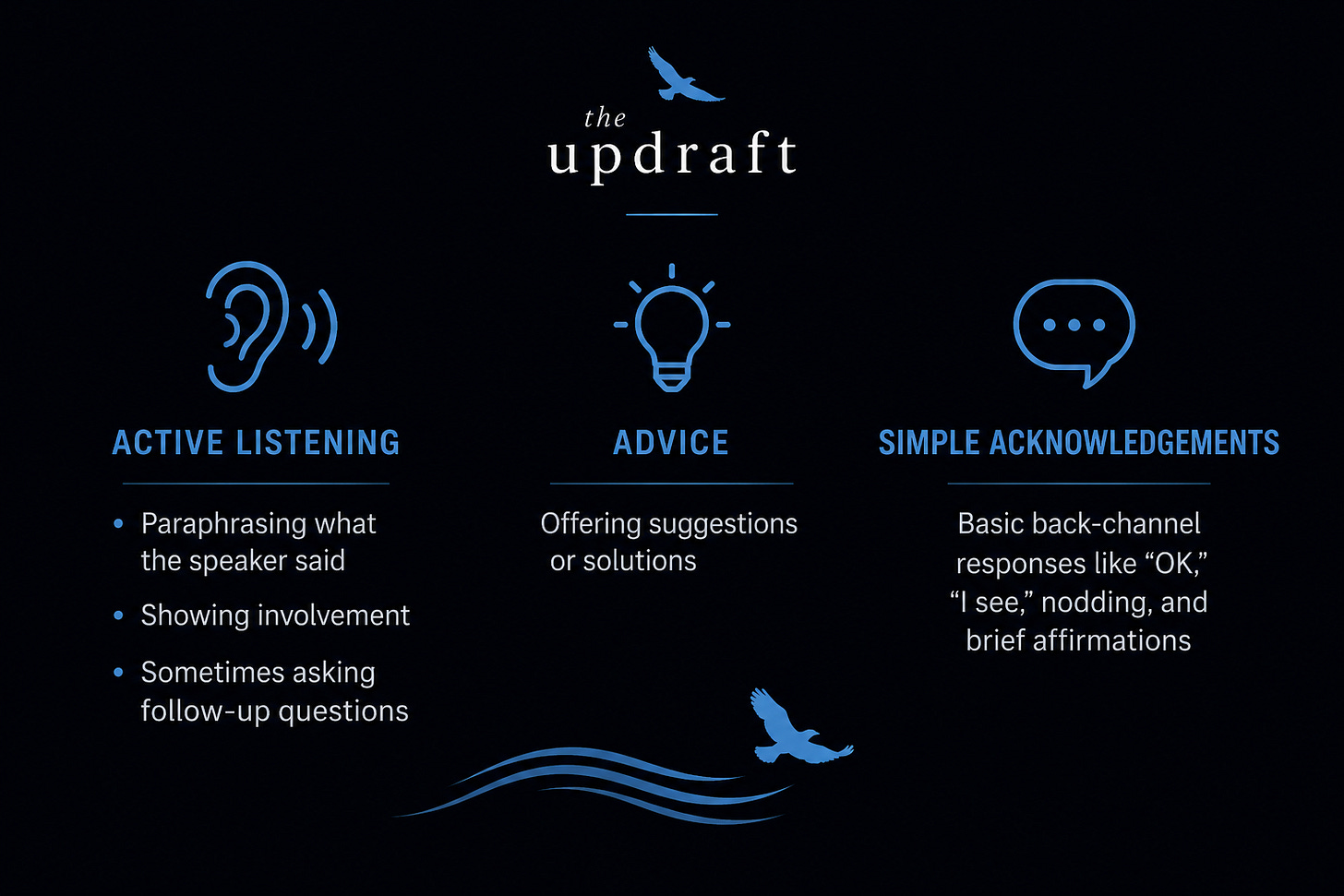
Our scientists compared three listener behaviors in initial peer interactions:
-
Active listening: paraphrasing what the speaker said, showing involvement, and sometimes asking follow-up questions
-
Advice: offering suggestions or solutions
-
Simple acknowledgements: basic back-channel responses like “OK,” “I see,” nodding, and brief affirmations
How they did it
They made 115 undergraduate participants interact with trained volunteers.
Each volunteer was trained to respond in one of the three listening styles above. The conversations were short, around 3 to 7 minutes, and used two starter topics:
-
weekend plans
-
biggest disappointment with the university so far

After the interaction, participants rated the conversation on three main outcomes:
-
Perceived understanding
Did the listener make me feel understood?
-
Communication satisfaction
Was this a satisfying conversation?
-
Social attractiveness
Did this person seem like someone pleasant to interact with?
The researchers also did a manipulation check by reviewing videos to confirm the volunteers actually behaved differently across conditions. The manipulation check confirmed the groups behaved meaningfully differently across conditions.
Main findings
1. Active listening increased feelings of understanding
The mean scores reported in the paper move in a neat staircase:
-
Simple acknowledgement: 11.79
-
Advice: 14.48
-
Active listening: 17.27
Participants in the active listening condition felt more understood than participants who received either advice or simple acknowledgement responses.
2. Active listening improved ‘conversation satisfaction’ over minimal acknowledgement, and not much over advice
Reported means:
-
Simple acknowledgement: 3.27
-
Advice: 3.68
-
Active listening: 3.81
Participants were more satisfied with conversations when the listener used active listening than when the listener used only simple acknowledgements.
But active listening did not significantly outperform advice on satisfaction.

So, advice was roughly as satisfying as active listening in this study. Context and listener preference still matter.
3. Active listening increased social attractiveness over minimal acknowledgement, but not over advice
Reported means:
-
Simple acknowledgement: 3.65
-
Advice: 3.84
-
Active listening: 4.02
Listeners using active listening were judged more socially attractive than those using only minimal acknowledgements.
But again, active listening and advice were statistically similar. Advice did not hurt the listener’s appeal here.
In terms of raw interpersonal hotness:
Active Listening > Advice > Simple Acknowledgement
What we take away
Their interpretation is pretty non-mythical. No jump-scares in this data set.
Here are some deeper takeaways:
-
Feeling understood is psychologically distinct from receiving help.
-
Minimal acknowledgement leaves people emotionally underfed.
-
Active listening is more about ego suppression than technique.
-
Being heard changes psychology.
-
Tiny conversations (<10 mins) shape fundamental identity judgements.
-
I like this person.
-
I think they are attractive.
-
-
I want to be around this person.
In general - this person makes me feel understood.
Think about that.
Think about how complex you are as a person, and how in just 3 to 7 minutes of someone listening well, you can feel genuinely understood.
That’s the power of emotional intelligence.
In human interaction, understanding is not a prelude to connection.
It is the connection.
Leadership connection
Leaders think they need to be the loudest, the first to decide, the most certain-sounding person. Confidence. Volume. Power. Rahhhhhhh!
This study highlights the dichotomy that:
Interpersonal influence begins with accurate emotional attunement, not intellectual dominance.
-
the fastest responder is not always the most trusted
-
the smartest person in the room may still fail relationally
-
emotional precision can outperform strategic brilliance in first impression
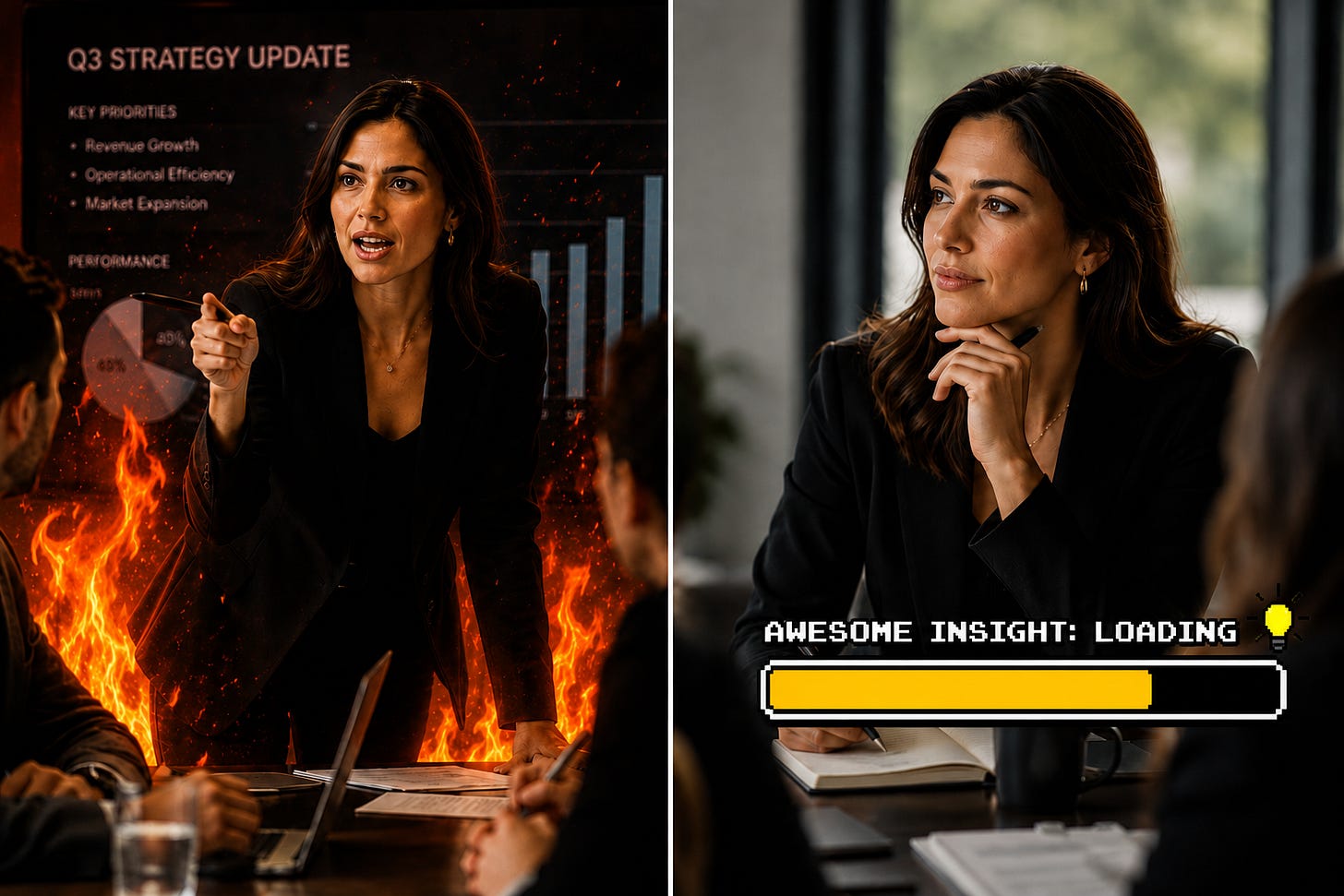
You want to be powerful? Fuck the volume and fuck the feeling of needing to appear in charge.
-
Be the quietest - and when you speak say things that make people want to listen.
-
Be the last to decide - and make a great decision.
-
Be comfortable in being the least certain - and work to find out.
You want to be hot?
- Starts with the ears, my friends. :)
The most important step is always the next one.
-Dan
Did you learn something? Did I make you laugh or smile? Make my day and send this to someone else who might enjoy it too.
References
All photos generated on my home AI installation with prompts from my own notes.
Weger, Harry Jr., Gina Castle Bell, Elizabeth M. Minei, and Melissa C. Robinson. “The Relative Effectiveness of Active Listening in Initial Interactions.” International Journal of Listening 28, no. 1 (2014): 13–31. https://doi.org/10.1080/10904018.2013.813234. (tandfonline.com)

Dan is co-founder of Kestryl Edge, a leadership development consultancy helping operations-heavy companies reduce turnover and rework through emotional intelligence. Work with us →
Enjoyed this? Subscribe to The Updraft on Substack for more.
Originally published at dankorus.substack.com. The Updraft is the canonical home for this piece.