
Bosses affect your 🫵🏻 health more than doctors 🩺🥼
How to build a high trust environment with emotional intelligence skills.
Team,
These last few weeks have been all about trust. First with the Millennial Masters collaboration on a post about Low Trust Leaders creating Low Trust Teams.
Now, a leftovers essay with my remaining thoughts about the impact low trust has on our health and how we can exercise our emotional intelligence skills to build a high trust environment.
Let’s rock.
A safari for the low trust leader
Low trust leaders are everywhere.
Why?
Hierarchies easily slip into political status war games. Information, decisions, and resources are hoarded for positional security. Optics drive decisions to protect ego. And the resulting low trust landscape is, unfortunately, best navigated with the very same low trust actions that created it. Our corporate system encourages and rewards low trust behavior.

It’s not hard to spot a low trust leader…
-
They micromanage and gate keep information, creating dependencies, positioning themselves as a bottleneck approver.
-
They punish people for raising problems and escalating bad news.
-
They interpret asking for help as sign of weakness.
-
They say one thing in public and do another thing behind closed doors.
“Leaders who fail to demonstrate vulnerability-based trust tend to create environments where self-protection, not performance, becomes the dominant behavior.”
— Lencioni, The Five Dysfunctions of a Team (2002)
Craig or Grizzly Bear? - Why care?
As humans we are sensitive to low trust environment. We’re not great at interpreting between a low trust environment and a physical threat, though.
Our body releases the same chemical cocktail needed to survive a grizzly bear as it does to survive Craig from accounting.

Adrenaline, Cortisol, and Norepinephrine are all released in a low trust situation to spike our heart rate, suppress non-essential body functions, and sharpen our vigilance.
We were NOT designed to run on this high-octane hormonal mix of full time.
Long term use comes with a host of mental and physical consequences:
-
Increased cognitive bandwidth consumption (brain ram) allocated to threat monitoring. This could be deciphering tone in emails, anticipating reactions, rehearsing self-protective scripts. Anticipatory anxiety leads to hyper-vigilance fatigue.
-
Nervousness around self-disclosure. Every interaction begins to carry a small tax. “How much do I say? Is this safe to admit? Will this be used against me?” We all bring a mask to work. How much should we show people we don’t trust who we are?
-
Creativity and individuality is stifled. People perform compliance by managing expression and suppressing judgement. The widening fault line between who you are and how you present is a slow and certain psychological bleed.
-
We develop memories improperly and forget stressful encounters. Long term heightened cortisol interferes with how the brain forms and encodes memories. Our brain prioritizes survival over memory forming. The more stressed we get, the less we remember.
Living in this environment we develop symptoms like headaches, GI issues, muscle tension, elevated blood pressure, and disrupted sleep.
Over time, we’re at increased risk for depression, anxiety disorders, hypertension, heart attacks, strokes, weight gain, insulin resistance, and even type 2 diabetes. (Yaribeygi, 2017; Joseph, 2017; Mariotti, 2015, Hackett, 2017)
So… why do we care?
Our bosses have a greater influence on our personal health than our doctors and our family.
One more time…
Our bosses have a greater influence on our personal health than our doctors and our family.
Learning? :) Send this post to someone who would enjoy it!
Who’s job is “trust”, anyways?
The literature on workplace is quite clear on this:
-
The most influential person to build & erode trust is the leader.
- Leader behavior is the primary antecedent of psychological safety, which is the precondition for learning, voice, and performance. (Edmondson, 1999 & 2018)
-
Trust is contagious.
- Trust is bidirectional but power asymmetry means leader behavior sets the conditions more than anyone else in the professional ecosystem. (Lee and Rasdi 2025)
-
Trust spreads. And it flows downward the easiest
- Leaders who are trusted by their own managers tend to behave more trustingly toward their reports. Heightened trust cascades to heightened performance. (De Cremer et al., 2018)
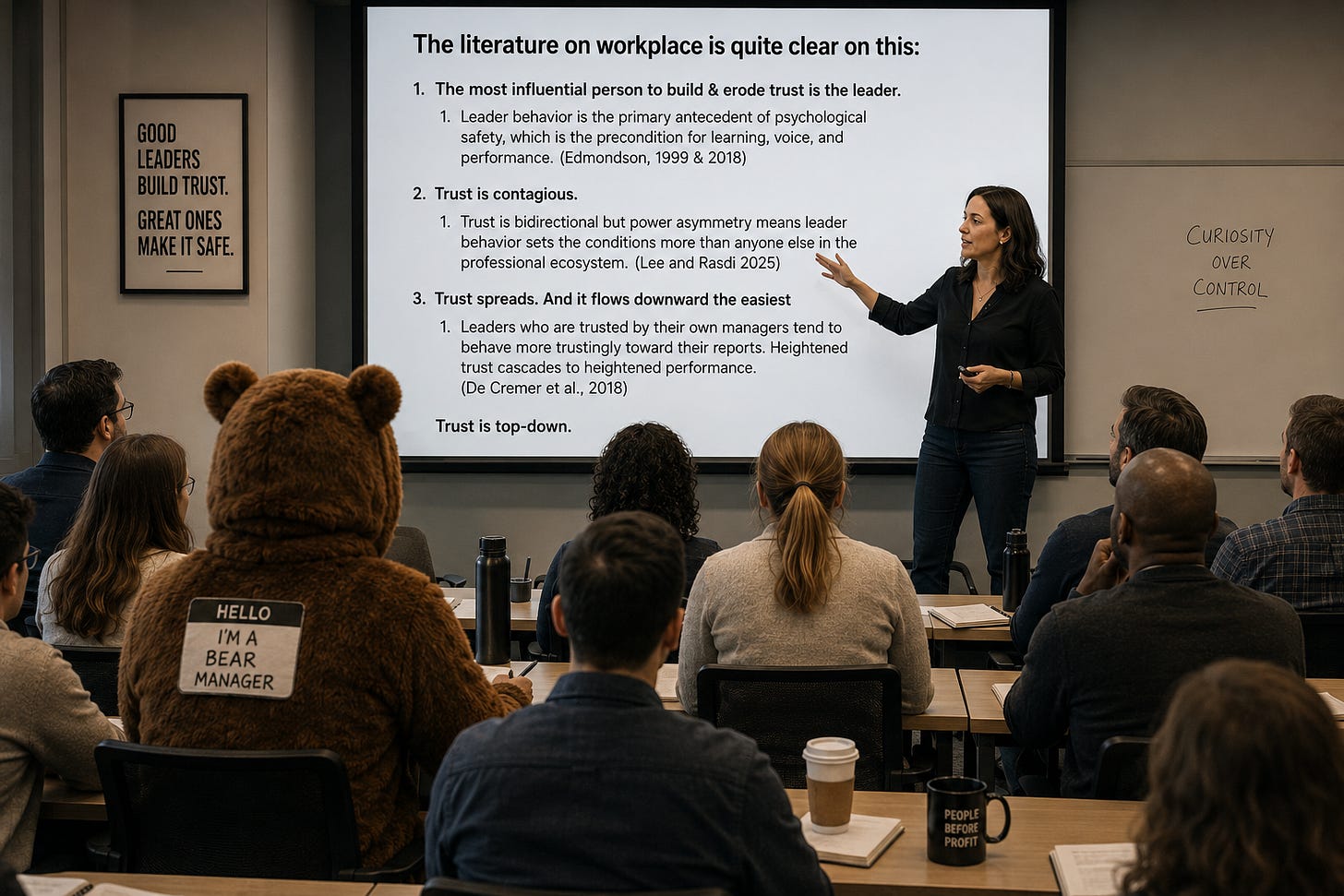
Trust is top-down.
The proof is in the pudding - EQ in practice
We need trust to feel safe and to live in a state of biochemical safety.
Enter, Emotional Intelligence (EQ).
Building trust is entirely dependent on leaders developing and executing emotional intelligence skills. (Knight et al. 2015)
Want trust? Build EQ skills.
Chiefly:
-
self-awareness
-
pausing
-
self-regulation
-
empathy
-
follow-through
Trust starts inside - Build self-awareness
Step one to emotional intelligence is knowing your own emotions. What makes you tick and what ticks you off.
“How the hell are you supposed to love someone else if you can’t love yourself?”
- Ru Paul
Self-aware leaders:
-
Understand how their mood and energy affect the room.
-
Are honest about their blind spots (rather than defensive).
-
Know their triggers, can name them, and can identify a triggering moment before they act. Can distinguish between “I’m reacting” and “I’m responding”
-
Responding is confident, collected, and controlled.
-
Reaction is chaotic, unpolished, hurtful, and generally unproductive.
-
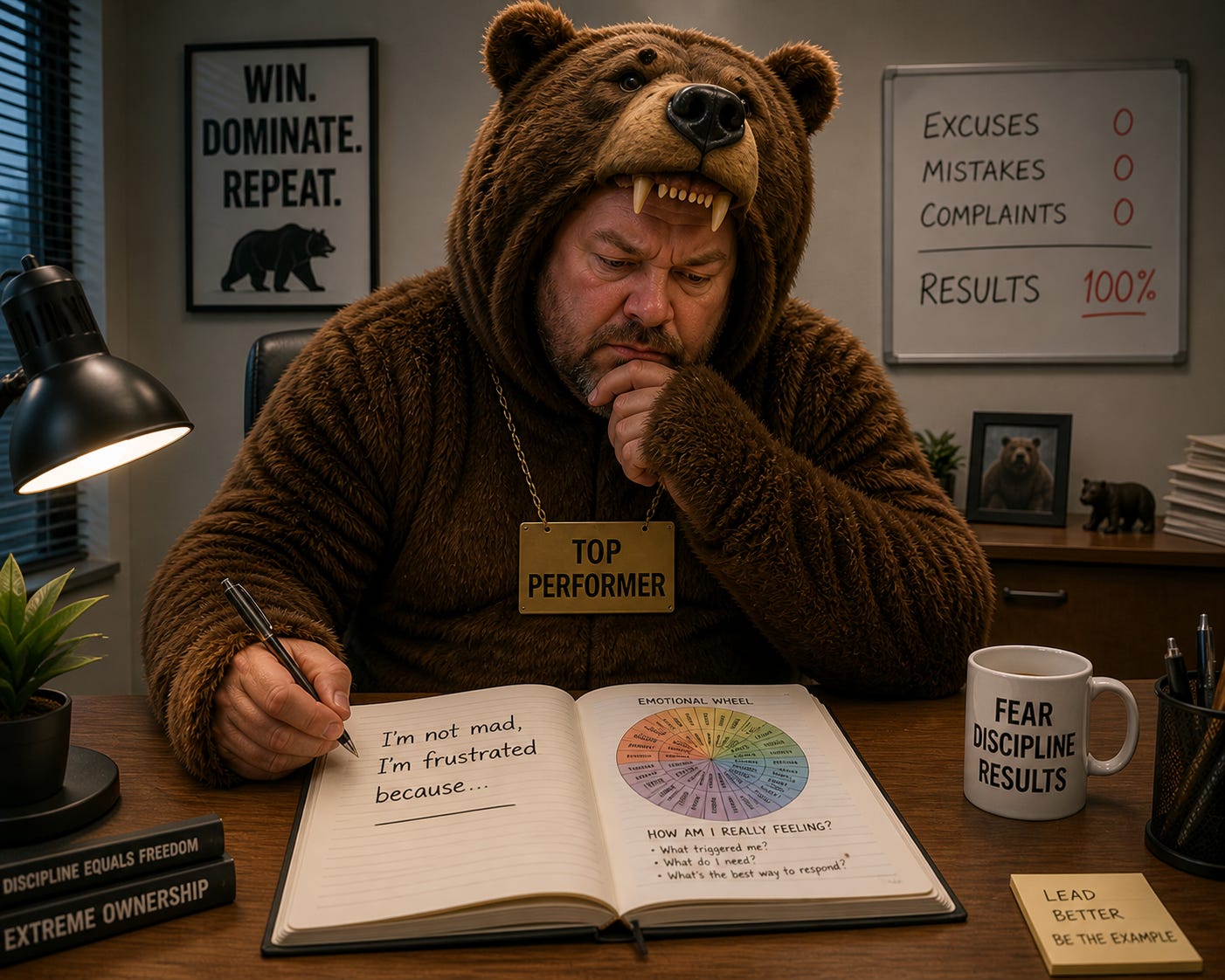
There’s an aura to self awareness. People feel the difference between a leader who knows themselves and one who doesn’t.
Slow down, breath - Learn to take your time
A leader who visibly manages their own reaction in a tense moment teaches their team that emotions are welcome. They slowly change the paradigm that emotions are weapons or displays of weakness.
Calming yourself calms the room.
Over time the team learns they can show up as themselves and they don’t need to change the facts to avoid a minefield of your triggers and assumptions.
Breathing is the fastest path to regulation.
Pause.
Breath… slowly.
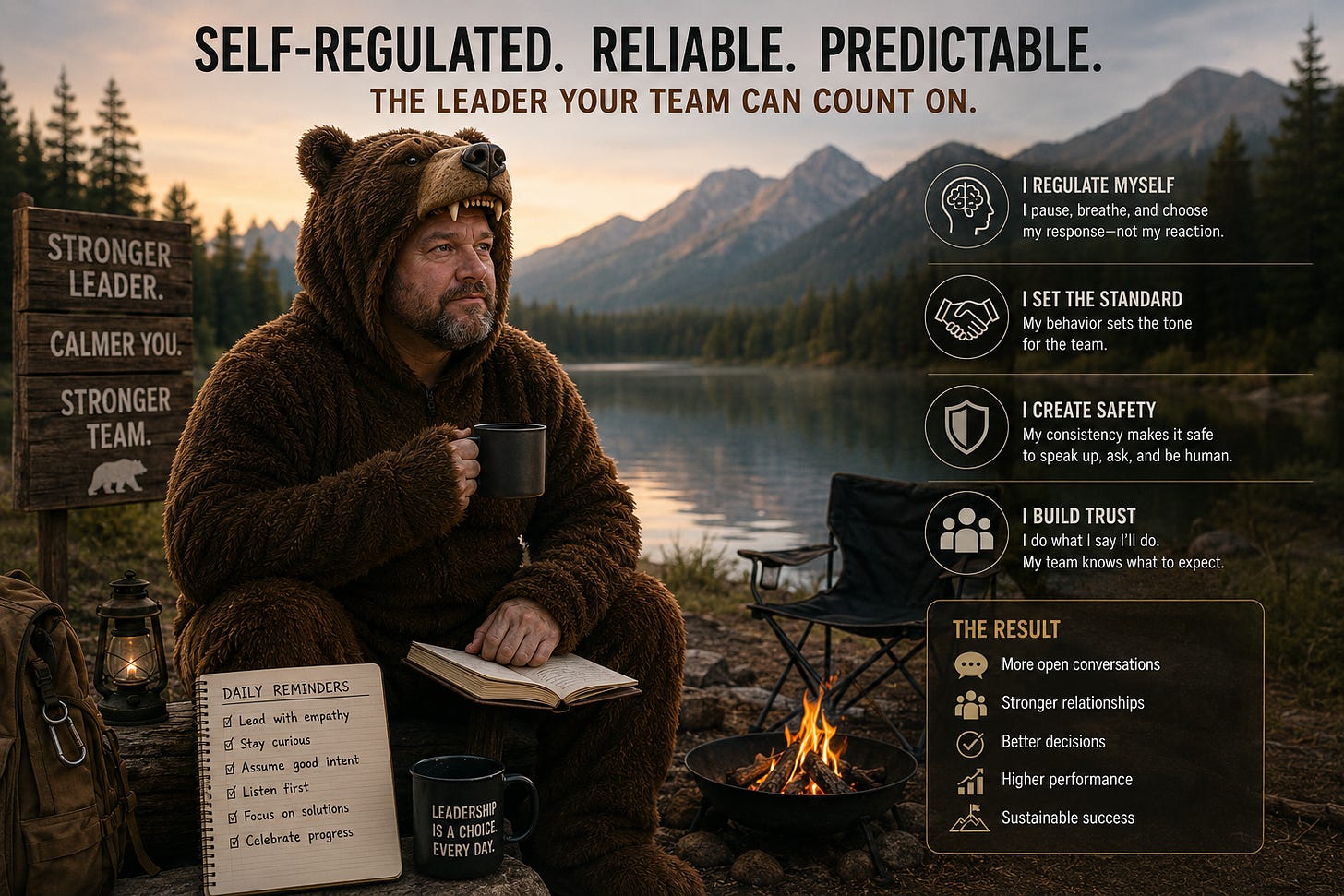
Imagine the waves of the ocean. Our calmest breathing happens in sets of six seconds. The rhythm of the tide felt around the world. (Lehrer et al. 2000)
One trick I use is carrying a nice notebook with a pencil or pen I really like. Something I want to use. I write while people talk. To do’s, summative points, and questions.
Writing forces me to engage and ensures my own accuracy before I respond with my own thoughts. It buys me time.
It keeps my hands busy, my mouth shut, and my ears open.
Consistently consistent self-regulation
Regulation makes you predictable. People trust leaders they can anticipate.
Self-regulated leaders model that it’s possible to feel something without being ruled by it.
-
They don’t punish people for their own bad days
-
They pause before responding to emotionally charged situations
-
They can receive hard news without flipping the table
These small moments build the sense of security.
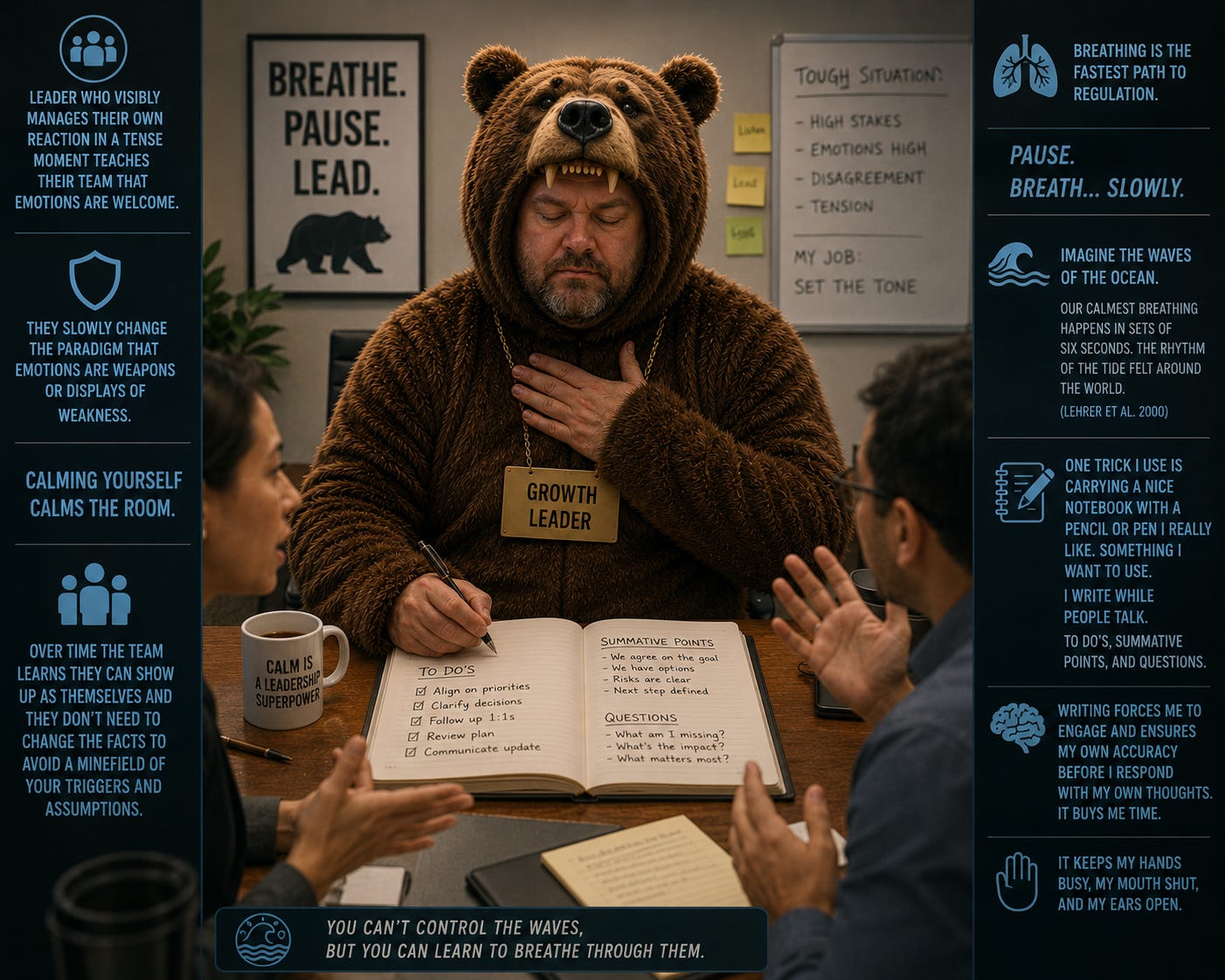
“Psychological safety isn’t a perk — it’s the precondition for every behavior we associate with high performance: speaking up, experimenting, admitting error.”
— Edmondson, The Fearless Organization (2018)
The teammate doesn’t speed into work because they know you won’t bring the hammer down over being a couple minutes late. Mistake gets brought up because they know you won’t blame them and will instead examine the system. This, is trust. And trust takes time.
Empathy - The bridge
Not sympathy... empathy.
Sympathy - “I understand your event.”
Empathy - “I’m here with you and your event.”
People trust leaders who they believe genuinely understands and engages in their reality.
Empathy is a a skill, like anything else. And building on the foundations of EQ we can train empathy much like we train the ability to actively listen.

“Empathy is simply listening, holding space, withholding judgment, emotionally connecting, and communicating that incredibly healing message: you’re not alone.”
- Brene Brown
Empathetic leaders:
-
Try to holistically understand someone’s experience before offering solutions or judgement.
-
Read what’s not being said: hesitations, body language, and the energy behind the words.
-
Make people feel seen and valued as a whole person, not just a role.
-
Adjust their approach based on what the individual actually needs in the moment.
Be the one that follows through
EQ without action is for posers.
-
Have the hard conversation.
-
Give the tough feedback that’s honest and caring.
-
Patch ruptures. When you get it wrong, acknowledge and fix it.
-
Advocate for your people, not just to their faces but in rooms they’re not in. That’s where they need you most.
Advocating is huge. It’s a majority of our jobs as leaders in larger hierarchies where external teams handle most of our teams’ technical needs.
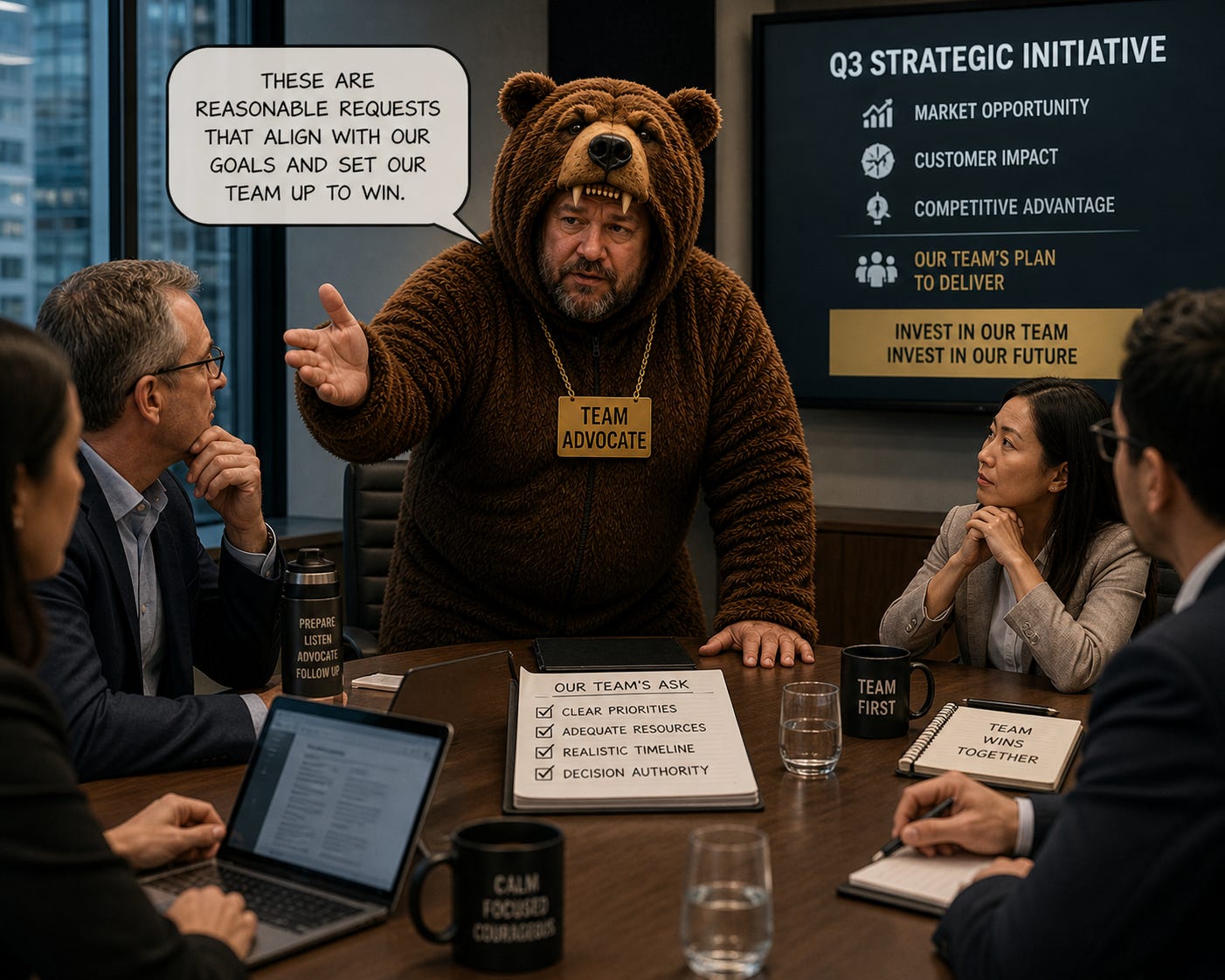
People WILL find out eventually whether their leader has their back. The advocates earn the trust they’ve worked towards.
It feels so good to know your boss has your back. You want trust and loyalty? You want a high performing team? Start here. Have your people’s backs. Advocate.
The most important step is always the next one.
-dan
This post is public and free. If it helped you, share it with someone.
Want more? Here’s where to go next:
Kestryl Edge Substack
References
All images created by ChatGPT.
Brown, Brené. Dare to Lead. New York: Random House, 2018.
Edmondson, Amy C. The Fearless Organization: Creating Psychological Safety in the Workplace for Learning, Innovation, and Growth. Hoboken, NJ: Wiley, 2018.
Gallup. State of the Global Workplace Report. Washington, DC: Gallup, 2023.
Goleman, Daniel. Emotional Intelligence. New York: Bantam Books, 1995.
Goleman, Daniel. Working with Emotional Intelligence. New York: Bantam Books, 1998.
Hackett, Rebecca A., and Andrew Steptoe. “Type 2 Diabetes Mellitus and Psychological Stress: A Modifiable Risk Factor.” Nature Reviews Endocrinology 13, no. 9 (September 2017): 547–60. https://doi.org/10.1038/nrendo.2017.64.
Harms, Peter D., and Marcus Credé. “Emotional Intelligence and Transformational and Transactional Leadership: A Meta-Analysis.” Journal of Leadership & Organizational Studies 17, no. 1 (February 2010): 5–17. https://doi.org/10.1177/1548051809350894.
Joseph, Joshua J., and Sherita Hill Golden. “Cortisol Dysregulation: The Bidirectional Link between Stress, Depression, and Type 2 Diabetes Mellitus.” Annals of the New York Academy of Sciences 1391, no. 1 (January 2017): 20–34. https://doi.org/10.1111/nyas.13217.
Knight, Jennifer Redmond, Heather M. Bush, William A. Mase, Martha Cornwell Riddell, Meng Liu, James W. Holsinger Jr., et al. “The Impact of Emotional Intelligence on Conditions of Trust among Leaders at the Kentucky Department for Public Health.” Frontiers in Public Health 3 (2015): 33. https://doi.org/10.3389/fpubh.2015.00033.
Lee, Michelle Chin Chin, and Roziah Mohd Rasdi. “Trust in Leader as Antecedent to Trust in Team Members, Team Cooperation, and Team Performance: A Multilevel, Longitudinal, Mediational Perspective.” Psychological Reports (2025). https://doi.org/10.1177/00332941251377383.
Lehrer, Paul M., Evgeny Vaschillo, and Bronya Vaschillo. “Resonant Frequency Biofeedback Training to Increase Cardiac Variability: Rationale and Manual for Training.” Applied Psychophysiology and Biofeedback 25, no. 3 (September 2000): 177–91. https://doi.org/10.1023/A:1009554825745.
Lencioni, Patrick. The Five Dysfunctions of a Team: A Leadership Fable. San Francisco: Jossey-Bass, 2002.
Mariotti, Agnese. “The Effects of Chronic Stress on Health: New Insights into the Molecular Mechanisms of Brain–Body Communication.” Future Science OA 1, no. 3 (2015): FSO23. https://doi.org/10.4155/fso.15.21.
van Kleef, Gerben A., Carsten K. W. De Dreu, and Antony S. R. Manstead. “Searing Sentiment or Cold Calculation? The Effects of Leader Emotional Displays on Team Performance Depend on Follower Epistemic Motivation.” Psychological Science 21, no. 12 (December 2010): 1827–34. https://doi.org/10.1177/0956797610387443.
Yaribeygi, Habib, Yunes Panahi, Hedayat Sahraei, Thomas P. Johnston, and Amirhossein Sahebkar. “The Impact of Stress on Body Function: A Review.” EXCLI Journal 16 (2017): 1057–72. https://doi.org/10.17179/excli2017-480.
Zenger, Jack, and Joseph Folkman. “The Tipping Point of Distrust.” Harvard Business Review, July–August 2019.

Dan is co-founder of Kestryl Edge, a leadership development consultancy helping operations-heavy companies reduce turnover and rework through emotional intelligence. Work with us →
Enjoyed this? Subscribe to The Updraft on Substack for more.
Originally published at dankorus.substack.com. The Updraft is the canonical home for this piece.