
Burnout is Systematic. Don’t ask “Who?” ask “How?”
Burnout has been a big topic in my circles and I want to double down on exploring the works of Christina Maslach and Michael Leiter.
Most people talk about burnout as if it were a drained battery: too much output, not enough recharge. The solution, we’re told, is to plug yourself back in and try harder. Try Different! Or even, this job may not be for you.
That story is simple and misleading.

Decades of research led by Maslach and Leiter show that burnout is not just about working long hours or feeling tired. It is a workplace syndrome caused by chronic job stressors that have not been successfully managed (World Health Organization, 2019). That definition shifts the focus away from individual weakness and toward organizational conditions.
Too often, burnout is treated as a personal failure.
Employees are told to build resilience, practice self-care, and manage stress better. While those interventions can help at the margins, they do not address the underlying causes when the job itself is the source of the strain. Burnout, in its core form, is not a failure of the person. It is a failure of the system.
Burnout Is More Than Exhaustion
The foundational research defines burnout as a three-part syndrome:
-
Exhaustion - feeling depleted and unable to recover.
-
Cynicism or detachment - developing a negative or distant attitude toward the job.
-
Reduced efficacy - feeling ineffective or unable to perform well.
(Maslach & Jackson, 1981; World Health Organization, 2019)
Someone can be working long hours and feel exhausted, yet still love their work and feel effective.
That person is overextended, not burned out.
Burnout begins when exhaustion is accompanied by disengagement and self-doubt. We’re not just talking fatigue here, people. We’re talking mass erosion of enjoyment, vitality, and connection.
Stop Asking “Who Is Burning Out?”
Organizations often frame burnout as an individual issue. They ask:
-
Who is struggling?
-
Who needs support?
-
Who needs to become more resilient?

This framing leads to solutions focused on fixing the individual. But research shows we are asking the wrong questions here.
The better question is:
Why are people burning out?
That shift re-frames burnout as a signal about the work environment. It directs attention to job design, leadership behavior, and organizational systems rather than personal shortcomings.
As Maslach and Leither’s work consistently shows, burnout is best understood as a mismatch between people and their work conditions, not as a defect in the individual (Leiter & Maslach, 1999).
The Six Areas That Drive Burnout
Research identifies six key areas where mismatches between employees and their work environment lead to burnout:
-
Workload - Not just too much work, but work that is relentless or unmanageable.
-
Control - Lack of autonomy or ability to influence how work is done.
-
Reward - Insufficient recognition, feedback, or compensation.
-
Community - Poor relationships, isolation, or lack of trust.
-
Fairness - Inequity, favoritism, or inconsistent treatment.
-
Values - Misalignment between personal values and organizational priorities.
(Leiter & Maslach, 1999)
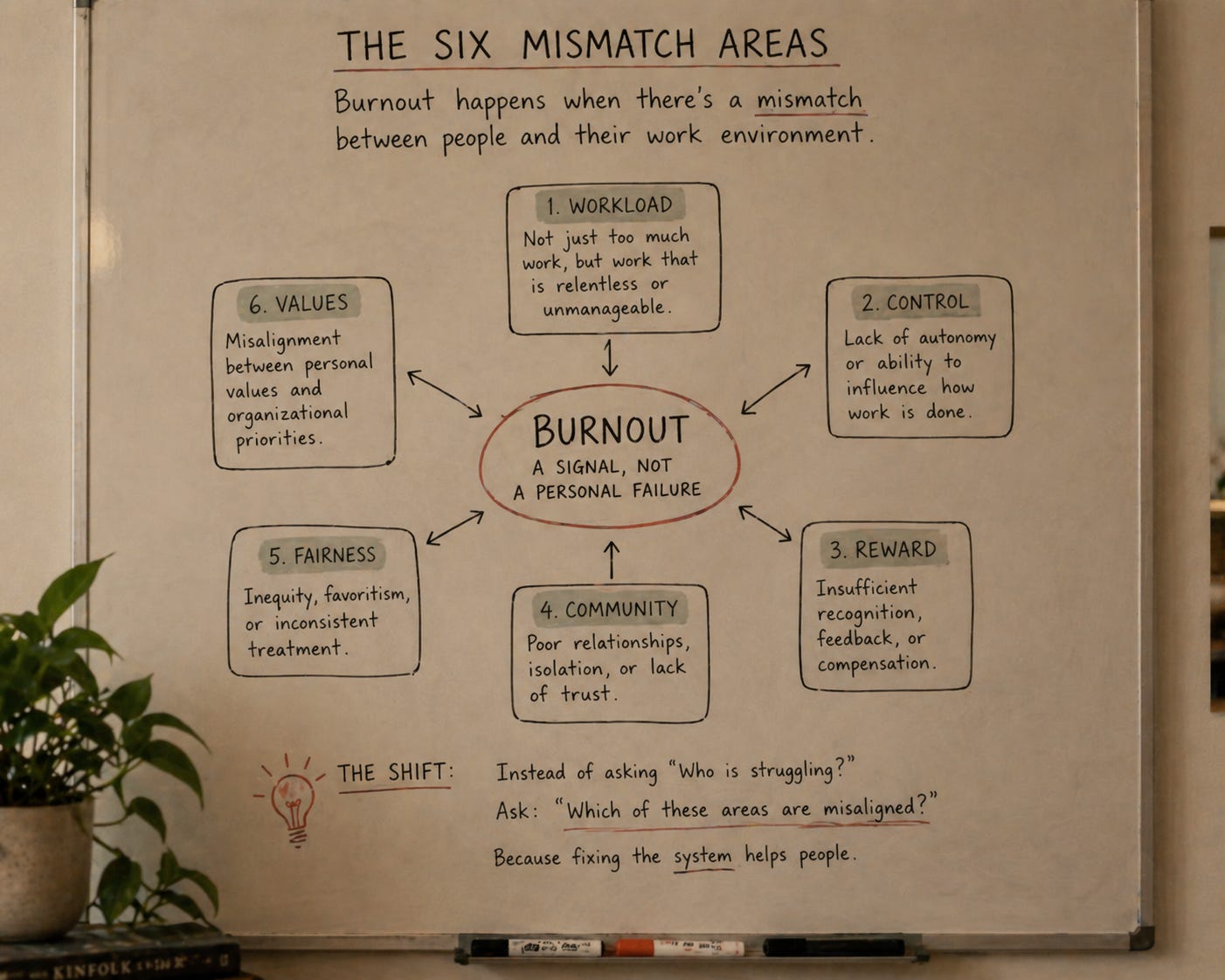
Burnout is more likely to manifest when multiple mismatches stack together. A heavy workload may be tolerable if people feel supported, valued, and in control. And when workload combines with unfairness, poor leadership, and lack of recognition, the experience becomes corrosive.
The “Pebbles in the Shoe” Problem
Burnout is rarely caused by one dramatic failure. More often, it emerges from small, chronic irritations.
These include:
-
Unnecessary administrative tasks.
-
Inefficient systems and tools.
-
Constant interruptions.
-
Unclear expectations.
-
Lack of input into decisions.
Individually, these may seem trivial. Collectively, they become what Maslach describes as “chronic job stressors” that steadily wear people down (World Health Organization, 2019).
These small frictions matter because they pull people away from meaningful work and create a sense that effort is wasted. Over time, that disconnect fuels cynicism and disengagement.
Why Organizations Still Get This Wrong
From a business perspective, burnout should be an obvious priority. It is linked to:
-
Lower engagement.
-
Reduced productivity.
-
Higher turnover.
-
Increased errors.
(Leiter & Maslach, 2009)
These are hard problems to sometimes spot in a business. Unless your Key Performance Indicators (KPIs) are fine tuned to measure errors, engagement, and productivity… you will have a hard time identifying the problem before it becomes wide spread.
Several patterns in low EQ workplaces explain this:
-
Leaders assume jobs are fixed and employees must adapt.
-
Managers are overloaded and do not seek input.
-
Organizations favor simple, individual-focused solutions.
-
Toxic behaviors are sometimes rewarded as high performance.
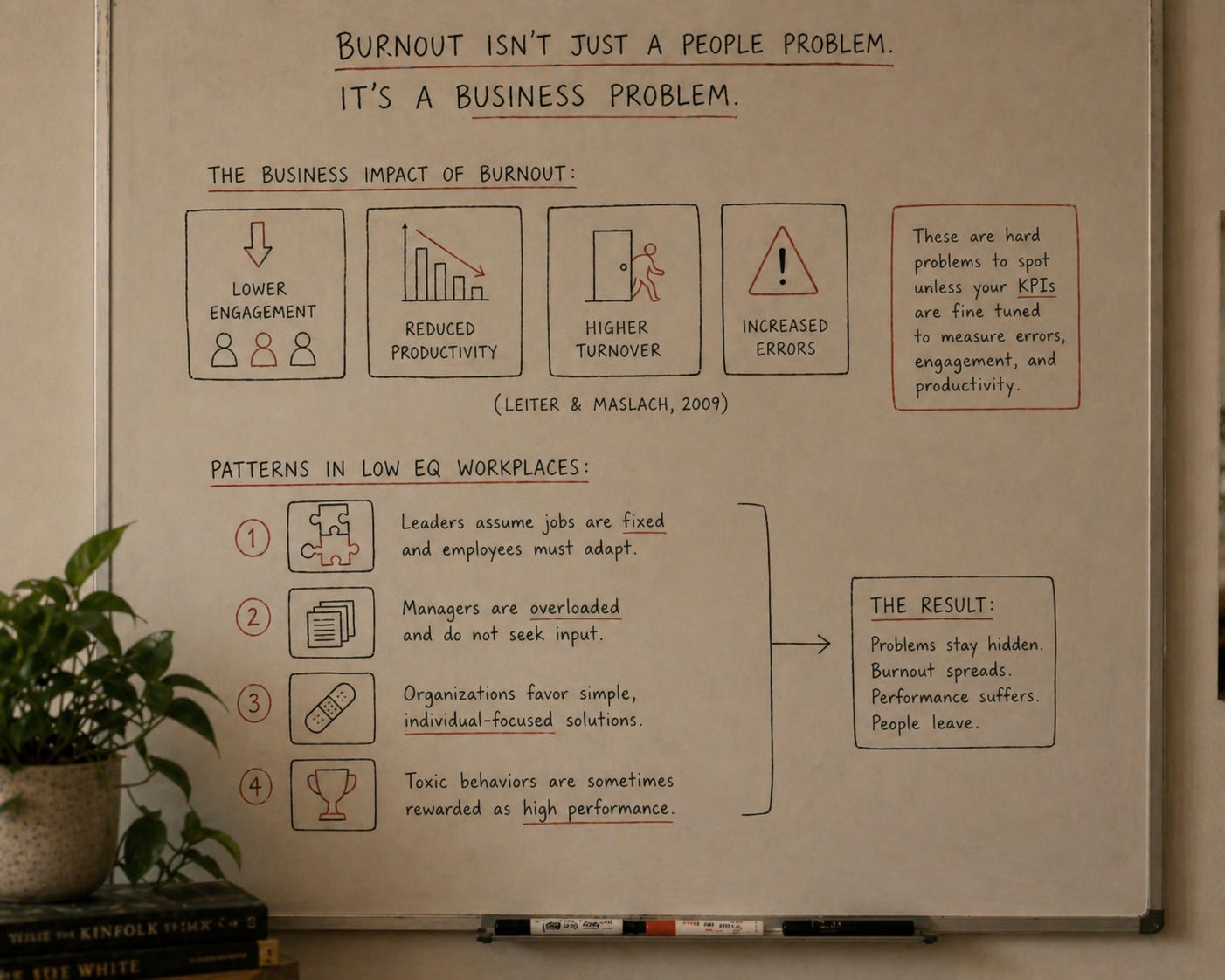
Let’s not forget a common issue. Managers themselves are often under intense pressure, which limits their ability to support others. Burnout can cascade downward, creating a cycle where stressed leaders unintentionally create stressful environments.
Toxicity Is Systemic, Not Just Personal
Workplace toxicity is often blamed on individuals. While difficult personalities can certainly cause harm, toxic environments can exist even without clearly toxic people.
Systems, incentives, and norms shape behavior.

At the same time, organizations often fail to address harmful behavior when it does arise. Employees may hesitate to speak up, and leaders may avoid difficult conversations. Without intervention, negative dynamics spread, undermining trust and collaboration.
Healthy workplaces require more than policies. They require consistent, visible action that reinforces fairness, respect, and accountability.
What Better Leadership Looks Like
The solution to burnout is not a one-time initiative. It is an ongoing process of improving how work is structured and experienced.
Maslach and Leiter suggest treating workplace well-being like a regular doctor checkup:
-
What is working well?
-
What is getting in the way?
-
Where are people experiencing friction?
-
What small changes would make work better?
This approach aligns with broader leadership frameworks that emphasize psychological safety, employee voice, and supportive conditions as drivers of performance and well-being (U.S. Surgeon General, 2022).
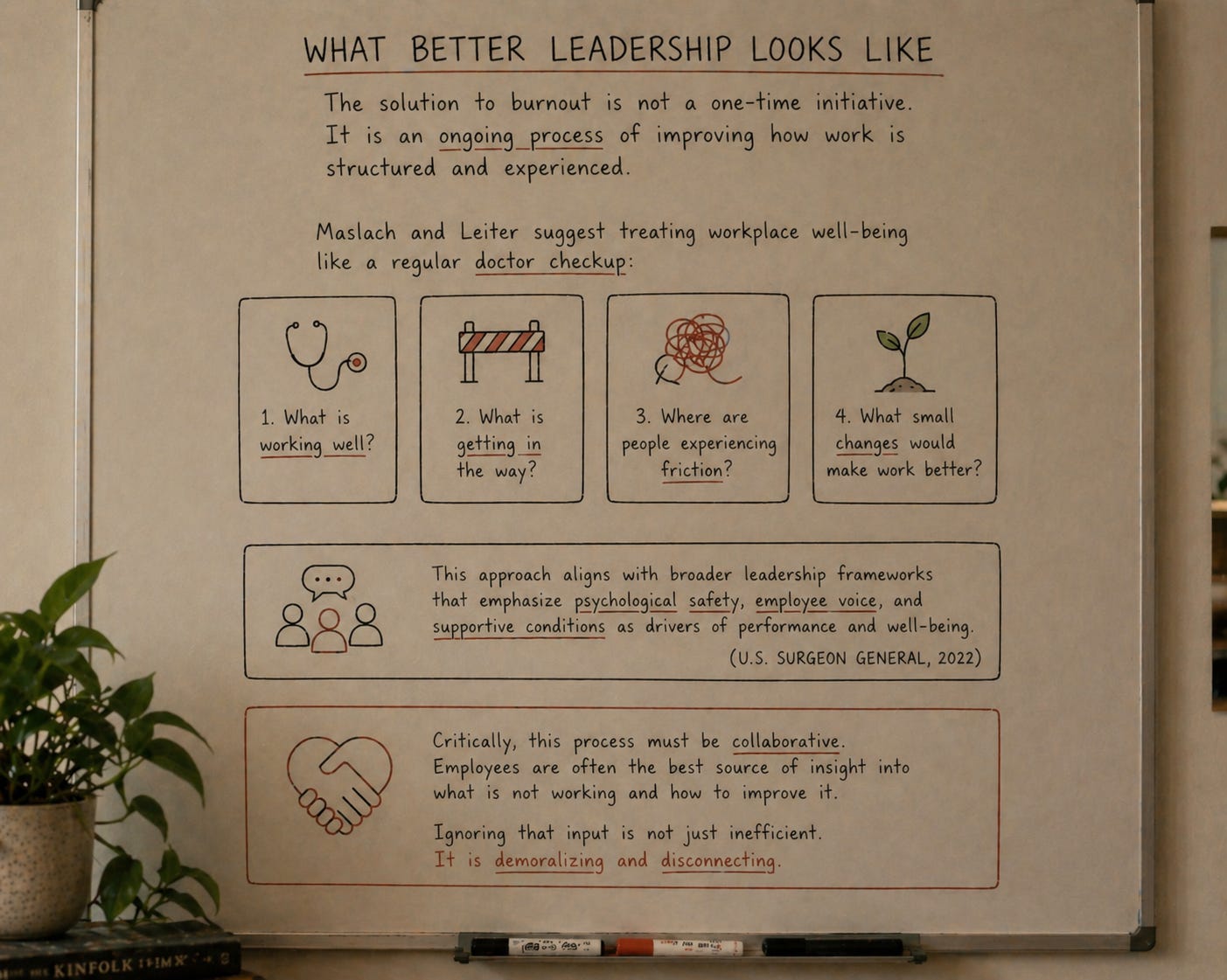
Critically, this process must be collaborative. Employees are often the best source of insight into what is not working and how to improve it. Ignoring that input is not just inefficient. It is demoralizing and disconnecting.
“How?” Questions for Leaders
If you suspect burnout is being propagated in your environment, or if you’re interested in preventing burnout in the first place, here are some “how” questions to work through.
-
How is work actually getting done day-to-day vs. how we think it gets done?
-
How much of our team’s time is spent on low-value or unnecessary work?
-
How do new responsibilities get added and what gets removed when they do?
-
How much control do people have over how they do their work?
-
How safe do people feel asking for help or admitting mistakes?
-
How often do strong contributions go unrecognized?
-
How consistent and transparent are our decisions around workload, rewards, and opportunities?
-
How often do we ask, “What’s getting in the way of doing great work?”, and actually act on it?
The Takeaway
Burnout is not a sign that employees are weak, fragile, or incapable. It is a signal that something in the system is broken.
The research is clear: burnout emerges from chronic, manageable workplace conditions (World Health Organization, 2019; Leiter & Maslach, 1999). Organizations have the ability and the responsibility to address it.
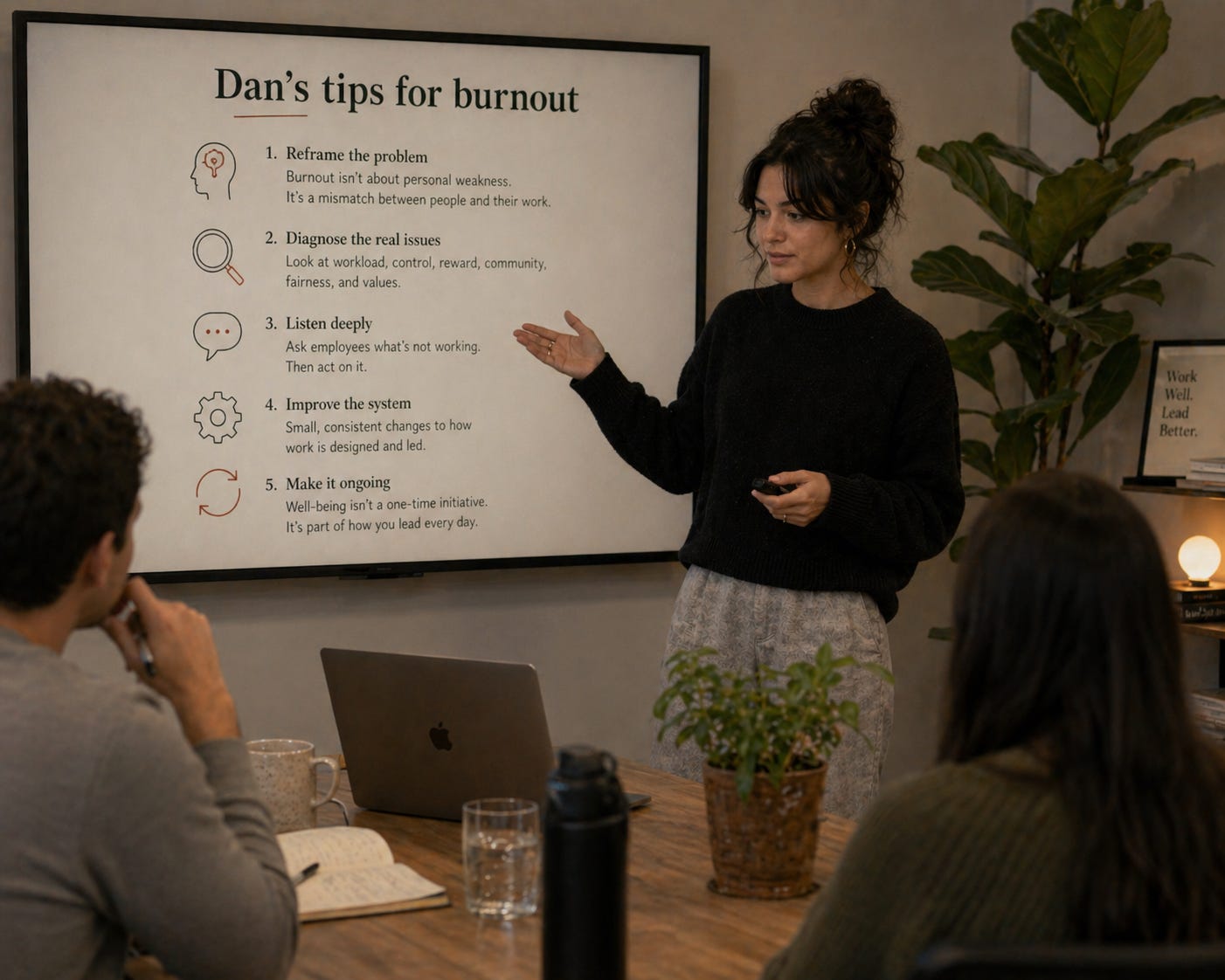
Better leadership is not about pushing people harder. It is about designing work that allows people to perform at their best without being worn down in the process.
The real question is not whether burnout can be reduced.
It is whether leaders are willing to redesign the workplace to make that possible.
The most important step is always the next one.
-dan
References
Leiter, Michael P., and Christina Maslach. 1999. “Six Areas of Worklife: A Model of the Organizational Context of Burnout.” Journal of Health and Human Services Administration 21 (4): 472–89.
Leiter, Michael P., and Christina Maslach. 2009. “Nurse Turnover: The Mediating Role of Burnout.” Journal of Nursing Management 17 (3): 331–39.
Maslach, Christina, and Susan E. Jackson. 1981. “The Measurement of Experienced Burnout.” Journal of Occupational Behavior 2 (2): 99–113.
U.S. Department of Health and Human Services, Office of the Surgeon General. 2022. Framework for Workplace Mental Health and Well-Being. Washington, DC: U.S. Department of Health and Human Services.
World Health Organization. 2019. “Burn-Out an Occupational Phenomenon: International Classification of Diseases (ICD-11).” Geneva: World Health Organization.
Background Summary
Burnout remains one of the most critical leadership and management challenges in 2026, driven by chronic workplace stress, declining employee engagement, and outdated organizational practices. Modern research shows burnout is not just about long hours or workload, but a systemic issue rooted in poor job design, lack of autonomy, weak leadership communication, and misalignment between employee values and company goals. Effective leaders are shifting from reactive wellness initiatives to proactive burnout prevention strategies, focusing on improving work environments, reducing operational friction, and addressing the root causes of stress. High-performing organizations are prioritizing employee experience, psychological safety, and sustainable productivity as key drivers of retention, performance, and long-term business success.
Forward-thinking management teams are redefining leadership by emphasizing collaboration, transparency, and continuous workplace optimization. Instead of relying solely on individual resilience or HR-driven programs, companies are adopting data-informed approaches to identify burnout risk factors such as excessive workload, lack of recognition, toxic culture, and limited career growth. In 2026, top leadership trends include redesigning roles for better work-life balance, empowering managers to act as coaches rather than task enforcers, and creating feedback loops that allow employees to shape their work conditions. Organizations that successfully address burnout and workplace stress are seeing measurable gains in productivity, innovation, and employee satisfaction, making burnout prevention a core pillar of modern leadership strategy.

Dan is co-founder of Kestryl Edge, a leadership development consultancy helping operations-heavy companies reduce turnover and rework through emotional intelligence. Work with us →
Enjoyed this? Subscribe to The Updraft on Substack for more.
Originally published at dankorus.substack.com. The Updraft is the canonical home for this piece.