
Leadership in 'Blood Over Bright Haven' by M. L. Wang
What do you do when you find out your societies success is forged on violence and murderous exploitation?
What do you do when you find out your societies success is forged on violence and murderous exploitation?
I finished Blood Over Bright Haven for book club. It’s one of those books you can recommend to anyone. So, if you don’t mind spoilers, read on! If you do… go take a day or two to read this book. You won’t regret it. 🙂
Rich world development, great characters, and well defined setting that makes all the heavy topics and philosophical commentary come together.
On the surface, it’s a book about a young woman on her journey to break gender norms through her intelligence and unprecedented skill. I thought it might be light hearted sci-fi adventure.
As we read on we find out the book is also a brutally violent commentary on immigration, race, privileged, religion, rape culture, systems of power and oppression, and the morality that underpins our society.
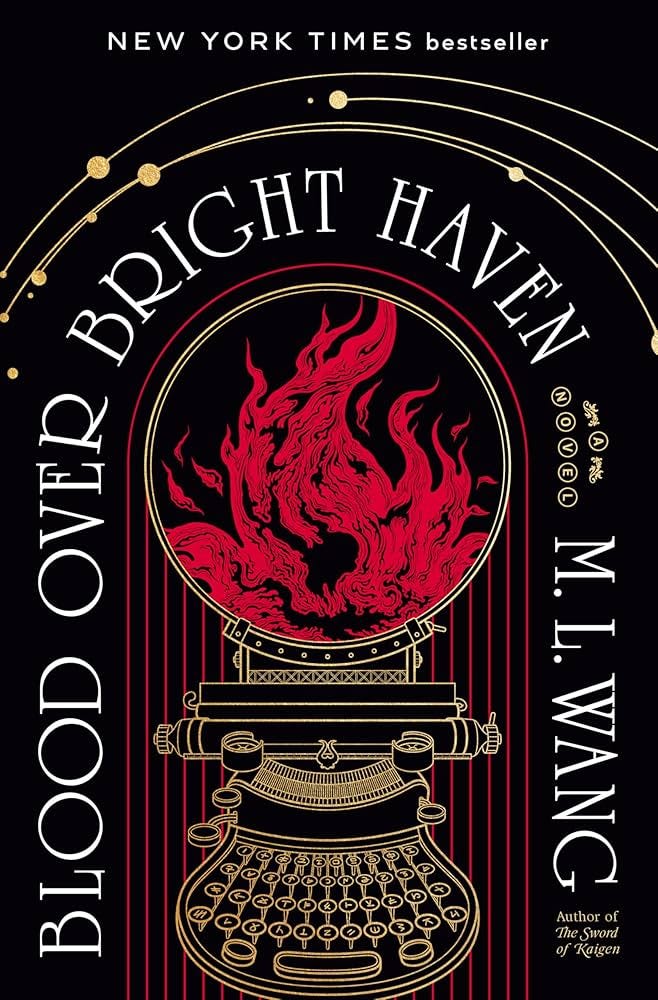
The commentary is topical in today’s political discourse. If I thought high schoolers could read this and not be traumatized I would say it should be on high school reading lists for seniors. Maybe it should be… you read it and tell me where the line is.
Because I’ve been knee-deep in leadership literature this year it’s hard for me to read a book and to not be thinking about its parallels to leadership and emotional intelligence frameworks.
Here are my leadership notes after reading.
1. Technical competence alone doesn’t make a good leader
Sciona (the protagonist) is brilliant, relentless, and unquestionably capable. The story keeps poking at a hard truth: raw intelligence without empathy can distort judgment. Smarts don’t make someone inherently good, better than, or correct.
2. Systems can be unjust even when individuals succeed
Sciona “wins” her position, but the institution she enters is built on exploitation.
Rising through a broken system doesn’t fix the system itself. It makes you complicit. Leaders have to look beyond personal achievement and ask, “What am I reinforcing just by being here?”
3. Listening is a form of power
Characters in the book who survive with their humanity intact tend to be the ones who actually listened to those around them. In particular those with less station and power.
The characters who ignore marginalized voices face catastrophic consequences. Leadership is not high tower monologues. It is ground level conversations.
4. Curiosity can be dangerous… and necessary
Sciona’s drive to uncover truth is both heroic and destructive.
Questioning the system is essential and questioning without regard for consequences can harm others. Leaders need curiosity with responsibility.
5. Moral courage matters more than social approval
There are moments where doing the right thing costs status, safety, or belonging.
Leadership often means standing alone when the crowd prefers comfort over truth. Applause is a poor compass.
6. Exploitation thrives behind abstraction
The magic system itself becomes a metaphor: when harm is hidden behind layers of theory, distance, or “that’s just how it works,” people stop questioning it.
Leaders have to pull those hidden costs into the light. If you can’t explain who pays the price you haven’t looked hard enough.
Abstraction is how we can live a guilt-free a life of comfort at the expense of others.
7. Identity shapes perspective, whether you admit it or not
Sciona believes she’s purely rational, but her background and biases influence her decisions constantly. The lesson: leaders who think they’re “objective” are often the least aware of their blind spots.
Self-awareness isn’t optional. As leaders we need to know our biases in order to meaningfully work past them when interacting with our teams.
8. Change is costly, but so is staying the same
Transformation demands sacrifice.
At the same time, refusing to change carries its own quiet, ongoing damage and personal erosion.
Leadership requires choosing which cost you’re willing to bear and following through.
Sciona and Authentic Leadership
Sciona’s journey is one of self assurance and growth. When she finds out about the violent exploitation enabling the comfortable life of the privileged people around her, she does something about it.
She crashes out first. But then she harnesses her feelings of discomfort into productive action.
One of my biggest gripes in the leadership influence sphere is people trumpeting “just be yourself” or “once you have internal clarity you know have external authority”.
I believe these messages are deeply harmful and wrong. And, I think if we want to know what authentic leadership is and looks like we need search no further than Sciona Freynan.
Sciona comes to embrace her wrongness and then stands up to the oppressive powers that be.
She rebels for whats right and stands firm in her grounding of being there for the people that don’t have a voice for themselves.
Sciona risks her passions and life on her stance of justice and shows us what it means to have courage and to do the right thing because we believe it is right.
This is authentic leadership.
It’s punk rock, it dismantles systems of injustice through human morality, it’s doing the right thing even when the entire hierarchy is against you.
Keep reading.
The most important step is always the next one.
-Dan
References
Wang, M. L. 2025. Blood Over Bright Haven. Penguin Books.

Dan is co-founder of Kestryl Edge, a leadership development consultancy helping operations-heavy companies reduce turnover and rework through emotional intelligence. Work with us →
Enjoyed this? Subscribe to The Updraft on Substack for more.
Originally published at dankorus.substack.com. The Updraft is the canonical home for this piece.