
When Shi# Hits the Fan. Pt.IV The Hard Situations in Management.
Pt.IV of my "What the Fuc# is Leadership?" Series.
Team - Welcome to Part 4 in My “What the Fuck Is Leadership” Series.
-
In part 1, we reviewed modern and philosophical definitions of leadership.
-
In part 2, we journeyed a small historical run down of leadership studies focusing on the 1800s to 2000s.
-
In part 3, we examined the five most prevalent and popular leadership models of modern day.
So, in part 4, I wanted to look at a selection of the most difficult situations a leader, manager, or figure of authority can face and break down what styles or combinations of styles would be useful to use.
Think of this as my how-to for when shit hits the fan.
I’m writing this article for folks who have read, at minimum, part 2 and part 3. So, if you’re feeling foggy on what’s going on, it’s okay. Go give pt 2 and pt 3 a quick skim. Then come back and we’ll get down to business. Studied up? Let’s rock.
(Source, Chat GPT, 2026)
Elements of Hard Situations
The hardest situations all have certain elements in common. Let’s run through them.
Irreversible Consequences
Something you can’t undo later. One-way doors. These are your firings, promotions, and public decisions. This can also be major project decisions, setting cultural precedence, handling serious policy or ethical violations, honesty or reservation in critical moments, and whether or not action is taken at all.
I worked at a company where an employee had made racist remarks to one of my teammates. The recipients of those remarks took them as racial comments, and this was expressed to HR. HR and the CEO decided not to stand by their zero-tolerance policy and kept the offending individual.
The consequences? The victim felt deeply betrayed and unsupported. The entire team felt that the company had showed that it cared more about the career trajectory of one person who they wanted to give a second chance to than it did in upholding its zero-tolerance policy. The policy was never viewed again as zero tolerance. It was generally understood to be “on a case-by-case basis to be made subjectively by two people removed from the immediate situation.”
The lesson from this example of a decision with irreversible consequences?
“Values without action are as weak as the paper they’re written on.”
Emotional Dissonance
When the job you’re doing isn’t in line with what you think and feel. You have to say one thing and think another. Do something that isn’t in line with what you believe is best. This could be supporting a decision you don’t like, enforcing a flawed policy, projecting confidence when uncertain, staying composed when you are deeply upset, managing a person you don’t have confidence in, or not saying what you really think (Owens and Hekman 2012). What happens when you have to detach what you’re doing and saying from how you feel?
-
Cognitive drain.
-
Emotional numbness.
-
Perceived inauthenticity (people have a 6th sense for this).
-
Identity drift.
-
Mass loss of psychological safety.
-
Accelerated burnout.
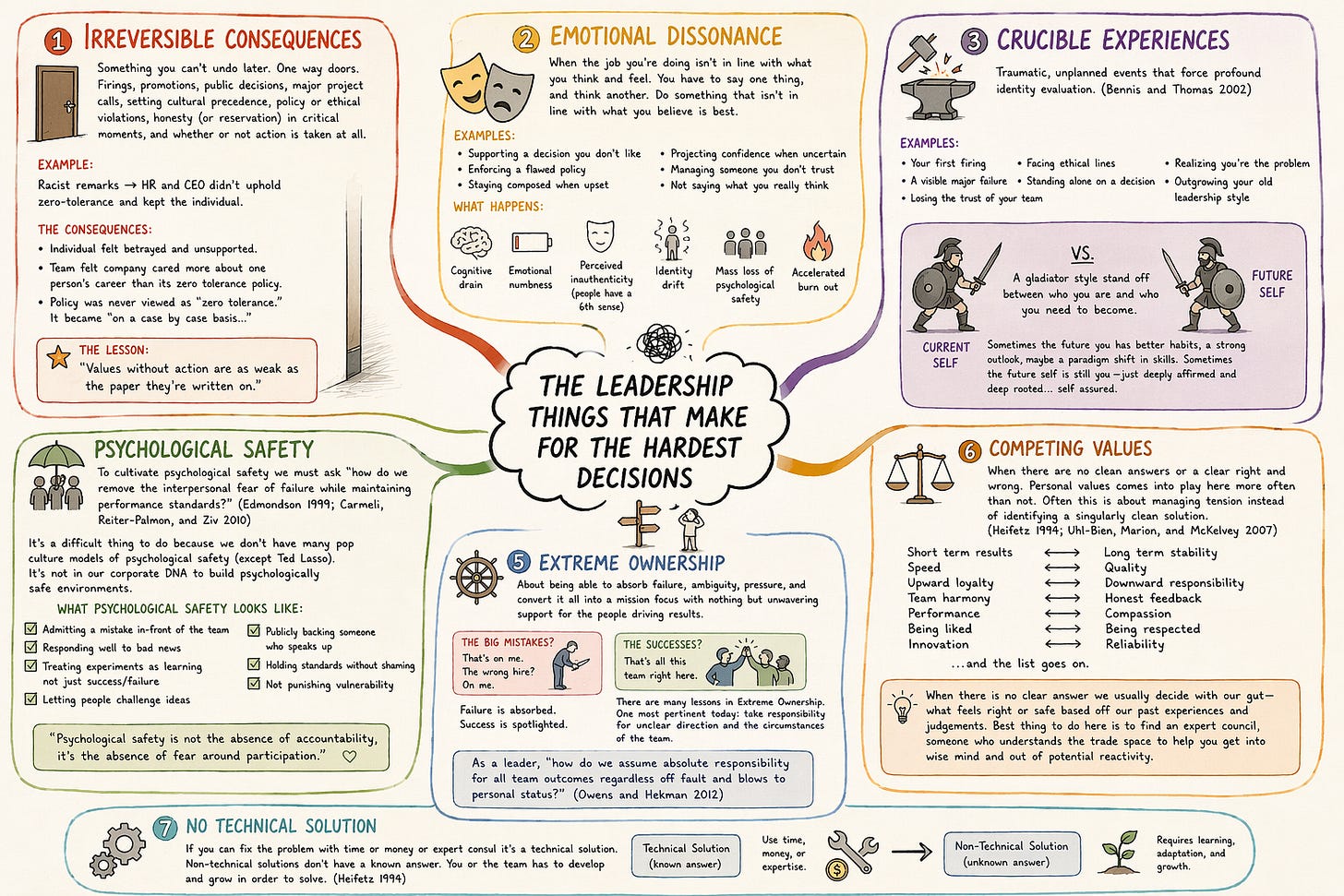
(Source, My Notes + Chat GPT, 2026)
Crucible Experiences
Traumatic, unplanned events that force profound identity evaluation.
Your first firing, a visible major failure, losing the trust of your team, facing ethical lines, standing alone on a decision, realizing you’re the problem, or outgrowing your old leadership style.
A crucible moment imagined in my mind is a gladiator-style standoff between the current self and the future self you need to become. Sometimes the future you has better habits, a strong outlook, or maybe a paradigm shift in skills. Sometimes the future self is still you, just deeply affirmed and deep-rooted... self-assured.
Psychological Safety
To cultivate psychological safety, we must ask “how do we remove the interpersonal fear of failure while maintaining performance standards?”. (Edmondson 1999; Carmeli, Reiter-Palmon, and Ziv 2010)
It’s a difficult thing to do because we don’t have many pop culture models of psychological safety, except Ted Lasso. It’s not in our corporate DNA to build psychologically safe environments.
What psychological safety looks like is admitting a mistake in front of the team, responding well to bad news, treating experiments as learning rather than just success or failure, letting people challenge ideas, publicly backing someone who speaks up, holding standards without shaming, and not punishing vulnerability.
“Psychological safety is not the absence of accountability, it’s the absence of fear around participation.”
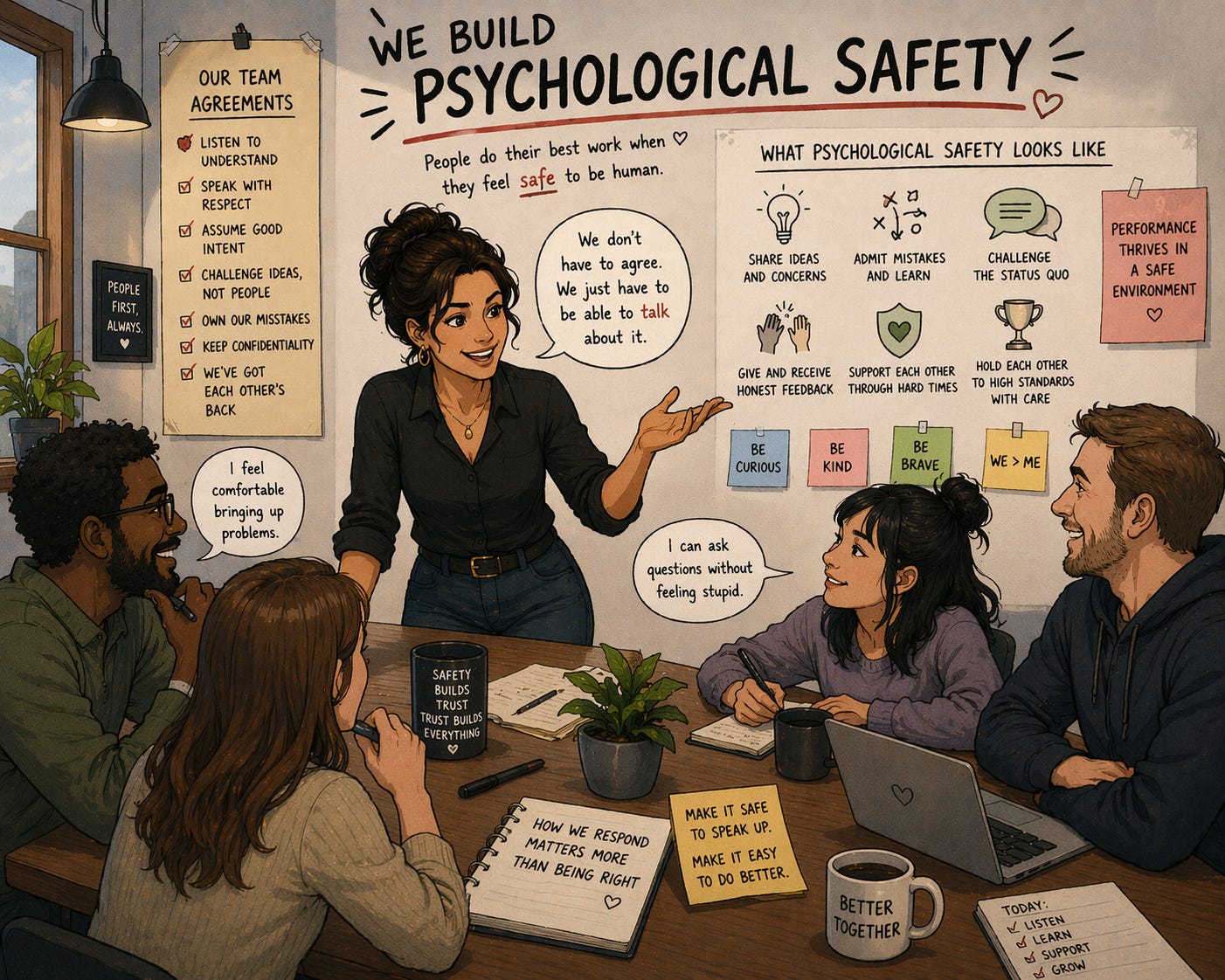
(Source, ChatGPT, 2026)
Extreme Ownership
For those who haven’t read the book, I highly recommend it as a leadership essential. It is the pinnacle of active servant leadership.
Extreme ownership is about being able to absorb failure, ambiguity, and pressure, and convert it all into a mission focus with nothing but unwavering support for the people driving results.
The big mistakes? That’s on me. The wrong hire? On me. The successes, though? That’s all this team right here. Failure is absorbed. Success is spotlighted. There are many lessons in Extreme Ownership, and one that is most pertinent today is an active decision to take responsibility for unclear direction and the circumstances of the team. As a leader the question we ask ourselves towards extreme ownership is, “how do we assume absolute responsibility for all team outcomes regardless of fault and blows to personal status?” (Owens and Hekman 2012)
Competing Values
When there are no clean answers or a clear right and wrong. Personal values come into play here more often than not. Often this is about managing tension instead of identifying a singularly clean solution (Heifetz 1994; Uhl-Bien, Marion, and McKelvey 2007).
Short-term results vs. long-term stability. Speed vs. quality. Upward loyalty vs. downward responsibility. Team harmony vs. honest feedback. Performance vs. compassion. Being liked vs. being respected. Innovation vs. reliability.
The list goes on and on.
Again, when there is no clear answer, we usually end up deciding with our gut. This translates to what we feel is right or safe based off our past experiences and judgments. The best thing to do here is to find an expert council, someone who understands the trade space to help you get into wise mind and out of potential reactivity. There is nothing wrong with gut decisions. If you have the time though, find a an expert council to affirm or fine tune your gut decision.
No Technical Solution
If you can fix the problem with time, money, or expert consul, it’s a technical solution. Non-technical solutions don’t have a known answer. You or the team has to develop and grow in order to solve (Heifetz 1994).
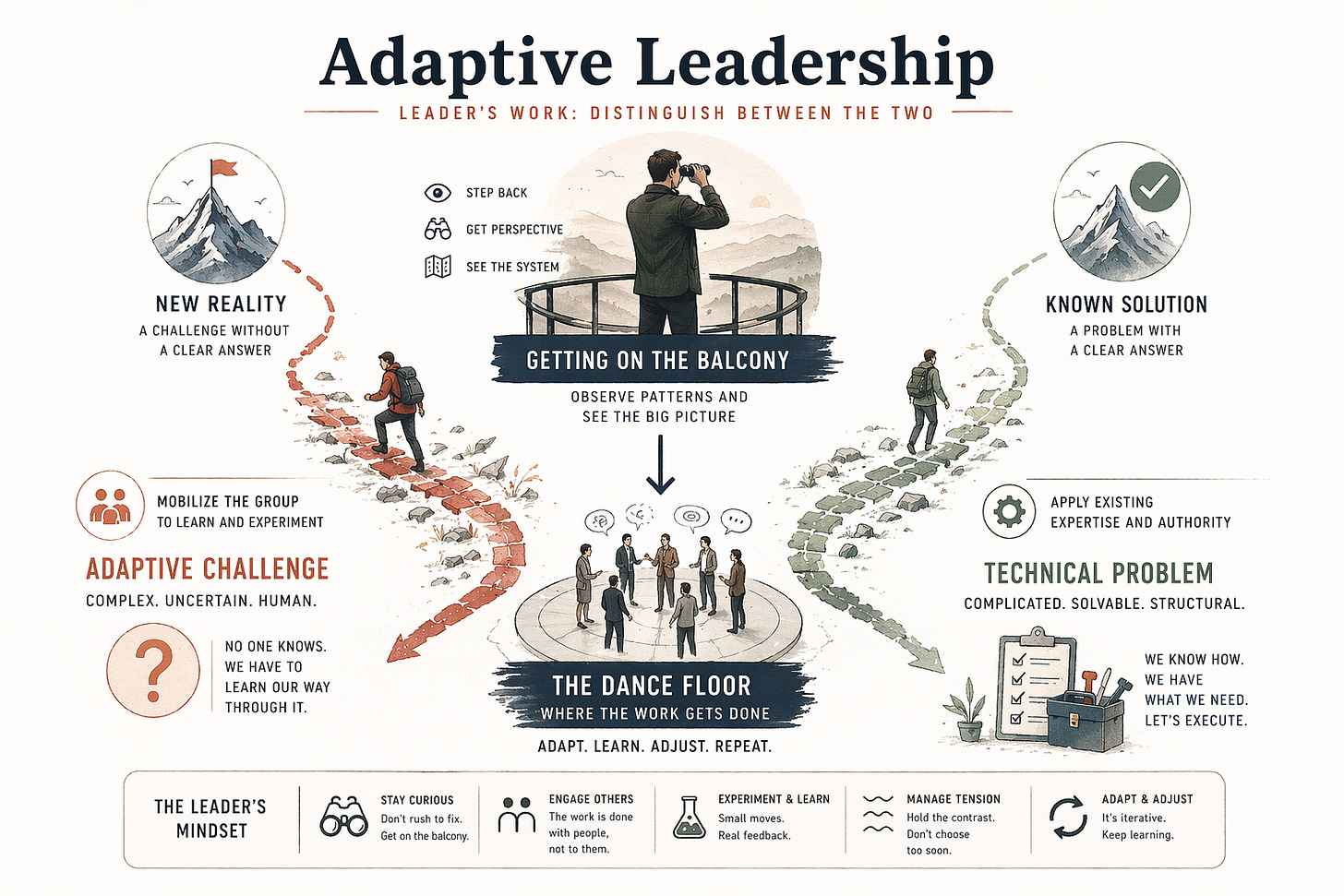
(Source, My Notes + Chat GPT, 2026)
This is where adaptive leadership comes into play and where the real meat and potatoes of leadership is. These problems are the low-trust environment, the low-accountability culture, a disengaged team, or a manager who lacks self-awareness. These are problems that require innovation rather than money and time, or drastic culture change to overcome and adapt to a changing market.
-
Technical problem → apply expertise.
-
Adaptive problem → facilitate growth.
The Hard Situations
Firing People
“At-will” employment doctrine makes terminations easy in theory, allowing employers to sever ties without establishing profound cause. Theory and practice are two separate things. Letting people go is universally recognized across all literature as the most devastating challenge in leadership.
The act of firing and severing a human relationship has been shown, regardless of if the individual had robust cause for being let go, to suppress oxytocin production, which triggers a severe stress response in both manager and employee (Zak 2013).
Firing disrupts us on a chemical level. You may have some mental gymnastics underway to justify the firing to yourself, and I think if you shared them with us, we’d agree with you that they are indeed valid on paper. Firing for cause, policy violation, theft, or profound incompetence is all still difficult but ultimately rationalizable. That doesn’t change the typical emotional burden. Firing employees who haven’t done anything wrong due to budget cuts, redundant mergers, or positional eliminations is universally soul-crushing. Worse still, if you’re in middle management and the people above you are giving the sentence, and you’re swinging the sword, that’s a whole new level of hell.
After a firing, there are considerations for working with the remaining team. The manager must simultaneously process their own emotional dissonance, absorb the grief and anger of the terminated employee, and somehow maintain engagement with a distrustful and sometimes traumatized team (Edmondson 1999; Carmeli and Gittell 2009).

(Source, ChatGPT, 2026)
So how does a manager go through this? Here it’s important to not dissociate from what makes us human. And therefore we need to be in tune with ourselves and our value system. There are skills to use, boundaries to create, and for leadership styles, I’d recommend leaning into your own Authentic Leadership. Authenticity is your best friend when firing people. Authentic leadership is the transparency between you and your employee. It lets them know they are talking to a person. Your empathy is what makes you human. There’s no need to be a robot, and it’s okay to feel shitty after you fire someone, even when it’s perfectly justifiable. You don’t need to say everything you really think, but giving an honest, transparent, and fair assessment so the employee knows where you are coming from is important. They need to know why this is happening.
Authenticity aside, your boundaries are where you need to be diligent. Remember, your job is to be a coach and be there for the team. You can’t expect yourself to over-extend for someone who doesn’t want to be there for themselves. That’s unreasonable. Set a personal boundary that you will do your best to be there for the team and that if they don’t take advantage of your support and resources, their decision isn’t your failure. Coaching and adaptive leadership are the defaults for helping people improve. Authenticity and transactional leadership lends the honesty to evaluate their performance and effort against what’s fair for the rest of the team.
The tools to use when firing are your documented conversations and performance check-ins from all the hard work you did trying to support the individual. If you don’t have that and you’re firing anyway, shame on you.
You should have clear, journaled entries that clearly describe the gap in performance or behavior, what you offered in support, and all your check-ins towards remedying the issue. These are the facts. These are the receipts that make a gut-wrenching decision grounded in reality.

(Source, Chat GPT, 2026)
Below is a template for an authentic conversation to fire a low performer.
My advice? Make it quick, bring your receipts, and remember, it’s not a negotiation; it’s an informational meeting. The decision has already happened. If you’re solid on your coaching communication that should have been happening up to this point, it shouldn’t be that big of a surprise to the individual.
Conversation Template: “Hey [Name], thanks for sitting down with me. I want to be upfront with you because I don’t want to drag this out or make it more difficult than it already is. We’ve had a number of conversations over the past [time period] about expectations around [specific areas], and where things needed to improve.
I know you’ve been putting in effort to try to get there.
At this point though, the role needs a level of consistency and performance that we’re still not seeing, and I’ve made the decision to end your employment, effective today.
I know that’s really hard to hear. This isn’t about you as a person or your character. It’s about the fit between what the role requires and where things have landed. I
also want to own my part in this. It’s on me to make sure expectations and support are clear, and even with the conversations we’ve had, we still ended up here.
I want to walk you through what happens next so nothing catches you off guard—[briefly explain logistics]. I’m here for any questions you have, and I want to handle this in a way that’s clear and respectful.”
Firing will always be difficult. And, part of me thinks it should be difficult.
Antonio Damasio, one of the leading figures in affective neuroscience, coined the phrase:
“We are not thinking machines that feel, we are feeling machines that think.”
Finding firing hard is human.
The High-Performance Asshole
The person on the team who does whatever they want because they feel they are unfireable. The top performer who’s rude because they think they own the place. This is the person with exceptional results, high profitability, or irreplaceable technical knowledge who is highly toxic, flippant, abrasive, a gatekeeper, and is deeply entitled. (Einarsen, Aasland, and Skogstad 2007).
This is a problem of conflicting incentive structures that need to be untangled by the leader.
Managers are incentivized to produce output. They are also responsible for the wellbeing of their team. Low output can harm wellbeing, and so can keeping the person on the team. There’s tension in supporting brilliance and maintaining corporate governance and human decency.
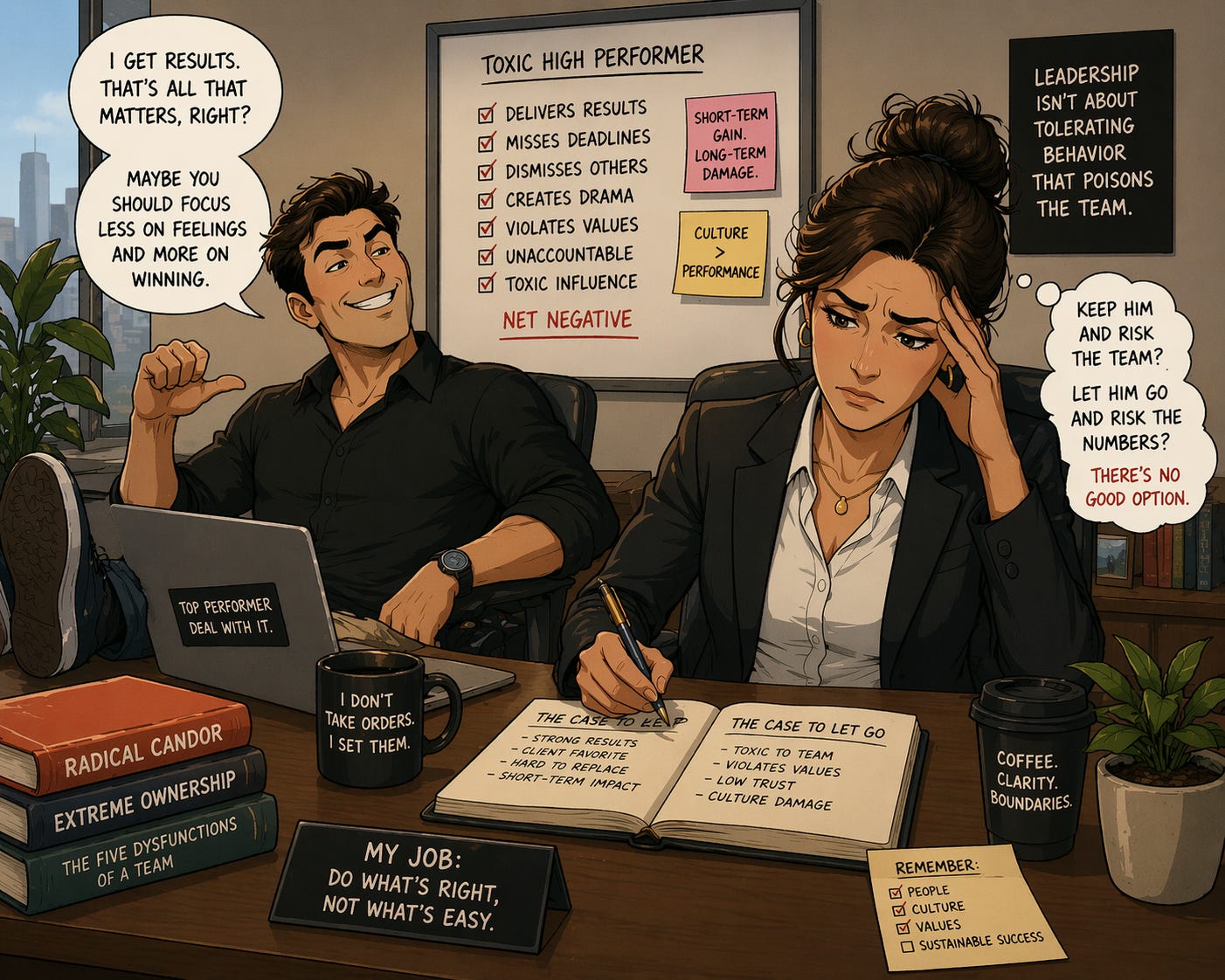
(Source, ChatGPT, 2026)
You have many options here. The easiest thing to do, and what most do, is nothing. On the other extreme, you can also fire the individual. In between is where the wheat separates from the chaff in terms of ability to navigate complexity.
The wins to be had in the grey space come from employing coaching leadership to coach the individual’s behavior. Simultaneously, using transactional or structural leadership to change the incentive system to reward for good behavior stronger than good results.
Coaching for behavior is tough. We’re taught to coach for numbers, results, and outcomes, rather than for how we get those measurables. As any seasoned leader will share, coaching for technical results is easy compared to coaching for behavior.
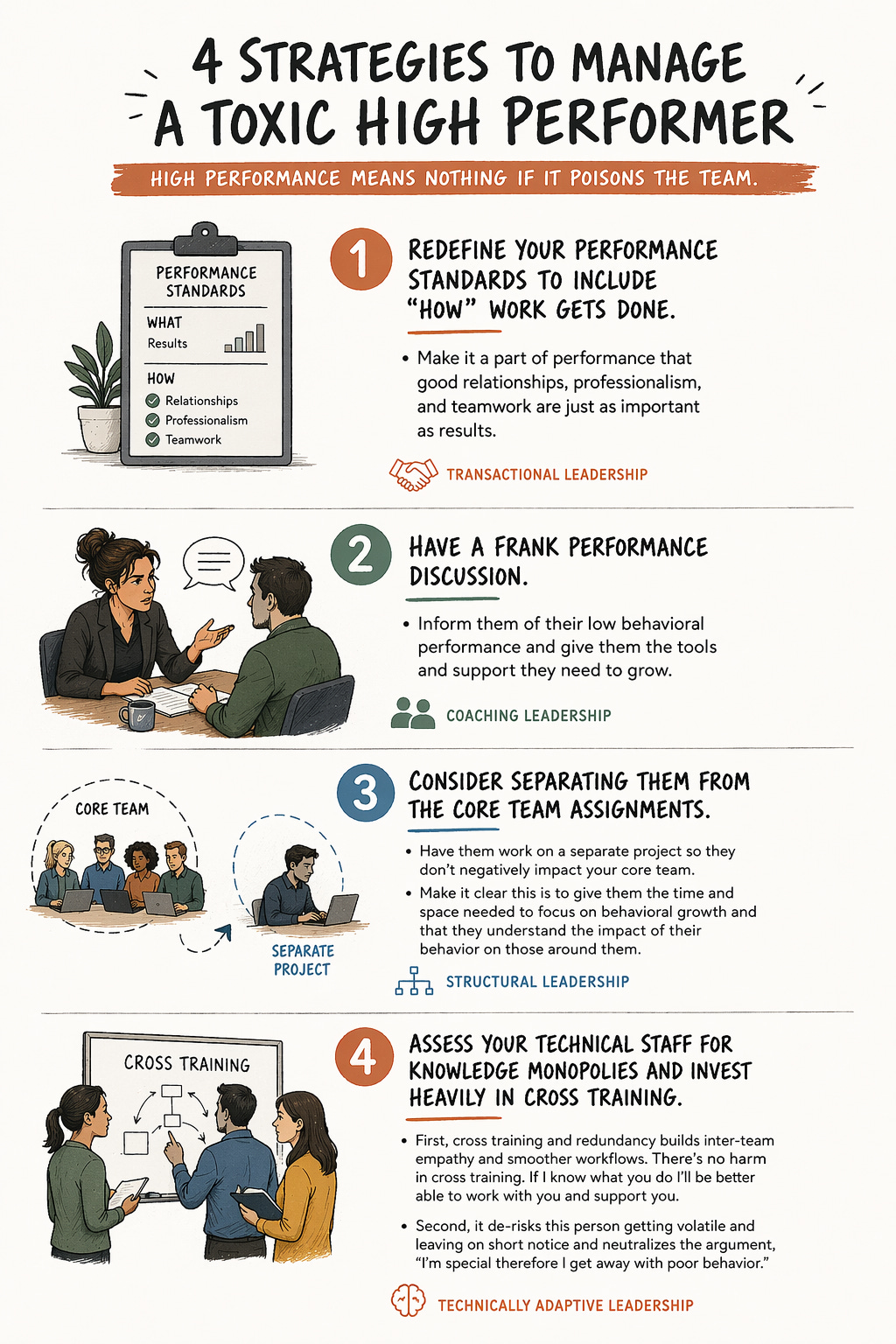
Here’s how we get this done:
-
Redefine your performance standards to include “How” work gets done.
- Make it a part of performance that good relationships, professionalism, and teamwork are just as important as physical results. (Transactional leadership)
-
Have a frank performance discussion with your high performer to inform them of their low behavioral performance and give them the tools and support they need to grow. (Coaching leadership)
-
Consider separating them from the core team assignments until they show growth.
-
You can do this by having them work on a separate project so they don’t negatively impact your core group of performers.
-
Make it clear this is to give them the time and space needed to focus on behavioral growth and that they understand the impact of their behavioral actions on those around them. (Structural leadership)
-
-
Assess your technical staff for knowledge monopolies and invest heavily in training people to be able to do everything that person does.
-
To start, cross-training and redundancy is great for inter-team empathy and smoother workflows. There’s no harm in cross-training. If I know what you do, I’ll be better able to work with you and support you.
-
Second of all, it de-risks this person getting volatile and leaving on short notice and neutralizes the argument of “I’m special therefore I get away with poor behavior.” (Technically adaptive leadership)
-
(Source, My Notes + ChatGPT, 2026)
Here is a sample coaching conversation you could use to get these sorts of behavioral conversations started.
Coaching Sample:
Leader: I want to talk about something important. You’re delivering strong results, and that’s valued here. At the same time, I’ve seen some patterns in how work is getting done that are creating friction on the team. Can we walk through that together?
Employee: Sure… like what?
Leader: For example, in last week’s design review, there were a few moments where others were cut off or their ideas were dismissed pretty quickly. I also heard from two team members that they’re hesitant to bring things to you because of how those interactions have gone. How do you see those situations?
Employee: I mean, I’m just trying to move things forward. People bring weak ideas sometimes.
Leader: I hear that speed and quality matter to you. That’s a strength. At the same time, what impact do you think those interactions are having on the team’s willingness to contribute?
Employee: I don’t know… maybe they take it personally.
Leader: That’s possible. What I’m seeing is that we’re getting less input overall, and some good ideas may not be surfacing. How do you think that could affect the team’s performance over time?
Employee: I guess it could slow things down if people stop speaking up.
Leader: Right. So there’s a bit of a tradeoff showing up. If you were to keep your standards high and create space for others to contribute, what might that look like in practice?
Employee: Maybe… let people finish, ask more questions first?
Leader: That’s a solid start. What else?
Employee: I could give feedback after hearing them out instead of shutting it down immediately.
Leader: I like that. Let’s make this concrete. Over the next two weeks, what specific behaviors are you willing to try in meetings?
Employee: Let people finish, ask at least one question before critiquing, and keep feedback focused on the work, not the person.
Leader: Good. I’ll also check in with the team, and we’ll reconnect in two weeks to see what’s changing. One thing I want to be clear on: your results are strong, and your impact on the team is part of your performance too. This isn’t optional. How does that land with you?
Employee: Yeah… I get it.
Leader: Alright. I appreciate you being open to working on it. Let’s see how this goes.
What’s important in these conversations is asking open-ended questions and not prescribing the answer right away.
This can help keep the conversation from getting too defensive.
In this example, I wrote the employee as a little embarrassed and open to working through the conversation amicably. This is usually the case, but with more difficult employees, you may need to slow the conversation down and give them more room to have a reaction or get something off their chest first before they’re open to feedback. If they still aren’t getting it, you’ll need to bring in more folks to back you up. I would leverage HR or a peer manager just to be there in the room. This can neutralize poor reactions and volatility and can also drive home the gravity of the situation and your standards. With difficult employees, documentation is everything. Having some backup and taking good notes gets you further than tackling sticky situations on your own.
Leadership is a team sport.
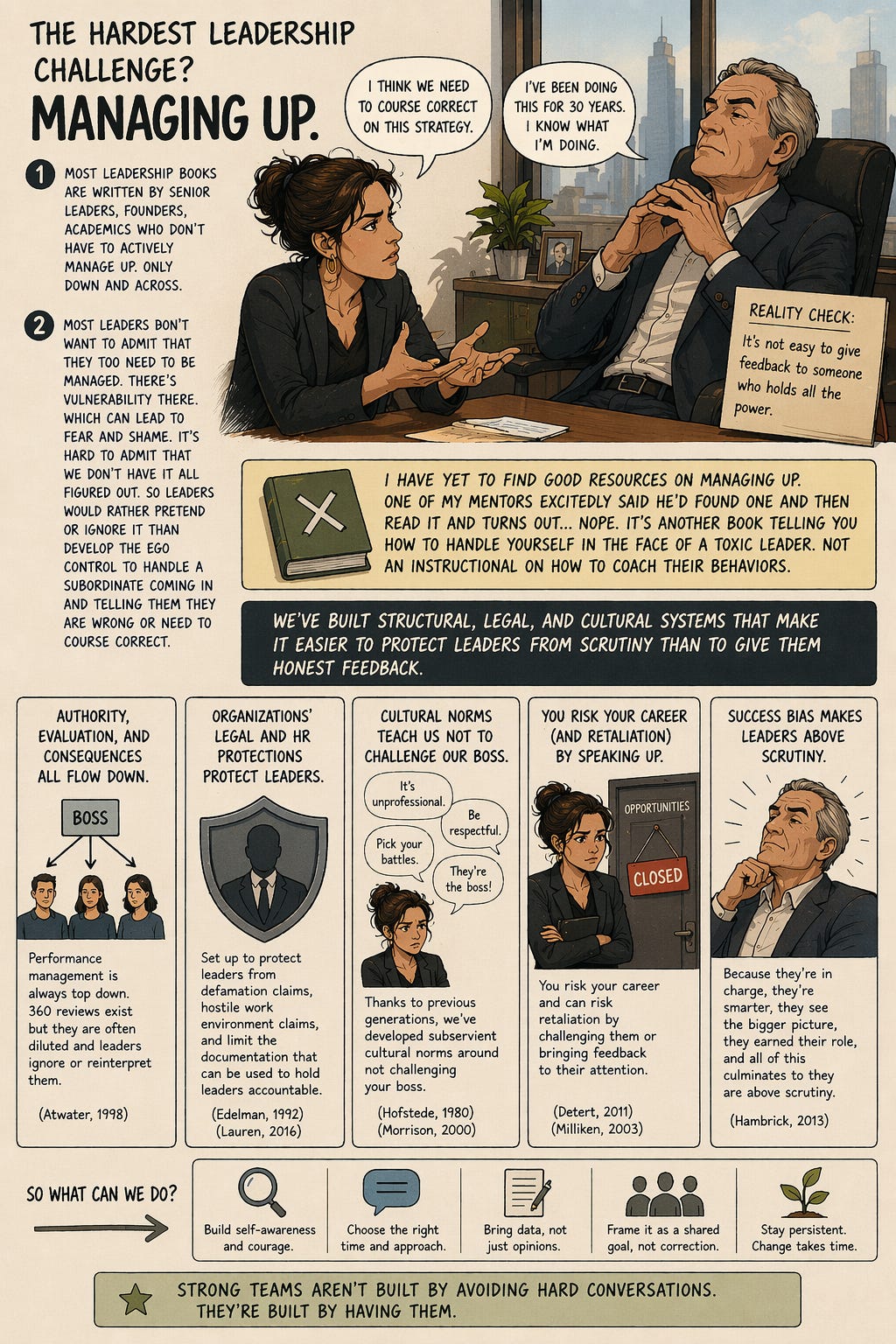
Managing Up - Shielding the Team from Toxic Executives
Most leadership and management books you’ll find out there talk about managing down or managing yourself. They are survival guides on how to personally handle the shit that rolls down the proverbial hill. Few have a tools-based perspective on how to stop the shit in the first place, at the top of the hill. That’s harder.
I think the reason for the knowledge vacuum is twofold:
-
Most leadership books are written by senior leaders, founders, and academics who don’t have to actively manage up, only down and across.
-
Most leaders don’t want to admit that they too need to be managed. There’s vulnerability there, which can lead to fear and shame. It’s hard to admit that we don’t have it all figured out. So, leaders would rather pretend or ignore it than develop the ego control to handle a subordinate coming in and telling them they are wrong or need to course correct.
I have yet to find good resources on managing up. One of my mentors excitedly said he’d found one and then read it and turns out... nope. It’s another book telling you how to handle yourself in the face of a toxic leader, not an instructional on how to coach their behaviors.
We’re all getting it right? We have survival guides for ship wreck. Not manuals on how to stop the ship from wrecking.
Subscribe if you want manuals on preventing the ship wreck in the first place and not just anecdotal prose on how it’s our job to survive toxic environments.
(Source, My Notes + ChatGPT, 2026)
We’ve built structural, legal, and cultural systems that make it easier to protect leaders from scrutiny than to give them honest feedback.
-
Authority, evaluation, and consequences all flow down. Performance management is always top-down. 360 reviews exist, but they are often diluted, and leaders ignore or reinterpret them. (Atwater, 1998)
-
Organizations’ legal and HR protections are set up to protect the leaders from defamation claims and hostile work environment claims, and limit the documentation that can be used to hold leaders accountable. (Edelman, 1992) (Lauren, 2016)
-
Thanks to previous generations, we’ve developed subservient cultural norms around not challenging your boss. It’s unprofessional, you need to be respectful, pick your battles, “They’re the boss!” (Hofstede 1980) (Morrison, 2000)
-
You risk your career and can risk retaliation by challenging them or bringing feedback to their attention. (Detert, 2011) (Milliken, 2003)
-
We have a success bias that because they’re in charge, they’re smarter, they see the bigger picture, and they earned their role, and all of this culminates to the idea that they are above scrutiny. (Hambrick, 2013)
Boss critique is taboo. Leaders are easier to evaluate from above than from below. This all culminates to the reality that many of the established methods for managing up try to do so while keeping the leader’s ego intact. It’s comical. We have centuries of thought on how to be a good leader top-down, but our best suggestions for being a good leader bottom-up are “try and inception the feedback to them without undue personal risk or damage to their ego.”
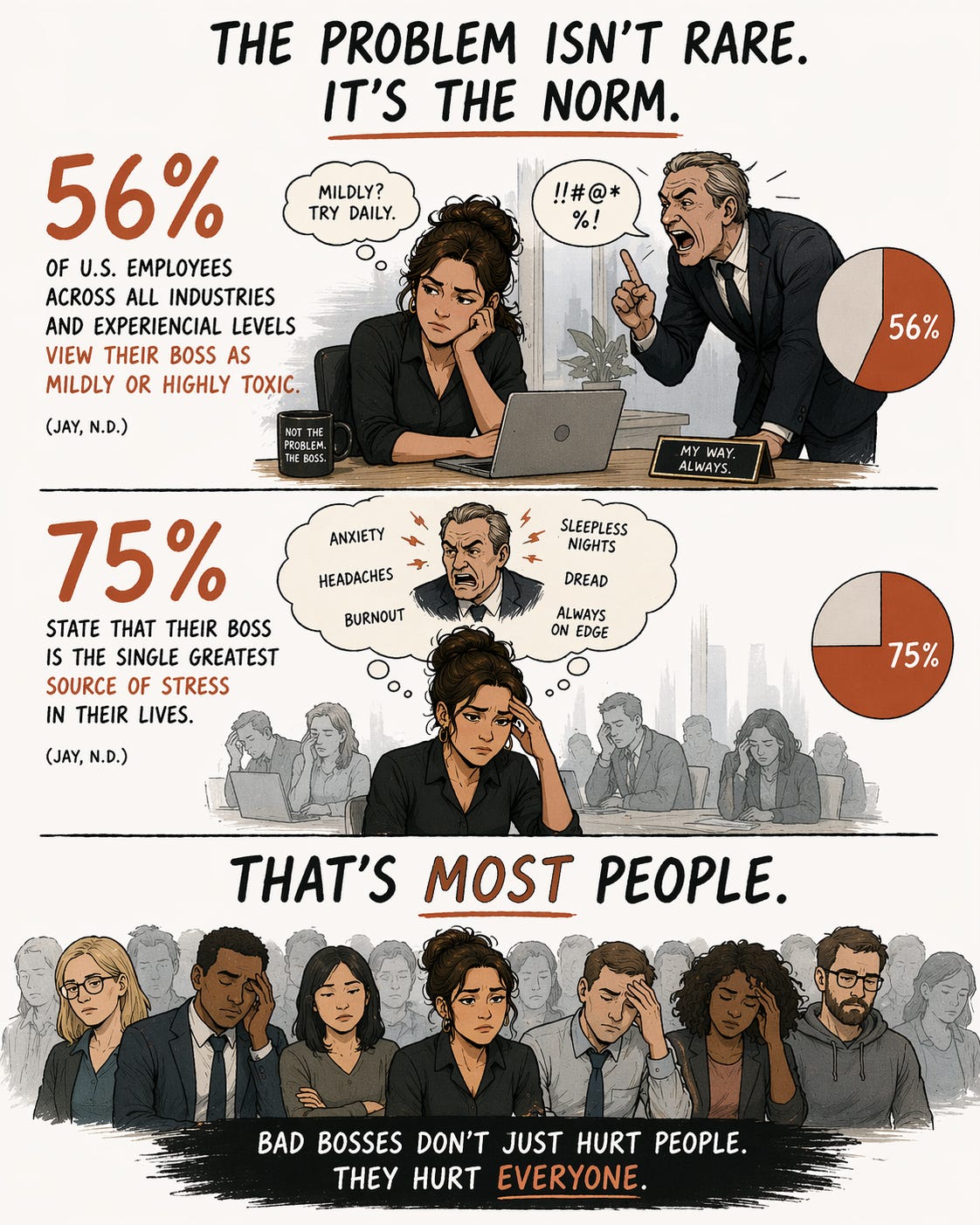
So… we’re missing tools and resources on managing up. What’s the magnitude of the problem?
-
56% of U.S. employees across all industries and experiential levels view their boss as mildly or highly toxic. (Jay, n.d.)
-
75% state that their boss is the single greatest source of stress in their lives. (Jay, n.d.)
THAT’S MOST PEOPLE.
(Source, Jay, N.D. + ChatGPT, 2026)
This blows my mind! And I know as a manager and a leader I am statistically complicit in this. All of us managers and leaders need to know this and realize the part we have so we can be open to growth.
Okay, so what do we do? How does one manage up?
There are skills you need:
-
Advanced communication and perception skills.
-
The ability to think under pressure in a confrontational and emotionally charged environment.
- You have to be able to calm yourself and stay in Wise-Mind when they inevitably say hurtful and off-color remarks. (They have learned to wield the power imbalance to try and put you in a fight/flight/freeze response to get what they want.)
-
Expert translation skills (being able to deliver critique in a way it won’t activate their emotional defenses).
There are leadership models to employ here:
-
Inclusive leadership: This is for your team. Making sure they are being heard and engaged, and you are aware of how they are doing and what they need. You’re the pillar of emotionally regulated ability and the umbrella between them and the boss you need to manage. (Carmeli, Reiter-Palmon, and Ziv 2010)
-
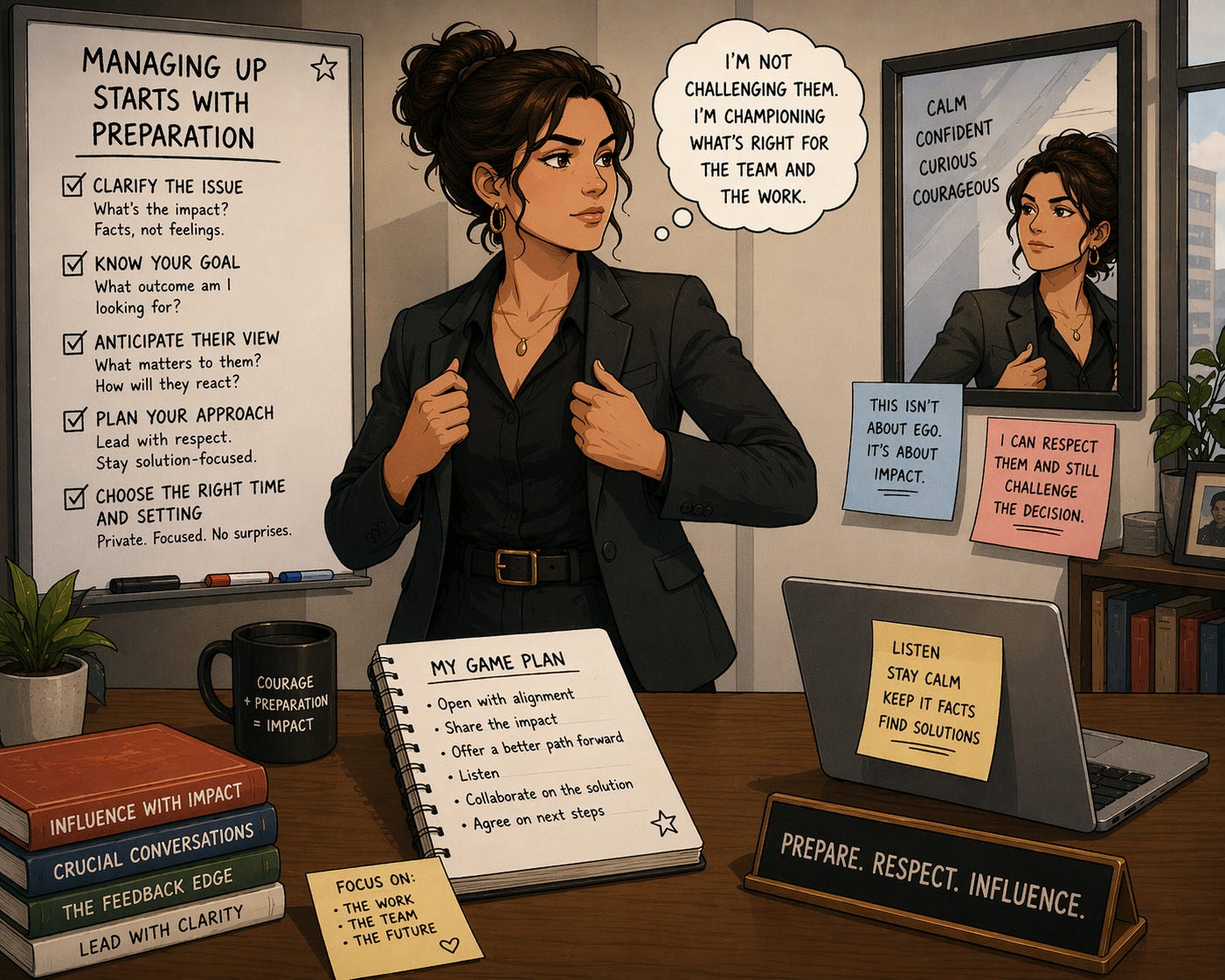
Coaching leadership: There is a way to coach up. The conversation is the same, but you need your boss’s respect first. You have to be able to get on their level if you want to coach them on their behavior. (Ellinger and Bostrom 1999)
(Source, ChatGPT, 2026)
And putting the skills and styles together, I follow these steps when managing up:
-
Build a relationship with the boss. Anything you can latch onto: coffee, food, books, family, anything. Find something you have in common.
-
Figure out what’s important to them at work. Results, optics, control, stability, being liked, being thought of as smart, whatever it is, figure it out.
-
Mirror their language patterns.
- Subtly use jargon they like.
-
If they are a big “headlines” person, stick to the headlines and only add details when asked.
-
Most toxic bosses hate surprises and react emotionally to anything that deviates from their expectations.
- You can hedge this with predictable weekly status emails covering progress, top risks, and your actions for the next week. Sometimes this is more than enough. The boss won’t even care about the problems; they’ll only care that you know what they are and can theoretically fix them.
-
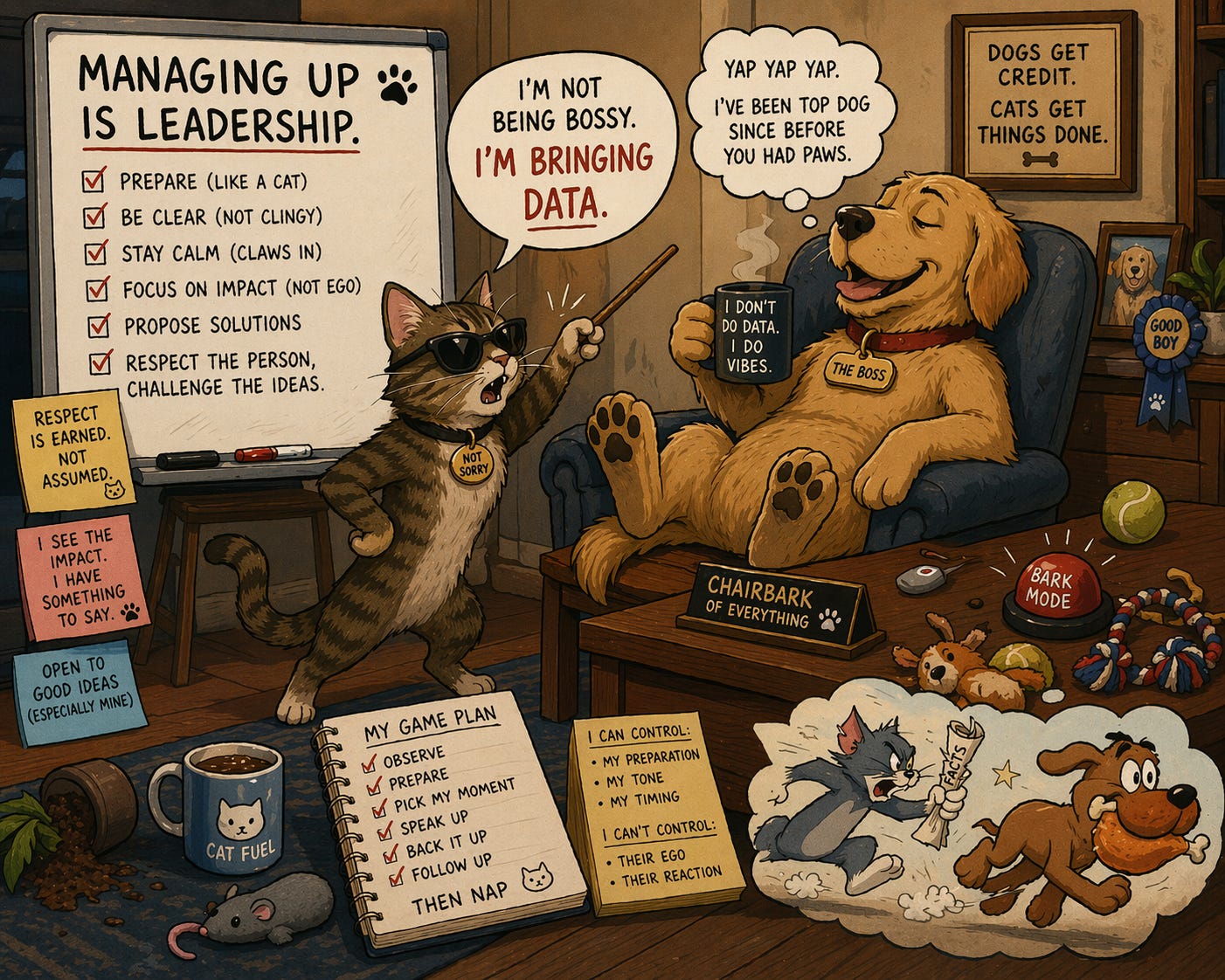
Translate what’s going on with the team into the thing the boss cares about.
-
Mirror their concern.
-
Translate the problem into their value system.
-
Offer a clean and easy lever to pull.
-
(Source, ChatGPT, 2026)
Key Takeaways
Management is full of hard situations. They shape us to become better and the hard situations are how we learn, grow, and find out what we’re made of. These are three I wanted to cover in this post, and I will discuss more of them in greater detail in future posts.
The most important step is always the next one.
- Dan
References
Atwater, Leanne E., Joan F. Brett, and Atira Charles. “Words the Wise: Self-Awareness, Feedback, and Leader Effectiveness.” Journal of Management 24, no. 5 (1998): 575–98.
Rating: 7.5/10 — Strong focus on the gap between how leaders see themselves and how their teams see them.
Key takeaway: Leaders who seek and accept feedback from below are consistently rated as more effective than those who rely solely on top-down evaluation.
Avolio, Bruce J., and William L. Gardner. “Authentic Leadership Development: Getting to the Root of Positive Forms of Leadership.” The Leadership Quarterly 16, no. 3 (2005): 315–38.
Rating: 9/10 — Highly readable for an academic piece and very relevant for real leadership situations.
Key takeaway: Leaders who are self-aware, transparent, and values-driven build more trust and resilience, especially in high-stakes situations.
Bennis, Warren G., and Robert J. Thomas. “Crucibles of Leadership.” Harvard Business Review 80, no. 9 (2002): 39–45.
Rating: 9.5/10 — Extremely readable, story-driven, and directly relevant.
Key takeaway: Leaders are often shaped by “crucible” moments. Intense, often traumatic experiences that force identity growth and define how they lead.
Boyle, John. “The At-Will Employment Doctrine: A Review.” Employment Law Journal (n.d.).
Rating: 7/10 — Technical but necessary for understanding the legal landscape of termination.
Key takeaway: While “at-will” allows for easy termination in theory, the human and chemical disruption of the act makes it the hardest task a leader faces.
Carmeli, Abraham, and Jody Hoffer Gittell. “High-Quality Relationships, Psychological Safety, and Learning from Failures in Work Organizations.” Journal of Organizational Behavior 30, no. 6 (2009): 709–29.
Rating: 8/10 — Solid academic read with strong relevance to team recovery and failure.
Key takeaway: Teams with strong relationships and psychological safety are better at learning from failure instead of collapsing into blame.
Carmeli, Abraham, Roni Reiter-Palmon, and Enbal Ziv. “Inclusive Leadership and Employee Involvement in Creative Tasks in the Workplace: The Mediating Role of Psychological Safety.” Creativity Research Journal 22, no. 3 (2010): 250–60.
Rating: 8.5/10 — Very relevant to collaboration and innovation; moderately dense.
Key takeaway: Inclusive leadership increases psychological safety, which directly drives creativity and engagement.
Detert, James R., and Amy C. Edmondson. “Implicit Voice Theories: Taken-for-Granted Rules of Self-Censorship at Work.” Academy of Management Journal 54, no. 3 (2011): 461–88.
Rating: 8/10 — A fascinating look at why people stay silent even when they have good ideas.
Key takeaway: Employees often have “internal scripts” that tell them challenging the boss is dangerous, even if the boss says they want feedback.
Edelman, Lauren B. “Legal Ambiguity and Symbolic Structures: Organizational Mediation of Civil Rights Law.” American Journal of Sociology 97, no. 6 (1992): 1531–76.
Rating: 7/10 — Dense and academic, but critical for understanding organizational self-protection.
Key takeaway: Organizations often create symbolic compliance structures (like HR policies) that protect the company more than the individual.
Edmondson, Amy C. “Psychological Safety and Learning Behavior in Work Teams.” Administrative Science Quarterly 44, no. 2 (1999): 350–83.
Rating: 8/10 — Foundational but a bit dense; absolutely worth it.
Key takeaway: Teams perform better when people feel safe to speak up, take risks, and admit mistakes without fear.
Einarsen, Ståle, Merethe Schanke Aasland, and Anders Skogstad. “Destructive Leadership Behaviour: A Definition and Conceptual Model.” The Leadership Quarterly 18, no. 3 (2007): 207–16.
Rating: 7.5/10 — More conceptual, but highly relevant for toxic leadership situations.
Key takeaway: Toxic or destructive leadership behaviors systematically harm teams, even when performance outcomes appear strong in the short term.
Ellinger, Andrea D., and Robert P. Bostrom. “Managerial Coaching Behaviors in Learning Organizations.” Journal of Management Development 18, no. 9 (1999): 752–71.
Rating: 7.5/10 — Practical but slightly dated; still useful.
Key takeaway: Coaching-oriented leaders improve employee development and performance by asking questions and guiding rather than directing.
Hambrick, Donald C., and Timothy J. Quigley. “Toward More Realistic Contextualized Views of Strategic Leadership.” Strategic Management Journal 35, no. 11 (2013): 1654–65.
Rating: 7/10 — Heavy on theory, light on direct action, but good for context.
Key takeaway: The “success bias” in leadership assumes that those at the top are naturally superior, which often blinds them to their own flaws.
Heifetz, Ronald A. Leadership Without Easy Answers. Cambridge, MA: Harvard University Press, 1994.
Rating: 8/10 — Conceptually heavy but extremely important.
Key takeaway: The hardest leadership problems are “adaptive challenges” with no clear solutions, requiring learning, tradeoffs, and behavior change.
Hofstede, Geert. Culture’s Consequences: International Differences in Work-Related Values. Beverly Hills, CA: Sage, 1980.
Rating: 8.5/10 — A classic in cross-cultural management and authority structures.
Key takeaway: Power distance, the degree to which people accept hierarchy, varies by culture, but remains a massive barrier to managing up.
Jay, N. “The Real Stressor: U.S. Employee Perceptions of Leadership.” Workplace Wellness Journal (n.d.).
Rating: 9/10 — Eye-opening statistics that confirm the magnitude of the toxic leadership problem.
Key takeaway: The majority of workers view their boss as a primary source of stress, which highlights a massive need for better training and accountability.
Lauren, J. “The Shield of Compliance: How HR Protects the C-Suite.” Legal Review (2016).
Rating: 8/10 — A sobering look at the legal protections that favor senior leadership.
Key takeaway: Document everything, because the legal and HR systems are not inherently designed to support the subordinate.
Milliken, Frances J., Elizabeth W. Morrison, and Patricia F. Hewlin. “An Exploratory Study of Employee Silence: Issues that Employees Don’t Communicate Upward and Why.” Journal of Management Studies 40, no. 6 (2003): 1453–76.
Rating: 8.5/10 — Essential for understanding the “silence” that kills organizations.
Key takeaway: Employees fear that speaking up will be viewed as complaining or will lead to career retaliation.
Morrison, Elizabeth W., and Frances J. Milliken. “Organizational Silence: A Barrier to Change and Development in a Pluralistic World.” Academy of Management Review 25, no. 4 (2000): 706–25.
Rating: 7.5/10 — Theoretical but powerful for understanding cultural norms.
Key takeaway: When silence becomes a norm, the organization loses its ability to innovate and detect early warning signs of failure.
Owens, Bradley P., and David R. Hekman. “Modeling How to Grow: An Inductive Examination of Humble Leader Behaviors, Contingencies, and Outcomes.” Academy of Management Journal 55, no. 4 (2012): 787–818.
Rating: 8.5/10 — Strong mix of rigor and practical insight.
Key takeaway: Leaders who show humility (admitting limits, valuing others) create better learning environments and stronger team performance.
Scott, Kim. Radical Candor: Be a Kick-Ass Boss Without Losing Your Humanity. New York: St. Martin’s Press, 2017.
Rating: 10/10 — Required reading for anyone with a pulse in management.
Key takeaway: You can be direct and challenge people while still caring personally; in fact, you have to if you want a healthy team.
Sinek, Simon. Start with Why: How Great Leaders Inspire Everyone to Take Action. New York: Portfolio, 2009.
Rating: 9.5/10 — The ultimate primer on inspiration and purpose.
Key takeaway: People don’t buy what you do; they buy why you do it. Empowering people with the “Why” promotes deep engagement.
Uhl-Bien, Mary, Russ Marion, and Bill McKelvey. “Complexity Leadership Theory: Shifting Leadership from the Industrial Age to the Knowledge Era.” The Leadership Quarterly 18, no. 4 (2007): 298–318.
Rating: 7/10 — Dense but powerful for understanding modern organizations.
Key takeaway: Leadership in complex environments is about enabling adaptability and networks, rather than controlling outcomes from the top.
Willink, Jocko, and Leif Babin. Extreme Ownership: How U.S. Navy SEALs Lead and Win. New York: St. Martin’s Press, 2015.
Rating: 10/10 — Brutally effective mindset for taking absolute responsibility.
Key takeaway: There are no bad teams, only bad leaders. Own the failures so you can finally own the successes.
Zak, Paul J. “The Neuroscience of Trust.” Harvard Business Review (2013).
Rating: 9/10 — Very readable and directly applicable.
Key takeaway: Trust and human connection are biologically driven (via oxytocin), and breaking them triggers real physiological stress responses.
Background summary
In a corporate world saturated with leadership platitudes and high-level theory, this series cuts through the noise to provide a “how-to” for when shit hits the fan. From navigating the chemical stress of terminating employees to the high-stakes strategy of managing up against toxic executives, this guide explores the most difficult, non-technical challenges a leader can face. By blending affective neuroscience with foundational leadership models like Extreme Ownership, Authentic Leadership, and Psychological Safety readers gain a tools-based perspective on how to facilitate growth in low-trust environments and maintain performance standards without sacrificing human decency.
Whether you are dealing with a “High-Performance Asshole” who creates knowledge monopolies or struggling with the emotional dissonance of enforcing flawed policies, these articles provide actionable frameworks for the modern manager. Learn how to transform “Crucible Experiences” into profound identity growth and discover the translational skills needed to frame complex problems for leaders who resist scrutiny. This isn’t just a survival guide for shipwrecks; it’s an instructional manual on how to stop the ship from wrecking in the first place, ensuring your team remains resilient, accountable, and psychologically safe in the face of irreversible consequences.

Dan is co-founder of Kestryl Edge, a leadership development consultancy helping operations-heavy companies reduce turnover and rework through emotional intelligence. Work with us →
Enjoyed this? Subscribe to The Updraft on Substack for more.
Originally published at dankorus.substack.com. The Updraft is the canonical home for this piece.