
Crosswinds - Jennifer Houle
Jennifer knows her shit and puts people first.


Researching people is always a fun experiment for me. I wonder “how far do I have to go before I find the real them?”
In researching Jennifer, not far at all.

She’s a systems optimizing leader who designs and forges workplaces that are built for the people.
To her name are several decades of work in HR, leadership, governance, and organizational design.
She’s a leader not for the money, fame, glory, but because she can make a positive difference.
For the love of the game.
For those who sit in their job, defeated, a little frustrated, thinking, “There has to be a better way than this?”
Jennifer Houle can show you that way.
Jennifer knows her shit and puts people first.
Who are you today?
2026 has been one of the most challenging years of my life. Usually when people say that, they're speaking from the other side of the transformation, so they've made sense of it, and they can tell you what’s changed, but I'm still very much in the middle of it. I guess that’s who I am today, someone who’s in the thick of it, but hopeful about what’s on the other side.

Tell us your story of how you got here.
If we’re speaking career-wise, then I got here via three things: luck, hustle, and ADHD.
Luck, because there have been people throughout my life who saw something in me before I saw it in myself. They nudged me toward opportunities I never would have pursued on my own.
Hustle, because once I step through an open door, I work relentlessly to make sure I deserve to be there. If I’m going to do something, I want to become exceptional at it.
I wasn’t diagnosed with ADHD until my forties, but looking back, it explains a lot. The systems I built to compensate became strengths, and my curiosity became an asset. My ability to see patterns and think nonlinearly has become the foundation of my career.

What did you do in order to grow?
I don’t have a post-secondary degree. In fact, I barely graduated high school, and for a long time, I was embarrassed by that. Traditional education, the structure of it all, the curriculum, even the physical space of the institution itself has always felt uncomfortable for me. I now understand that experience through the lens of neurodivergence, but at the time it just felt like I was really stupid. I would see some people I knew breeze through university and think, really? I’m dumber than that guy??
Eventually, I realized that maybe the conventional education system isn’t built for everyone. Once I stopped seeing that as a reflection of my intelligence, I found another way. I challenged the professional designation exam for Human Resources and earned the same designation as people who had taken the traditional route. I just got there on my own terms.
Then, I just never stopped learning. I read constantly. I ask too many questions. I push myself into situations that stretch me.
For years I assumed I must be terrified of public speaking because everyone says they are. Then, one day I decided I wanted to be a speaker, so I pitched to an event called DisruptHR, and was accepted. Then I did it again two years later.
I realized I wasn’t actually afraid to do it; I had just accepted someone else’s narrative as my own. For the last two years, I’ve been a speaker coach for the event.
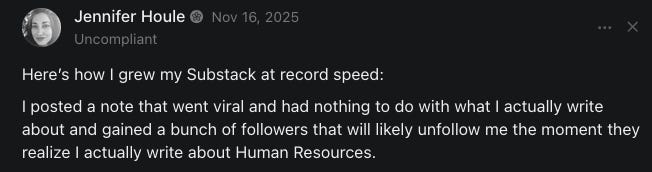
The same thing happened with writing. I always felt like I wasn’t qualified to write about HR without a degree, even though I’ve been in the field for over 15 years. But writing is my passion, so I went for it. Once I started betting on myself, opportunities began finding me. I’ve been featured and interviewed multiple times as an HR expert in The Globe and Mail, published in HR magazines, and was personally invited by my profession’s regulatory body to deliver a webinar for HR professionals.
If I want to grow, then I must refuse to accept constructed limitations until I’ve tested whether they’re actually true.
How did you learn emotional intelligence?
My understanding of emotional intelligence was shaped by being an observant person. I will always question why people behave the way they do. Especially in my line of work, you will see people at their absolute worst. I mean, people will behave outrageously. But it’s so reductive to say, “Wow, what’s wrong with that person?” Instead, there’s more value in asking something like, “What factors are at play that are making this person behave this way?”
Once you realize that not everyone makes space for those observations, for that grace, you attach a name to it. Maybe it’s emotional intelligence? Whatever it is, I believe it’s a practice…a muscle that needs building and then constantly requires exercise, because without that, it atrophies, and I don’t ever want that to happen to me.

How would you change the workplace if you could change anything?
I‘d stop the powers that be from intervening at the symptom level and start reflecting on the system. By that I mean stop treating every problem as though it’s tied to individuals. Have you ever worked at a company where they’re always getting rid of “problem people”, yet, somehow, the same issues keep popping up even though the players have changed? That’s a systemic issue, not a people one.
That’s the foundation of the work I’m doing through Uncompliant. I want to help people become more intentional about designing the human systems that shape how work is actually experienced. We invest enormous effort into designing products, services, and customer experiences. We need to apply that same level of intention to the experience of work itself.

What is leadership to you?
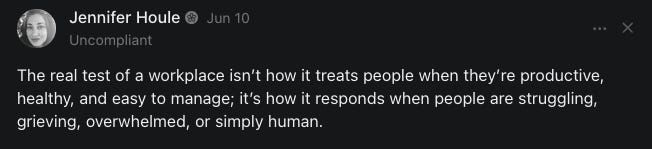
It's easier for me to explain what leadership isn't because I think that tells you much more about what I believe leadership is. To me, the opposite of leadership is protecting your own comfort, status, or ego at the expense of the people and systems you're responsible for.
When do you feel you became a leader?
I hesitate to call myself a leader because I associate that word with hierarchy, and I’m not into that. But just because you hesitate to define yourself as a leader doesn’t mean other people don’t see you as one.
Once I started putting my ideas into the world through my writing, people...strangers, started reaching out to tell me things like, “You said what I’ve been feeling for years,” or, “You put words to something I couldn’t explain.” I’m not trying to lead anyone or anything, but I’ve come to realize that when you’re willing to say something out loud where others might hesitate, then you give them permission to do the same. Maybe that’s leadership.
Did you change after becoming a leader? If so, how?
I grew a tail…it’s a bit of an issue.
I will always pursue personal growth and transformation, so yes. Leadership is just a byproduct.

What’s a funny, ridiculous, embarrassing, or wild story from your life?
One day, I was out grocery shopping, and every time I went down an aisle, I ran into the same elderly man. Because it kept happening, we eventually started acknowledging each other. First, with a nod and a smile, then with an “Oh, hi again,” and a friendly laugh. It was funny! We had built this little friendship.
After grocery shopping, I had to run to the pharmacy next door. I walked in, and who do I see but my elderly friend, reaching for some items on a shelf. So, since we were now besties, I walked up behind him and whispered, “I’m following you.” But when he slowly turned around to face me, I realized this wasn’t the same man from the grocery store.
I saw the terror spread across this poor man’s face, and instead of apologizing or explaining myself, I panicked and fled the pharmacy.
My friends and family still use this incident to terrorize me, even though it was years ago. They will randomly whisper, “I’m following you,” or ask me if I’ve threatened any seniors lately.

What emotions do you read from people? What do you do about it?
It’s not so much a “read” for me as it is a sensation. I think those who know, know. But for those who don’t, I’ll try to explain it.
If someone is feeling sad, I am sad for them, of course, and if they’re happy, I’m happy for them. But I also feel disrupted, as though my energy has been displaced. Have you ever seen those slowed-down videos of someone sneezing, where you can see how far and wide their sneeze juices spread? That’s what it feels like to be around people who are in a heightened emotional state. They’re getting their emotional sneeze juices on me, and I can see it and feel it, and now it’s on me, and now I’ve breathed it in.
As a result, I have a very short social battery. To cope with that, I need to take frequent breaks in social situations. I’m very selective about how I spend my time and with whom I spend it.
How does power affect you?
It depends. If power is being weaponized, then I find it deeply uncomfortable. If it's being used to challenge ideas, create opportunities, or improve systems, then I’m okay with it. It really comes down to whether power is being used to serve the person holding it or the people impacted by it.
What decision looked reasonable at the time but troubles you now?
Having a kid!
I’m not troubled by how hard or exhausting it is to parent; my dog is more exhausting than my son. But the moment I became a mother, I discovered a depth of vulnerability I didn’t know existed. That’s troubling. The lack of control is troubling.
That said, in every lifetime, I hope to experience the joy of knowing him.

What feedback has followed you through more than one job or chapter of your life? Why has it been difficult to change?
My strongest feedback loop is a behavior I’ve repeatedly observed in myself.
My mom has a very domineering personality, and I learned early on that accommodating her was easier than challenging her. I brought that pattern into adulthood, finding myself gravitating toward friendships and relationships where I was easily dominated.
I’m aware of it; I’ve made a lot of positive changes, but it’s still there, and in vulnerable moments, it comes out. Some of that has shown up in my work, too. There have been times when I have absolutely prioritized harmony over speaking up. I’m getting much better at recognizing those moments, but it’s a practice.
Jennifer is big on polls.
What do you wish you learned earlier?
I wish I’d learned to love and respect myself way sooner in life.
I mean this very practically: You can have the most supportive family, friends, and community, but at the end of the day, you’ve really only got yourself. And if you don’t genuinely love and respect yourself, then you actually have nothing. How bleak does that sound?
A huge part of learning to love yourself is believing you deserve a full life. Why shouldn’t I be the one to write the book, give the keynote, or build something meaningful? For the first time in my life, I’m starting to believe that I can actually do those things, and it’s only because I respect myself enough to try.

What’s an underrated skill to develop as a leader? How would you coach someone to learn it?
I don't think we spend nearly enough time teaching leaders how to slow down. Most leadership development focuses on what to say, how to influence outcomes, how to delegate, but I believe active observation is where strong leadership begins. Before you can solve any problem, you have to see it clearly. I'd coach someone to spend less time trying to move fast and more time becoming curious. Curiosity almost always produces better leadership outcomes than certainty.
What’s a hill you will die on without regrets?
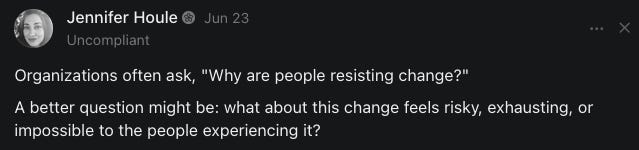
We’ve built a world where work has become the organizing principle of human life.
We measure our worth by our productivity, job titles, and how busy we are. What an absolute tragedy. Don’t get me wrong…purpose and contribution matter. But work should enrich life, not consume it.
My son’s classroom has a wall with pictures of what the kids want to be when they grow up. Another parent was shaking their head at how many kids said “YouTuber,” but I have a different perspective. Without even realizing it, these kids are questioning assumptions my generation just accepted. Can work be creative, flexible, joyful, and integrated into life instead of dominating it? I hope the answer is yes.
Who do you look up to? Why them?
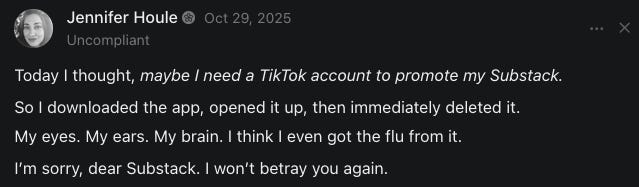
I don’t know that I look up to anyone in particular, but I genuinely and profoundly love women so much. We instinctively understand what we’ve had to overcome just to get where we are; hell, sometimes just to exist. There’s an unspoken kinship that comes from having navigated this world as women, and no one can take that away from us.
My sister, my niece, my friends, women in my community. And on Substack? Just to name a few…Rebecca from the Strategic Linguist. JHong from Natural Intelligence. Kathi from Chief Absurdist Officer. Shannon from The Flow. Brandi from The Corporate Unspiral. Amanda from Saved Not Sent. Rose from She’s Scrappy. Candy from Joint Custody. Megs from Pizza and Other Things. Chiedza from The Investigative Edge. Tricia from The Cunningly Good Marketer. Neela 🌶️ from Workmanshit. Have you seen the work these women are doing? It’s so diverse, so brilliant. I’m in awe.
What advice do you have for someone starting their first day of work?
Pay attention, because every organization has an informal network more powerful than the formal hierarchy. You got the job; you’ve already impressed them. Now you need to understand the system you've just joined. People who understand the system adapt faster, build stronger relationships, and are more effective because they work with the system instead of unknowingly working against it.

What advice do you have for the messy middle? The middle managers, the team leads, the senior contributors?
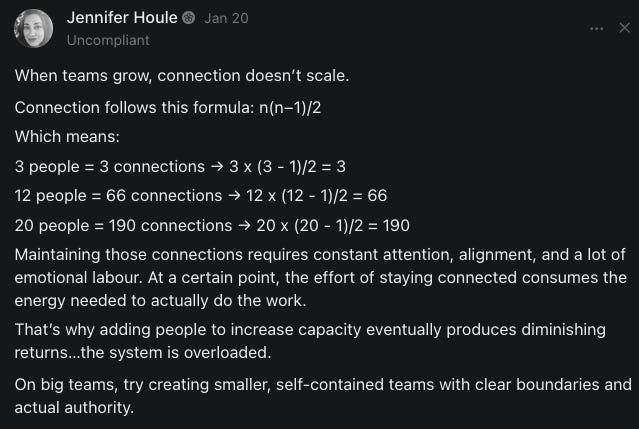
The system is designed so that middle managers spend the bulk of their time absorbing pressure from above and shielding everyone below. It feels noble, but it’s unsustainable, and it hides problems the organization actually needs to see.
My advice is to become a sense-maker instead. Translate strategy into something people can act on, and translate the lived experience of your team back to leadership in a way that helps them make better decisions. It’s not your job to protect the organization from broken systems, but it is your responsibility to help make them visible.

What advice do you have for senior leaders? The rain makers, the C-Suite, the people at the top?
Get off the damn balcony every once in a while! The more senior you become, the more time you’ll spend there, because that’s the job, and it’s important. But if strategy happens on the balcony, the consequences of your decisions are experienced on the dance floor.
You want to be strategic? Remember that your title changes your vantage point, but it doesn’t change reality. Make a habit of returning to the places where your work is felt. See how your decisions show up in meetings, processes, customer interactions, and the everyday experience of work. Listen with curiosity, not defensiveness.
Being competent and well-intentioned inside a broken system doesn’t protect you from being complicit in it. - Jennifer Houle
From others, we learn. Deeper roots, flying higher.
If you’re not already subscribed, consider doing so, or following, in order to stay involved in The Updraft.
More from Jennifer


The Updraft is a publication for writing on leadership and emotional intelligence.
I’m Dan Korus. Writer, runner, lover of milk duds, fully caught up on One Piece, dog walker, and founder of Kestryl Edge: a company dedicated to bringing emotional intelligence skills to leaders in the workplace.
Weekly essays, podcasts, lives, and interviews all on striving towards being a better leader.
 | A guest post by
|
Dan I love this format. Especially the little Notes interludes.
JHo I love… you 😍. <I’m following you> quite literally.
I just knew this would be good! 🤩
I've had it saved, ready to enjoy with my morning coffee. First of all, what a great format, Dan. It strikes the perfect balance; light-hearted, hugely informative, and deeply meaningful, which sums up Jen's approach perfectly too!
Great stuff from you both!