
Leaders Who Want Engagement, Go the Fuck To Sleep.
To Self-Care or Self-Cannot. A literature review of self-care and self-compassion in leadership.

This isn’t your normal Substack post. I will challenge you. I will ask you to consider primary sources. I will admit my own failure and expect you to self-admit yours. I will ask for growth.
Gurus, vibe-coaches, posers,… turn back now.
Self-Care as portrayed by pop-culture is horse shit. I will not argue for the bubble-bath industrial complex here. Nor for the cold-one (or six) before the family is acknowledged.
Leadership demands consistency and resilience. Success demands not giving up.
In order to survive the long haul towards betterness, we need to take care of, and love, ourselves.

Here’s the BLUF (Bottom Line, Up Front) for today’s literature review essay:
Leaders who protect their own resources lead in more health-supportive ways.12
Resiliency isn’t a trait, it’s a habit of resource management capability. 345 6
Concrete, observable routines work. Abstract exhortations don’t. 789
Self-care and self-compassion make leaders more useful, more stable, and more available. The evidence is strong in some places and uneven in others. 8 10
To sleep perchance to dream…
“The most common reason why senior leaders get fired is a lack of impulse control.
They are tired, stressed beyond belief, holding the weight of the world and they snap and say something stupid. They are gone. No going back. Words cannot be unspoken, unheard, or unread. So they react, and get fired.” - Mentor and friend, Dr. Zohgi, est. 2024.
I struggle with impulse control. It’s something I know about myself and not everyone sees. I like to move quick. To solve problems.
Virgil guiding me through my own layers of hell would no doubt show me a layer where I know something is wrong, someone mad at me, a mistake I made is left uncorrected. I have full knowledge of it. And am held in a conscious stasis… stuck and unable to do anything about it.
All leaders and managers have ticks and triggers that spur them into action. Into speaking their mind.
And, as modern media shows us every day, those who speak first, speak loudly, and act out of emotion, lose. End up appearing childish, misinformed, hasty, etc.
When I started the research for this essay, what became clear to me was that the most supported conclusions in self-care as it related to management and leadership are what is observed when self-care is not present.
Not what we garner when it’s there, but the consequences of its absence.
A 2020 JAMA Network Open study, physicians rated their immediate supervisors on general effectiveness characteristics. Those supervisors independently reported their own burnout, fulfillment, self-valuation, and sleep quality.11
Each 1-point increase in self-reported burnout was associated with a 0.19-point decrease in independently rated leadership behavior. Simply put, the more burnt someone self-reported, the shittier their leadership was rated. 10
We all think we’re above the law when it comes to these sorts of stats. That somehow they only apply to the participants we measured. Not everyone else.
“Well!, I’ve been getting 5 hours of sleep for years. It’s just how much I sleep. I’m different than everyone else.”
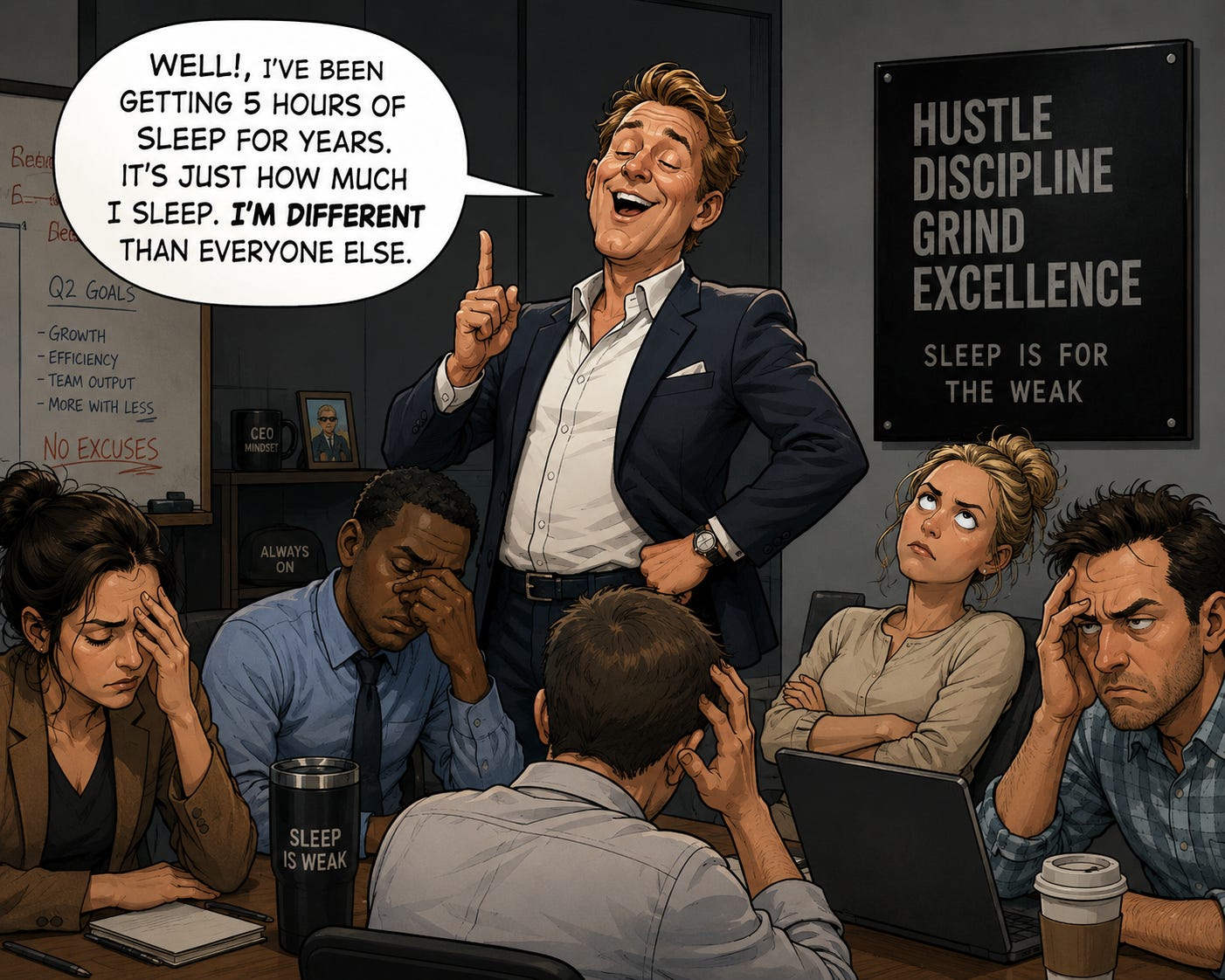
Positive thinking is powerful. It is not powerful enough to exempt us from biology.
The sleep literature, one of my favorite literature categories, provides some of the strongest evidence on how leader self-care failures degrade leadership behavior.
A daily experience-sampling study, poor nightly leader sleep quality predicted more daily abusive supervision via ego depletion which in turn reduced subordinate unit work engagement.12
Similarly, a subsequent study found that leader sleep devaluation - leader behaviors signaling that sleep should be sacrificed for work - undermined employee sleep quality and linked to higher subordinate unethical behavior across other work domains.13
If we needed more, a broader decision quality study showed multi-night sleep restriction increased dishonest decision making, and a 2025 review concluded that sleep loss impaired core decision processes such as value sensitivity and increases decision noise.1415
Skip your sleep and your team suffers. They get a grumpier leader, worse norms, and poorer decisions. The damage does not stay politely inside your skull.
I know myself all too well. I am one bad night of sleep away from insufferability. You can’t Red Bull your way out of the resting-Dan-face of a poor night of rest with no patience in the bank. So, I try for 7.5 hrs every night. Or else I join the cohort of impulsive leaders who succumb to their depletion and lash out. Rested, healthy, and late to work is better than assholish, grumpy, and fired.
Brandi Copeland and I discussed employee engagement trends on the Kestryl Edge Podcast recently. Brandi shared how employee disengagement is at an all-time low. Depending on the source, reports say only 23%-31% of employees are engaged at work.1617
The underlying sentiment is something we can all identify with: broadly, across America, people feel detached and are giving less shits.
On the episode in question, Brandi and I chatted about solutions. Mainly dancing with the prescription that engagement comes from listening, understanding, and the precursor habits of building trust.
So here’s another solution, it seems.
Leaders who want engagement,
go the fuck to sleep.
There are two things you can do today that will make you better tomorrow.
1. subscribe.
2. go to bed.
Be the leader future-you will be proud of.
Thus conscience doth make cowards of us all
There is a canon event in every new manager’s life: the first closed-door conversation where someone hands you their pain and you mistake holding it for helping.
You’re sitting there in your new chair. In a newly decorated office. An employee, new to you, comes in, closes the door, and begins to share problems, grievances, gossip, beef, real issues, bonafide conundrums, real world happenings.
As the newly minted “supporter of people,” you listen. Actively and with care. Investing in the emotions, investigating in the origins, and inventing solutions and plans to stop the bleed of this problem.
You’re the manager after all.
It’s your job to fix this.
Again.
Again.
And again.
Fixing one person’s problem spawns another and there’s a chain reaction of mess. Senior leadership wants to know what’s going on and gives you their ten cents on what you should have done even though you did everything right and they just didn’t listen the first time you told the story.
But, why argue?
And you go home tired. Exhausted. Not wanting to talk to another human because you’re drained. Zapped. Energy: gonzo.
The event is becoming a manager and learning how to set boundaries with your team for what of theirs you take on and what stays theirs.
The event is learning to regulate your empathy.
Empathy has a line.
I won’t pretend I know exactly where that line is. It’s somewhere between giving a singular shit and going home a brain-mush zombie. When we absorb the feelings of others and hyper-fixate on their experience, we degrade ourselves. Feeling too deeply. Lost in the sauce.

The literature gives us a better tool than numbness: self-compassion.
Self-compassion is self-kindness rather than harsh self-judgment, common humanity over isolation, and mindfulness rather than over-identification with painful thoughts and feelings. Unlike self-care, it is solidly defined with borders. The literature knows what it is and has colored the boundaries in with a swath of research and data. As a result, the evidentiary base for self-compassion and its benefits is stronger than for self-care.181920
Broadly, people who practice self-compassion are less threat-reactive around the self. Their self-compassionate responding makes it easier to face negative information without becoming engulfed or defensive.2122
Even brief self-compassion training has been shown to reduce stress responses. Related work found lower stress reactivity among more self-compassionate participants during repeated psychosocial stress.2324
Self-compassion does not simply make you “feel better.” It changes how strongly we are driven into fight, flight, collapse, or defensive self-protection under interpersonal pressure. 20 21
The benefits of self-compassion also include improved emotion regulation and psychological flexibility. We are able to give ourselves a less shaming, less avoidant way to process difficult emotions.2526
And the piece of information that makes me rethink my life so far?
Empathy training can increase negative affect and activate neural regions associated with sharing pain. Compassion training produces a different pattern associated with positive affect and prosocial motivation. Compassion and perspective-taking are associated with lower burnout and affective symptoms. Self-other emotional fusion is associated with worse outcomes.2728
Empathy, when overdone, makes us feel the negativity of those around us in a way that degrades the self.
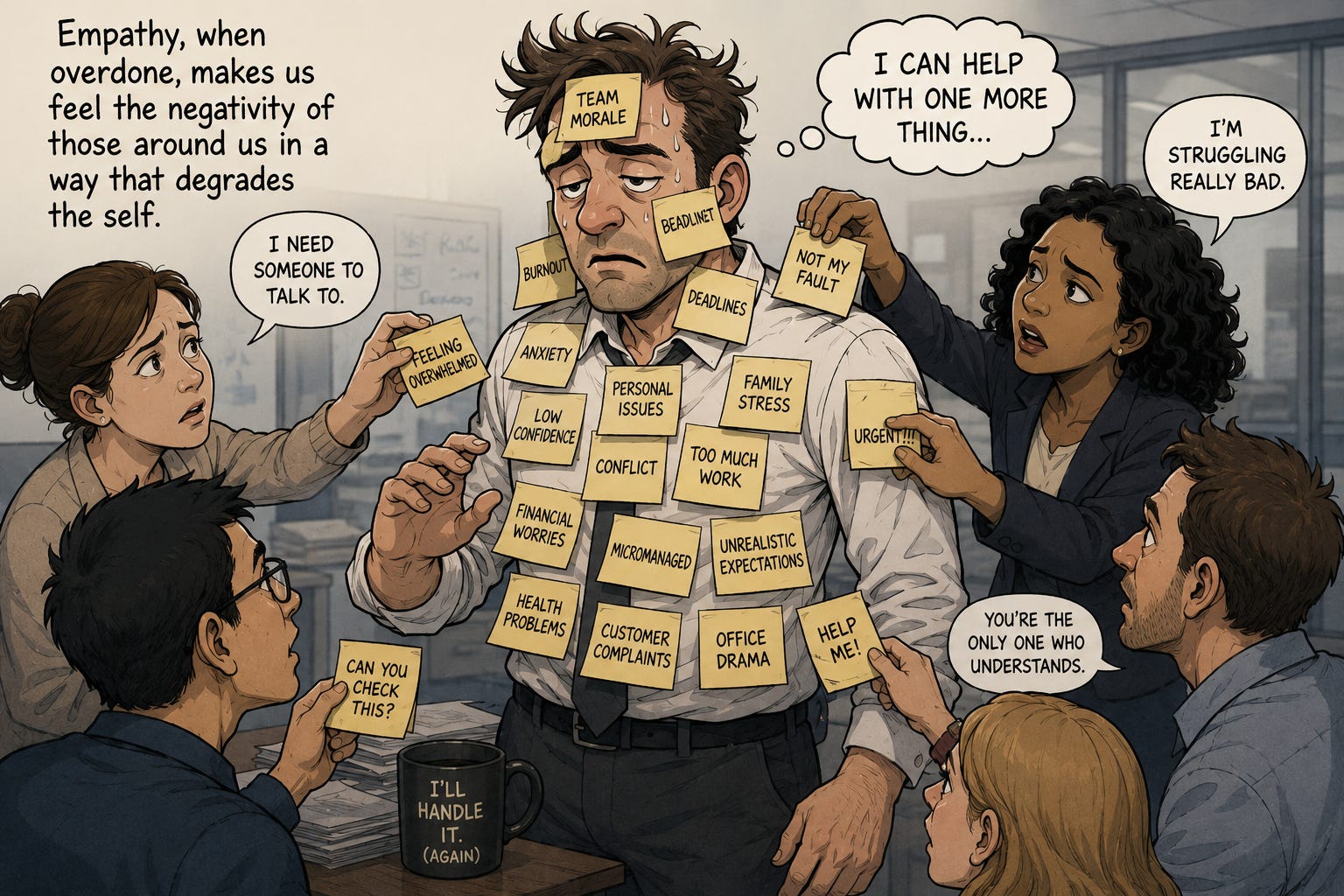
Compassion allows us to be there genuinely and perspective-take without succumbing to emotional contagion.
The literature does not support a simple “more empathy is always better” narrative. Several studies suggest unregulated empathy can be harmful. A safer conclusion is that the healthiest form of caring requires compassion, perspective-taking, and self-regulation. Not just emotional resonance. 2930 25
This is where the research gets annoying.
These words we find in the literature can mean so many things. One of the things any deep-diver discovers when spelunking around the leadership literature is that… it’s not great. Words are defined willy-nilly. Measurement standards are unique to each paper. Connection of evidence to cause across time is difficult.31 9
When I used to work in quantum dot nanoparticles for luminescent solar concentrators, windows that generated electricity, the field published a standards paper. A conglomerate paper where authors were invited to set the mathematical standards and definitions the field would use from then on. With performance equations set into stone, the field could advance and compare results across different laboratories more easily.
People are harder to study than quantum dots.
Where the literature interconnects, I have compiled solid conclusions and recommendations for leaders going forward.
Train the thing directly. Self-compassion is teachable. Targeted training can increase not only self-compassion but also mindfulness, compassion for others, and broader well-being. 16 22
Stop confusing empathy with emotional possession. The goal is to remain empathically available over time. Toward this end, the literature points away from indiscriminate affective contagion and toward compassion, perspective-taking, and self-regulation. 24 25
Practice relational skills early, often, and consistently. Mindful communication for physicians and loving-kindness training for doctors both improve relationally relevant outcomes. For leaders, mindful leadership and emotional-skills cultivation improved leadership-related behaviors and reduced some burnout markers. 32333435
Stop framing self-care as private indulgence. The strongest self-care papers do not frame self-care as the singular hot tub dip in Q2. It is defined as a pattern of support, balance, awareness, and sustainable professional functioning. It’s not optional comfort behavior, the pizza and ice cream after a week of no sleep. It’s habitual capacity building and burnout prevention. 2936
And, for the love of all things holy, we need to stop pretending individual habits can outmuscle a toxic system. Individual practices cannot substitute for organizational reform. Primary studies repeatedly identify time pressure, workload, and structural constraints as barriers. We again find that individual actions to wellness can only go so far when you’re in a hellscape work environment that perpetuates unhealthy behaviors and toxic standards. 37 9 38
So …
I have a theory. I can’t prove it.
We all know leaders who avoid empathy like touching it will melt them. I theorize they did not start their career cold. I think they were once too open.
Too absorbent. Too willing to make every problem their problem.
Then they burned out.

And because no one taught them boundaries, they built walls.
They do not refuse to feel because they are strong.
They refuse to feel because feeling once cost them too much.
They hide from others to avoid confronting their own pain
Toxic outward as a cure for the poison within.
to take arms against a sea of troubles
I cannot sit still.
To be loved I must earn it.
Chasing results, proof.
Me. Typed words on digital canvas. Est. 2026.
Something about meditation has always felt so counterproductive to me.
Why sit with your problems when you could be out there trying to kill them?
Remember when I said my hell was knowing I could make a change and being unable to act? Why would I impose this state of suspension upon myself.
Trust me. The irony of this post and my self-identified weaknesses is not beyond me.
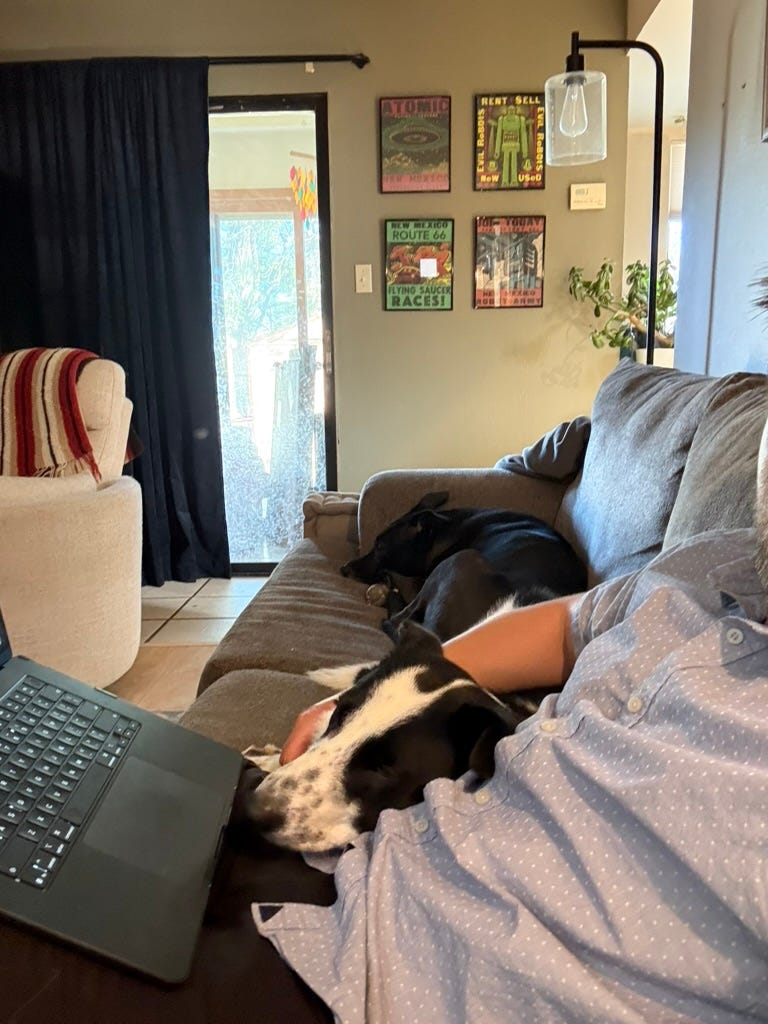
Yet sitting still is work. Rest is productive. I can feel it after a particularly epic nap. My body comes back more whole. Calm. Blood pressure relaxed. Tension melted into the couch I begrudgingly pull myself out of. Dogs looking up at me, offended, wondering why I would ever get up.
They didn’t ask me to, after all.
CrossFit legend Noah Ohlsen talks about downtime between intense training sessions. Reading. TV. Video games. Doing as little as possible.
The ideal athlete trains hard for several hours a day and spends the rest of the day weighted disproportionately toward nothing.
Resting.
Recovering.
Pro athletes can still feel guilty doing this. Chasing acute performance comes with the feeling that rest is laziness. That if they are not doing more, they are falling behind.
I get it.
Rest without shame is something I struggle with too. I know it would unlock higher performance when I am “on,” instead of leaving me in that sluggish march where I’m not done, not worthy of love yet, but not alive either.
I know it would unlock higher performance when I am “on,” instead of leaving me in that sluggish march where I’m not done, but I’m not alive either. 3 439
Much like we are not born brave. And to stand up with bravery does not require us to feel what we project.
Habits are our keeper.
Resilience is the sum of the habits that serve us. And therefore building resilience comes after building personal infrastructure to support outcomes that look like resilience. 5 340
Resilience is built.
With this regard their currents turn awry, and lose the name of action
I do not think self-care is soft.
I think softness develops when leaders confuse exhaustion for virtue. When they call depletion commitment. When recovery is viewed a character flaw.
I know this because I am not above it.
I want to move. Fix. Prove. Earn. Win. Be useful. Be needed. Be undeniable.
And my body keeps interrupting my soliloquy.
Sleep matters. Recovery matters. Boundaries matter. Self-compassion matters. Not because they make me gentler in some decorative, corporate-retreat way. They matter because without them I become less honest, less patient, less generous, less regulated, less able to stay with people when staying with people is the job.
The leader who cannot stop cannot recover.
The leader who cannot recover cannot regulate.
The leader who cannot regulate cannot remain kind and sturdy under pressure.
And the leader who cannot remain kind under pressure becomes the pressure.
Which, I keep coming back to.
Self-care is not escape from the work. It is what keeps me from turning the work into an omni-directional weapon.
It is not the cold-one before the family is acknowledged. It is acknowledging the family.
It is not the bubble bath industrial complex. It is going to bed before my ego starts writing checks my nervous system cannot cash.
It is not disappearing from responsibility. It is becoming someone who can carry responsibility without making everyone else acknowledge me and pay for the weight with imposed shame.
We do not need leaders who worship at the altar of grind until there is nothing left but caffeine, resentment, and our consequences.
We need leaders who can do the boring holy work.
Sleep.
Pause.
Reflect.
Repair.
Ask what belongs to them.
Ask what belongs to the system.
Ask what they are carrying because it is theirs, and what they are carrying because being exhausted makes them feel important.
The brutal little joke of it all.
Sometimes the most disciplined thing I can do is nothing.

Not forever. Not as avoidance. Not as surrender.
But long enough to come back human.
Long enough to not confuse urgency with wisdom.
Long enough to not confuse empathy with absorption.
Long enough to not confuse resilience with refusing to bleed.
Because action without recovery curdles into reaction.
Care without boundaries curdles into resentment.
Leadership without self-compassion curdles into control.
And control, eventually, curdles into cruelty.
So, to self-care or self-cannot!?
That is the question.
And I hate that the answer is sleep, boundaries, compassion, and rest.
But here we are.
~d
below is the holy work for those of us learning to worship at the Church of Nothing.
The Work
Protect sleep and recovery as non-negotiable performance conditions. 11 12 13
Train leaders in observable support behaviors rather than generic empathy language. 6 9
Use mindfulness and self-leadership training as capacity builders for self-regulation and detachment. 8 43
Measure and review leader well-being regularly.wind 41
Connect leader self-care to work design. 37 38
A concise implementation cadence :
First month
Baseline leaders and teams on burnout, sleep impariment, and one support-behavior measure. Identify high-strain teams. 42
First Quarter
Train managers in family-supportive and health-oriented behaviors; introduce delayed-send and boundary norms. 7 9
First Half-Year
Offer evidence-based mindfulnedd/self-leadership training for managers. 43
Ongoing
Review manager load, after-hours work, and interruption patterns together with well-being metrics. 37 42
About
I am the founder of Kestryl Edge, LLC. A company that teaches emotional intelligence and leadership to teams who face high consequence environments.
The Updraft is my personal space to write, reflect, learn, and document my personal journey building.
For quarterly company updates, check out Kestryl Edge on Substack.
We have a weekly podcast that’s all about leadership and EQ.
Reach out with questions, and welcome to The Updraft.
References
Photos generated with Chat-GPT 5.5 with prompts built with notes from my essay.
Franke, Franziska, Jörg Felfe, and Alexander Pundt. 2014. “The Impact of Health-Oriented Leadership on Follower Health: Development and Test of a New Instrument Measuring Health-Promoting Leadership.” German Journal of Human Resource Management 28 (1-2): 139-161.
Translation: caring for employee health can be measured as leadership behavior.
Klug, Katharina, Jörg Felfe, and Annika Krick. 2022. “Does Self-Care Make You a Better Leader? A Multisource Study Linking Leader Self-Care to Health-Oriented Leadership, Employee Self-Care, and Health.” International Journal of Environmental Research and Public Health 19 (11): 6733.
Translation: leader self-care shows up downstream. The boss’s habits become team experience.
Masten, Ann S. 2001. “Ordinary Magic: Resilience Processes in Development.” American Psychologist 56 (3): 227-238.
Translation: resilience is ordinary systems doing their job, not a cinematic trait handed down by thunder gods.
Bonanno, George A. 2004. “Loss, Trauma, and Human Resilience: Have We Underestimated the Human Capacity to Thrive after Extremely Aversive Events?” American Psychologist 59 (1): 20-28.
Translation: resilience is not just heroic comeback music. Sometimes it is ordinary adaptation doing quiet, dirty work.
Hobfoll, Stevan E. 1989. “Conservation of Resources: A New Attempt at Conceptualizing Stress.” American Psychologist 44 (3): 513-524.
Translation: stress is what happens when your resources are threatened, drained, or torched. Leadership lives inside that math.
Hammer, Leslie B., et al. 2013. “Measurement Development and Validation of the Family Supportive Supervisor Behavior Short-Form.” Journal of Occupational Health Psychology 18 (3): 285-296.
Translation: we can measure whether managers are actually supporting humans or just wearing empathy cologne.
Hammer, Leslie B., Ellen Ernst Kossek, W. Kent Anger, Todd Bodner, and Kristi L. Zimmerman. 2011. “Clarifying Work-Family Intervention Processes: The Roles of Work-Family Conflict and Family-Supportive Supervisor Behaviors.” Journal of Applied Psychology 96 (1): 134-150.
Translation: teach supervisors specific support behaviors and the people under the most strain actually benefit. Fancy that.
Mellner, Christin, Walter Osika, and Maria Niemi. 2022. “Mindfulness Practice Improves Managers’ Job Demands-Resources, Psychological Detachment, Work-Nonwork Boundary Control, and Work-Life Balance: A Randomized Controlled Trial.” International Journal of Workplace Health Management 15 (4): 493-514.
Translation: mindfulness for managers can help with detachment and boundaries. That is useful. Not enlightenment cosplay.
Guo, Yongxing, Siqi Wang, Yasin Rofcanin, and Mireia Las Heras. 2024. “A Meta-Analytic Review of Family Supportive Supervisor Behaviors: Work-Family Related Antecedents, Outcomes, and a Theory-Driven Comparison of Two Mediating Mechanisms.” Journal of Vocational Behavior 151: 103988.
Translation: manager support behaviors work because they change the resource math. Less slogan, more load-bearing beam.
Dannheim, Iris, Helena Ludwig-Walz, Anette E. Buyken, Veronika Grimm, and Anja Kroke. 2022. “Effectiveness of Health-Oriented Leadership Interventions for Improving Health and Wellbeing of Employees: A Systematic Review.” Journal of Public Health 30: 2777-2789.
Translation: health-oriented leadership is promising, but the evidence base still has wet paint signs all over it.
Shanafelt, Tait D., Mickey Trockel, Christine Ripp, et al. 2020. “Association of Burnout, Professional Fulfillment, and Self-Care Practices of Physician Leaders with Their Independently Rated Leadership Effectiveness.” JAMA Network Open 3 (6): e207961.
Translation: burned-out leaders were rated as worse leaders. The body keeps receipts and the team grades the paper.
Barnes, Christopher M., Lorenzo Lucianetti, Devasheesh P. Bhave, and Michael S. Christian. 2015. “‘You Wouldn’t Like Me When I’m Sleepy’: Leaders’ Sleep, Daily Abusive Supervision, and Work Unit Engagement.” Academy of Management Journal 58 (5): 1419-1437.
Translation: sleepy leaders leak their depletion onto the room. The team pays the invoice.
Barnes, Christopher M., Eli Awtrey, Lorenzo Lucianetti, and Gretchen M. Spreitzer. 2020. “Leader Sleep Devaluation, Employee Sleep, and Unethical Behavior.” Sleep Health 6 (3): 411-417.e5.
Translation: when leaders brag that sleep is optional, people learn the wrong religion.
Bütler, Monika, and Anna Conte. 2021. “Unethical Decision Making and Sleep Restriction: Experimental Evidence.” IZA Discussion Paper No. 14537. Bonn: IZA Institute of Labor Economics.
Translation: take away sleep and people do sketchier math with their ethics.
Lim, Jeryl Y. L., William D. S. Killgore, Duncan Bennett, and Sean P. A. Drummond. 2025. “The Impact of Sleep Loss on Decision-Making: Opening the Cognitive Black Box.” Sleep Medicine Reviews 82: 102114.
Translation: sleep loss does not merely make you tired. It gums up the decision machinery.
Gallup. 2025. State of the Global Workplace: 2025 Report. Washington, DC: Gallup.
Translation: the engagement problem is not just your cranky group chat. People are detached in measurable, expensive ways.
Harter, Jim. 2025. “U.S. Employee Engagement Sinks to 10-Year Low.” Gallup.
Translation: engagement is not dead, but it is definitely face down on the conference table.
Neff, Kristin D. 2003. “Self-Compassion: An Alternative Conceptualization of a Healthy Attitude toward Oneself.” Self and Identity 2 (2): 85-101.
Translation: this is the source code for self-compassion: self-kindness, common humanity, mindfulness.
Neff, Kristin D., and Christopher K. Germer. 2013. “A Pilot Study and Randomized Controlled Trial of the Mindful Self-Compassion Program.” Journal of Clinical Psychology 69 (1): 28-44.
Translation: self-compassion is trainable. The skill is not reserved for monks, therapists, or people with suspiciously clean kitchens.
Dorociak, Katherine E., Carla S. Rupert, Mary A. Bryant, and Mary A. Zahniser. 2017. “Development of the Professional Self-Care Scale.” Journal of Counseling Psychology 64 (3): 325-334.
Translation: professional self-care is a pattern, not a quarterly bubble bath with cucumber water.
Leary, Mark R., Eleanor B. Tate, Claire E. Adams, Ashley Batts Allen, and Jessica Hancock. 2007. “Self-Compassion and Reactions to Unpleasant Self-Relevant Events: The Implications of Treating Oneself Kindly.” Journal of Personality and Social Psychology 92 (5): 887-904.
Translation: self-compassion helps you look at your own mess without instantly becoming a defensive porcupine.
Klug, Katharina, Jörg Felfe, and Annika Krick. 2019. “Caring for Oneself or for Others? How Consistent and Inconsistent Profiles of Health-Oriented Leadership Are Related to Follower Strain and Health.” Frontiers in Psychology 10: 2456.
Translation: the best pattern is not martyr leader. It is leader who cares for self and others without splitting the atom.
Arch, Jennifer J., Kirk Warren Brown, David J. Dean, Lauren N. Landy, Kelly D. Brown, and Mark L. Laudenslager. 2014. “Self-Compassion Training Modulates Alpha-Amylase, Heart Rate Variability, and Subjective Responses to Social Evaluative Threat in Women.” Psychoneuroendocrinology 42: 49-58.
Translation: a tiny dose of self-compassion can calm the body before the interpersonal threat monster starts banging pans in the kitchen.
Breines, Juliana G., et al. 2015. “Self-Compassionate Young Adults Show Lower Salivary Alpha-Amylase Responses to Repeated Psychosocial Stress.” Self and Identity 14 (4): 390-402.
Translation: self-compassion is not soft. It is your stress system getting less trigger-happy.
Rojas, Bárbara, Eduardo Catalan, Gonzalo Diez, and Paula Roca. 2023. “A Compassion-Based Program to Reduce Psychological Distress in Medical Students: A Pilot Randomized Clinical Trial.” PLOS ONE 18 (6): e0287388.
Translation: in a high-pressure training environment, compassion practice improved regulation and reduced distress. Good news for the overachieving feral among us.
Duarte, Joana, and José Pinto-Gouveia. 2017. “Mindfulness, Self-Compassion and Psychological Inflexibility Mediate the Effects of a Mindfulness-Based Intervention in a Sample of Oncology Nurses.” Journal of Contextual Behavioral Science 6 (2): 125-133.
Translation: self-compassion helps explain why mindfulness can reduce burnout. It is not incense. It is mechanism.
Klimecki, Olga M., Susanne Leiberg, Matthieu Ricard, and Tania Singer. 2014. “Differential Pattern of Functional Brain Plasticity after Compassion and Empathy Training.” Social Cognitive and Affective Neuroscience 9 (6): 873-879.
Translation: empathy and compassion are not twins. One can drown with you. The other can throw a rope.
Romani-Sponchiado, Aline, Matthew R. Jordan, Argyris Stringaris, and Giovanni A. Salum. 2021. “Distinct Correlates of Empathy and Compassion with Burnout and Affective Symptoms in Health Professionals and Students.” Brazilian Journal of Psychiatry 43 (2): 151-157.
Translation: feeling what everyone feels can wreck you. Compassion and perspective taking are the sturdier tools.
Duarte, Joana, José Pinto-Gouveia, and Bárbara Cruz. 2016. “Relationships between Nurses’ Empathy, Self-Compassion and Dimensions of Professional Quality of Life: A Cross-Sectional Study.” International Journal of Nursing Studies 60: 1-11.
Translation: empathy without self-compassion can become a psychic sponge. Eventually, the sponge rots.
von Harscher, Heidi, Nathaly Desmarais, Robert Dollinger, Seth Grossman, and Scarlett Aldana. 2018. “The Impact of Empathy on Burnout in Medical Students: New Findings.” Psychology, Health & Medicine 23 (3): 295-303.
Translation: empathic concern and personal distress are not the same beast. One can protect. One can corrode.
Inceoglu, Ilke, Geoff Thomas, Chris Chu, David Plans, and Alexandra Gerbasi. 2018. “Leadership Behavior and Employee Well-Being: An Integrated Review and a Future Research Agenda.” Leadership Quarterly 29 (1): 179-202.
Translation: leadership research matters, but a lot of it is still methodologically wobbly furniture.
Krasner, Michael S., Ronald M. Epstein, Howard Beckman, Anthony L. Suchman, Benjamin Chapman, Christopher J. Mooney, and Timothy E. Quill. 2009. “Association of an Educational Program in Mindful Communication with Burnout, Empathy, and Attitudes among Primary Care Physicians.” JAMA 302 (12): 1284-1293.
Translation: mindful communication training helped physicians burn out less and relate better. Not magic. Practice.
Chen, Huazhen, Chenxi Liu, Xia Cao, Bin Hong, De-Hui Huang, Chia-Yih Liu, and Wen-Ko Chiou. 2021. “Effects of Loving-Kindness Meditation on Doctors’ Mindfulness, Empathy, and Communication Skills.” International Journal of Environmental Research and Public Health 18 (8): 4033.
Translation: compassion practice can move from the inner world to the patient room. Nice becomes operational.
van der Drift, Iris M., Linda Cillessen, Dirk van Dierendonck, et al. 2020. “Effectiveness and Feasibility of a Mindful Leadership Course for Medical Specialists: A Pilot Study.” BMC Medical Education 20: 104.
Translation: mindful leadership is plausible, useful, and still early. Good bridge, not final gospel.
Paakkanen, Miia, Frank Martela, Jari J. Hakanen, Lotta Uusitalo, and Anne Birgitta Pessi. 2021. “Awakening Compassion in Managers: A New Emotional Skills Intervention to Improve Managerial Compassion.” Journal of Business and Psychology 36: 1095-1108.
Translation: managers can practice emotional skills and get better at compassion-related leadership behavior. Adults can learn. Incredible.
Lee, Jacquelyn J., Shannon E. Miller, and Brian E. Bride. 2020. “Development and Initial Validation of the Self-Care Practices Scale.” Social Work 65 (1): 21-28.
Translation: self-care can be measured as professional practice, not treated as a scented candle crime scene.
Maslach, Christina, and Michael P. Leiter. 2022. The Burnout Challenge: Managing People’s Relationships with Their Jobs. Cambridge, MA: Harvard University Press.
Translation: burnout is not proof that someone failed at yoga. It is often a bad fit between people and work design.
Teetzen, Florian, et al. 2022. “The Mediating Effects of Work Characteristics on the Relationship between Transformational Leadership and Employee Well-Being: A Meta-Analytic Investigation.” International Journal of Environmental Research and Public Health 19 (5): 3133.
Translation: leaders shape well-being through demands and resources. Inspiration without work design is just fog machine leadership.
Connor, Kathryn M., and Jonathan R. T. Davidson. 2003. “Development of a New Resilience Scale: The Connor-Davidson Resilience Scale.” Depression and Anxiety 18 (2): 76-82.
Translation: resilience became measurable here, which means we can stop treating it like a motivational poster with abs.
Demerouti, Evangelia, Arnold B. Bakker, Friedhelm Nachreiner, and Wilmar B. Schaufeli. 2001. “The Job Demands-Resources Model of Burnout.” Journal of Applied Psychology 86 (3): 499-512.
Translation: burnout is not a vibes problem. It is demands eating resources like raccoons in a dumpster.
Windle, Gill, Kate M. Bennett, and Jane Noyes. 2011. “A Methodological Review of Resilience Measurement Scales.” Health and Quality of Life Outcomes 9: 8.
Translation: resilience measurement is useful, but messy. Pick tools carefully or you’re just measuring smoke.
Trockel, Mickey, Egbe B. Bohman, Elizabeth Lesure, et al. 2018. “A Brief Instrument to Assess Both Burnout and Professional Fulfillment in Physicians: Reliability and Validity, Including Correlation with Self-Reported Medical Errors, in a Sample of Resident and Practicing Physicians.” Academic Psychiatry 42: 11-24.
Translation: fulfillment and burnout can be tracked without building a giant HR surveillance blimp.
Tenschert, Julia, Marco Furtner, and Mike Peters. 2025. “The Effects of Self-Leadership and Mindfulness Training on Leadership Development: A Systematic Review.” Management Review Quarterly 75: 2811-2862.
Translation: leadership development should train self-management, not just hand out lanyards and call it transformation.
Shakespeare, William. Hamlet. Edited by Barbara A. Mowat and Paul Werstine. New York: Simon & Schuster, 2012.
Translation: if you haven’t read Hamlet. That’s your homework this week. Take a photo of you reading it and post it to substack, tagging me, as proof of completion.
Excellent and thorough piece of work, hope it didn’t give you sleepless nights!!
Dan, I appreciated how you moved the conversation away from motivation and toward biology. Because we often ask leaders to “control their emotions” as if it were simply a matter of discipline. But depleted brains make different decisions. Better self-regulation starts long before the difficult conversation. Because in reality it starts with how well we’ve managed our cognitive and emotional resources. I think your point that habits create resilience, rather than resilience creating habits, deserves more attention.