
Your Team Isn’t Taking Ownership Because You Trained Them Not To
Leaders: Learned Helplessness is On You. Become Unnecessary.
Your job as a leader is to not be needed.
You need a team competent enough that you can leave, and the work still happens as if you were there.
Every leader I work with wants to know how to pull this off.
Here’s how you know if this is for you:
-
You as a leader are making all the decisions.
-
During a crisis you find yourself at the epicenter with no actions taken until you prescribe them.
-
The team does not independently act to solve problems, big or small, proactively.
-
The team waits for you to tell them what they need in order to get something done.
-
You give someone a clear goal with a well-defined end state and you need to hand-hold through the process.
-
You are getting questions on everything that your team should be able to answer.
How To Train
I learned much about (classical and operant conditioning) training from my puppy, Barnabus.
He used to run to the door and bark when he wanted outside. If I opened the door right away, he learned barking worked. He continued to be loud and excitable when he wanted out.

So I changed the rules. I only opened the door when Barnabus sat calmly. If he jumped up, nothing happened. Bark? Nothing. After some practice, he learned sitting calmly was his ticket outside. Barnabus mastered this over time. I recalled him in with a treat every time he went outside. An easy recall practice opportunity.
We teach behavior by what we reward. For our teams, if we reward calm thinking and problem solving, people will do more of it. If we do nothing when people ask us to do their thinking for them, they’ll be stuck.
Training Critical Thinking
The fix here is subtractive. It’s mostly about what you need to stop doing.
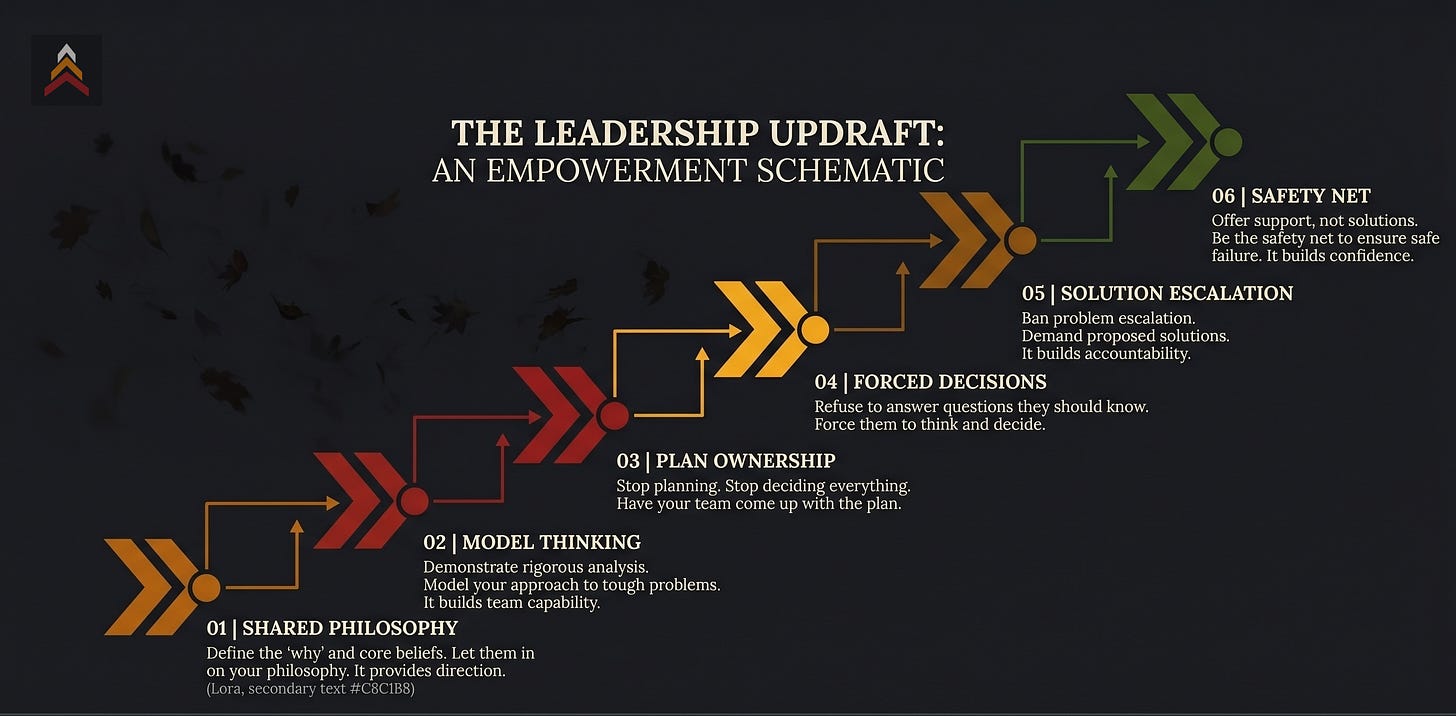
Stop answering questions you want your team to know the answers to.
Handing out answers isn’t teaching. You have to force people to navigate the friction of a good question instead. (Paul and Elder 2006)
When your team asks a question they should know, do not give the answer right away. Help them think instead.
Ask pointed questions like:
-
“How could you find the answer?”
-
“Who could help you learn this?”
-
“What would you search for first?”
Hold the line while they figure it out. Be their sounding board, not their search engine.
Have your team come up with the plan.
Knowles proved in 1975 people learn faster and engage more when they actually build the plan themselves. You want engagement? Stop handing down finished solutions.
When your team has a problem, do not give them the plan right away. Help them think of the plan first.
Ask questions like:
-
“What do you think we should do?”
-
“What is your plan?”
-
“How would you solve this?”
Set the parameters, step back, and let them execute. If their plan can work, trust them to try it. Praise good ideas and help your team grow.
Model your thinking for the tougher problems.
Lev Vygotsky’s 1978 research on the "zone of proximal development" boils down to this: people only master the hard stuff when you stand right next to them and guide them through the reps. There’s a difference between leading in front of and leading alongside.
When problems get bigger and harder, your team may need more help. Work through the problem with them and show them how you think.
You can say:
- “Your plan looks good. Let’s think through it together.”
Let your team lead the work while you support them. Be patient and teach them new skills. Over time, your team will learn to solve hard problems on their own.
Stop rewarding the complaint department.
B.F. Skinner beat this into our heads in 1953 with operant conditioning. People repeat the behaviors you reward. Period. If you reward your team for outsourcing their thinking to you, that’s exactly what they’ll keep doing.
Good leaders push their teams toward solutions. When your team shares ideas and thinks hard, support and praise them.
If someone brings you a problem, listen, help them think of a solution, and support them as they try it. Over time, your team will get better at solving problems on their own.
Be the safety net.
Amy Edmondson’s 2019 work on psychological safety proves that teams only take risks and grow when they know an honest mistake won't get their heads bitten off.
Do not give your team a problem and then leave them alone. Stay there to help and support them.
If something goes wrong, do not blame them. Take ownership and help them learn from the mistake.
Your team needs to feel safe to try, fail, learn, and try again. You don't build a team by protecting them from failure. You build one by making failure survivable.
Let them in on your philosophy.
Bass showed us in 2006 that if you want a team that actually functions, you have to let them in on the "why." Hiding your rationale behind a leadership curtain just breeds confusion.
Do not just push problems back on your team without helping them. Explain why you are asking questions and let them know you are there to support them.
You can say:
- “I want to help you learn to solve this on your own, and I’ll help if you need me.”
Tell them exactly what you're doing. Leadership isn't a magic trick; let them see the mechanics so they can actually step up.
Build the team that doesn't need you. Then watch what they build.
~d
References
Bass, Bernard M., and Ronald E. Riggio. Transformational Leadership. 2nd ed. Mahwah, NJ: Lawrence Erlbaum Associates, 2006.
Edmondson, Amy C. The Fearless Organization: Creating Psychological Safety in the Workplace for Learning, Innovation, and Growth. Hoboken, NJ: Wiley, 2019.
Knowles, Malcolm S. Self-Directed Learning: A Guide for Learners and Teachers. New York: Association Press, 1975.
Paul, Richard, and Linda Elder. The Thinker’s Guide to Socratic Questioning. Dillon Beach, CA: Foundation for Critical Thinking Press, 2006.
Skinner, B. F. Science and Human Behavior. New York: Macmillan, 1953.
Vygotsky, Lev S. Mind in Society: The Development of Higher Psychological Processes. Cambridge, MA: Harvard University Press, 1978.

Dan is co-founder of Kestryl Edge, a leadership development consultancy helping operations-heavy companies reduce turnover and rework through emotional intelligence. Work with us →
Enjoyed this? Subscribe to The Updraft on Substack for more.
Originally published at dankorus.substack.com. The Updraft is the canonical home for this piece.