
Fuck, Marry, Kill - Startup Success, Organizational Design, Emotional Intelligence
What matters most in the startup journey.
Startups are the lifeblood of innovation. They are where bureaucracy goes to die, where rules are challenged and broken, and where people from different backgrounds band together to build something new in the name of progress.
Lina and I both come from the startup world. We were baptized in the chaos of building and trained in the ancient art of wearing every hat at once.
Together, we wrote this piece on what matters most in the startup journey: the interplay between organizational design, emotional intelligence, and the conditions a company needs to thrive.

Lina gets the floor first.
Organizational Design – Lina
Good, emotionally intelligent bosses are great. Nobody really wants to work for somebody they don’t like. But there is something else that’s just as important: organizational design. You see, the research (and, to be honest, my own experience) has shown that companies that don’t implement sound organizational design struggle to retain talent.
And it does make perfect sense.
Having a “bad” boss is not great, we all know that, but while many people experience it as a nuisance they bond with their colleagues over, it’s usually the culture and system that eventually wear them down.
Employee #3. A Dream Job. But Sadly, Not Forever.
Several years ago, I joined a small company (as an employee #3!) where my job description was more suggestion intentionally crafted role. Believe it or not, I enjoyed it greatly. In fact, I enjoyed it so much that I’d boast to all my friends about how great I had it.
I was growing and learning at a tremendous speed, picking up skills I hadn’t even planned to even learn, figuring things out in real time, and building things from scratch. Badly at first, of course, but it was a school I didn’t know I wanted. I also had the opportunity to be involved in nearly all areas of the business and figure out what I liked and didn’t like in each of them. To sum up, I was getting paid to do work I enjoyed and learn new things along the way. It felt more like a dream than a job.
The company culture itself was questionable, however. And I didn’t necessarily see eye to eye with my boss (and that mattered to me), but I enjoyed the role itself so much that I ignored everything else.
Of course I did. We can’t have it all, after all.
The company eventually grew. More people joined, roles became more specific, and mine narrowed. At first, I felt relieved. I had been overworked, worked overtime regularly, and often couldn’t find time to eat, so having a clearer scope and people taking over parts of my work felt like a gift.
But what happened later was something I couldn’t have expected.
Because I had been there the longest, I became the person responsible for the critical things only I knew how to do. So over time, my role shifted into something where I was doing the most valuable work for the company, and the least interesting work for me.
I was spending most of my time updating spreadsheets, managing logistics, and tracking expenses. And, listen, I’m not a spreadsheet girlie. I started as a creative marketer – I loved nice pictures and engaging words.
We had conversations. We looked for ways to fix it. But I eventually accepted that there was no way forward. I no longer enjoyed my job or found meaning in it, and the culture and systems of the organization itself had become much more prominent in my experience.
So I started to feel stuck. My motivation and engagement hit rock bottom. I tried everything to stay motivated. And every single morning I’d manage it, right up until I walked through the door. Every time.
But the thing is, I had some shares I could’ve exercised if the company exited. The team was working hard toward that.
I wanted them.
But apparently not enough.
After a long time of deliberation, I quit.
And said goodbye to the shares that may or may not have been worth something in the future.
The Part I Only Figured Out After I Left
Here’s the thing I realized afterward, though. It wasn’t my boss that was the main character in this story.
My role was the painkiller. While it was working, I couldn’t feel anything else. But when it stopped fitting me, everything I’d been ignoring suddenly came into focus, the culture, the way decisions got made, what got rewarded, who got developed, how communication happened, what was prioritized. The whole room, basically.
And I realized I didn’t really vibe with any of it.
I’d hear my friends talking about their workplaces and how well their companies took care of them. And I was jealous.
There’s a name for what happened to me. Hackman and Oldham’s Job Characteristics Model says five things make people like their work: doing different kinds of things, seeing how your piece fits the whole, knowing it matters, having some say in how you do it, and knowing how you’re actually doing (Hackman, 1976).
Strip enough of them away and the work stops feeling meaningful, regardless of how much you loved it before.
The startup phase accidentally gave me all of them. The growth phase accidentally took most of them away. And once they were gone, I suddenly started to care about everything else.
Here’s what I now understand about organizations: it’s never just one thing – a role, a boss, a salary, or whatever.
When I look back at that startup, what I actually see is a whole system that nobody designed properly.
Galbraith had a model for this kind of thing - five elements that need to work together, and in my old company, I don’t think most of them did. Strategy that shifted before everyone got clarity on the previous one. A structure where the org chart and the actual power had nothing to do with each other. Decisions that happened to you rather than with you. Rewards that celebrated the wrong things. Growth that meant surviving the next sprint, not becoming better at your job.
All of it together creates the work culture. And once I could see it, I couldn’t un-see it.
That’s just how most startups are built - in a hurry, on instinct, with good intentions and no time to think.
But intentional org design doesn’t require a big company or a fancy consultant - it just requires someone who wants to make things work well together for the people inside it.
The Burning Room
Low emotional intelligence makes people not want to work for you in the first place (and makes sure they tell everyone about it when they leave).
But lousy organizational design does something more damaging: it loses the people who’d otherwise wanted to stay.
Emotionally intelligent leaders are more likely to notice when their design is failing their people and do something about it. They may not be equally important in theory, but without intentional org design, even the warmest, most likeable leader is just holding a good conversation in a burning room that nobody wants to be in.

[Typical day at work in startups :D]
Emotional intelligence - Dan
Technical intelligence can invent. Unreasonable people can dream. Emotional intelligence gets other people to build, buy, trust, endure, and believe, carrying the dream into reality.
Credentials ain’t it.
Startups fail when we mistake credentials for leadership capacity.
I live in Los Alamos, New Mexico, a town with the highest concentration of PhDs per capita.
When I started coaching CrossFit on the side, I began to learn the community and found out quickly where I was. A deadlift diagram I drew to explain core bracing turned into a heated discussion about moment arms, height disadvantages, and the force required per inch of athlete to lift the same weight.
I shit you not, someone pulled out a graphing calculator during my warm-up brief.
Step aside, gym bros. The engineers are talking, and their force calculations do not care about your partial reps.
Around here, you hear particle physics in the grocery store. You see chemical structure tattoos. NASA mission bumper stickers. The air itself smells like peer review and impact factor.
I share this because I want you to understand the water I swim in. I know what it feels like to be surrounded by people who are much more formally educated than I am.
And after five+ years of coaching, I’ve learned something startup culture still gets wrong: education and character are not the same thing.
The most credentialed people are not always the easiest to teach. They are not always the quickest to listen. They are not always the ones who show up, take feedback, adjust, and do the work.
Sometimes they are.
Often, they are not.
That matters because startup culture worships credentials. Founders often have graduate degrees. C-suites are full of them. And to be clear, a graduate degree is not nothing. It means you survived a difficult intellectual gauntlet. It means you developed advanced skills.
In my case, it means I know a thing or two about nanoparticles and can build one hell of a spreadsheet.
It does not mean I know how to hire, coach, give a performance review, repair trust, sell a vision, or lead people through uncertainty.
Giving a chalk talk is not founder sales.
Writing a research report is not a pilot proposal.
Technical skill overlaps with leadership, but the overlap is small.
Very small.
This is not an argument against education. It is an argument against confusing education with leadership.
You can be smart. Really smart. Fabricate-a-durable-solar-cell-from-trash-in-your-microwave smart.
But if you are a prick, if you cannot read the room, if you cannot bring people with you into the future, no one will follow you for long.
A room full of brilliant people does not automatically become a brilliant team. Woolley and colleagues found that group performance was not simply explained by the summed intelligence of individual members, but was more strongly linked to social sensitivity and inclusive participation in conversation (Woolley et al., 2010).
That is the thing emotional intelligence makes possible: who notices tension, who makes space, who can read what is happening before it becomes a fire.
That invisible field matters. Psychological safety is linked across teams to stronger learning, performance, information sharing, and engagement outcomes (Frazier et al., 2017).
That matters even more in startups, where ideas, hopes, and dreams are the product before the product is the product. Research on new venture teams found that ‘shared leadership’ predicted startup performance, including revenue and employee growth, which means companies scale when leadership moves through the team (Ensley et al., 2006).
Cults.
Startups are cult-like by nature.
Not always in the sinister way. But structurally? Absolutely.
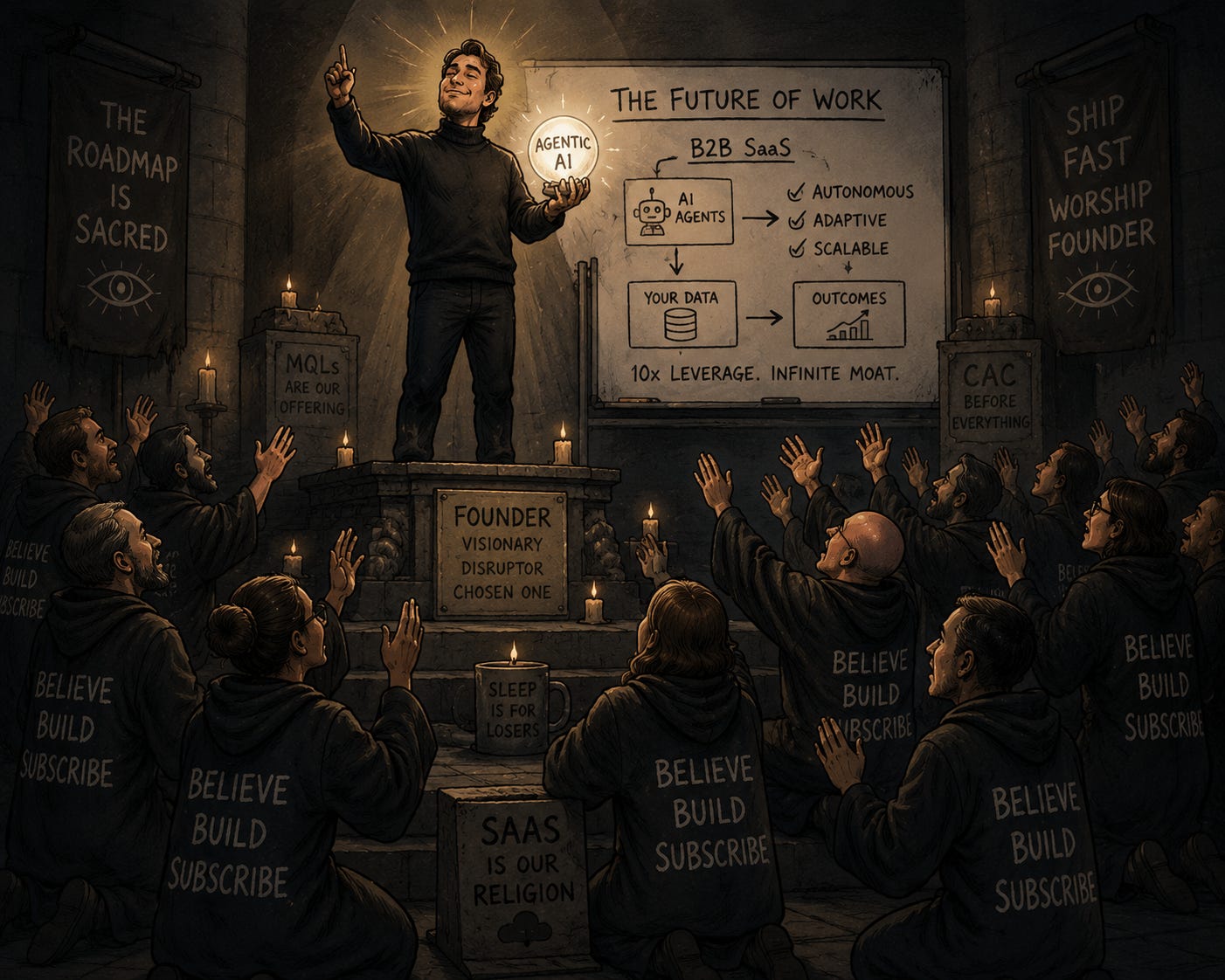
Our B2B SaaS enables business AI to bring agentic AI to your business. Then your business will have AI business leverage for your AI. And THAT’s Clarity.
Startups have origin myths. Sacred language. Rituals. Heroes. Enemies. A promised future. A tiny group of believers trying to convince the rest of the world that reality is about to change.
It’s part and parcel of their power to disrupt.
You almost have to build a belief system before you build a company, because in the beginning there is not much else to hold onto. There is no massive customer base. No stable process. No guarantee the thing will work. Often, no thing itself.
There is just a room full of people staring at uncertainty and deciding, together, not to blink.
And belief is dangerous.
The same force that helps a team endure can also be used to excuse harm. The mission becomes a muzzle. Loyalty begets silence. Sacrifice becomes exploitation. The founder’s vision can become a fog machine that hides the fact that people are exhausted, afraid, or being asked to confuse abuse with commitment.
CUE: ENTRANCE
From stage left, EMOTIONAL INTELLIGENCE walks onto the stage.
Deliberate. Calm. Unbothered.
It reaches the conference TABLE.
[A beat]
Then flips TABLE.
Q1 strategy decks, copies of Traction, and EOS scorecards explode into the air.
Emotional intelligence is the discipline of noticing what your belief system is doing to the people inside it. It is knowing when conviction has become coercion. When urgency turns into panic.
When standards become humiliation. When loyalty has become fear.
Because a startup needs belief.
Belief without emotional intelligence becomes a cult.
Belief with emotional intelligence becomes culture.
Not a soft skill.
Emotional intelligence creates the psychological safety that lets people tell the truth, challenge
bad assumptions, admit mistakes, and keep moving when the work gets ugly.
It is not the bedrock
or the foundation
or the pillars
or even the allegorical roof.
It is motherfucking gravity.
It is the invisible force that holds people together when life sucks. It is how you know you said the wrong thing. It is how you show up when things are unorganized, uncertain, and you are stressed to your wits’ end.
It is not a soft skill.
It is the hardest skill there is.
And for whatever asinine reason, most colleges do not teach it.
That is why startup culture keeps flattering technical founders into confusing brilliance with leadership. They were trained to think.
Not to lead.
You have to be unreasonable to build something new. A little delusional, too. Different is beautiful. Different is how we see futures other people have not made room for yet. But big dreams do not move by themselves. You cannot manifest them alone. You need allies.
You need people willing to lend their time, talent, reputations, and nervous systems to a future that does not exist yet. That is the founder’s real job.
Converting uncertainty into conviction. Fear into action. Conflict into collaboration. Talent into momentum. A private dream into a shared reality.
And that is why emotional intelligence is gravity.
You do not always see it, but you know when it is gone.
The room starts floating apart. The smartest people stop telling the truth. The quiet people
disappear first. Bad ideas survive because challenging them feels unsafe. The mission gets
louder and the culture gets weaker.
Brilliant ideas die when people stop believing, stop trusting, and stop following.
The best ideas do not carry companies.
People carry companies.
And emotional intelligence is what keeps them from letting go.
Share this post with another leader.
Authors
Lina
Lina spent 12 years inside startups and small companies. Now she helps founders fix messy, unclear ways of working by designing human-centred systems where people can do their best work and not lose themselves in the process.
Dan
Dan writes The Updraft, a publication on management science for leaders in high-reliability environments. Chemist. Ultra-marathoner. Founder @ Kestryl Edge, LLC.
References
Galbraith, Jay R. Designing Organizations: An Executive Briefing on Strategy, Structure, and Process. San Francisco: Jossey-Bass, 1995.
Hackman, J. Richard, and Greg R. Oldham. “Motivation through the Design of Work: Test of a Theory.” Organizational Behavior and Human Performance 16, no. 2 (1976): 250–279. https://doi.org/10.1016/0030-5073(76)90016-7.
Ensley, Michael D., Keith M. Hmieleski, and Craig L. Pearce. “The Importance of Vertical and Shared Leadership within New Venture Top Management Teams: Implications for the Performance of Startups.” The Leadership Quarterly 17, no. 3 (2006): 217–231. https://doi.org/10.1016/j.leaqua.2006.02.002.
Frazier, M. Lance, Stav Fainshmidt, Ryan L. Klinger, Amir Pezeshkan, and Veselina Vracheva. “Psychological Safety: A Meta-Analytic Review and Extension.” Personnel Psychology 70, no. 1 (2017): 113–165. https://doi.org/10.1111/peps.12183.
Woolley, Anita Williams, Christopher F. Chabris, Alex Pentland, Nada Hashmi, and Thomas W. Malone. “Evidence for a Collective Intelligence Factor in the Performance of Human Groups.” Science 330, no. 6004 (2010): 686–688. https://doi.org/10.1126/science.1193147.
Dan is co-founder of Kestryl Edge, a leadership development consultancy helping operations-heavy companies reduce turnover and rework through emotional intelligence. Work with us →
Enjoyed this? Subscribe to The Updraft on Substack for more.
Originally published at dankorus.substack.com. The Updraft is the canonical home for this piece.