
The Official Meeting Playbook for Leaders Who Want High Performance Results Without Turning Into A Stinky Corporate Goblin
Super Official. Super Playbook. Mount up! Tonight, we fly.

In high-consequence work, meetings are where risk moves around the room until someone either owns it, hides it, misunderstands it, or accidentally turns it into a quarterly initiative.
If you manage a team doing important work, safety-critical work, expensive work, or reputational-risk work, then some meetings are necessary and should be navigated with care.
Meetings are control surfaces.
A good meeting changes the state of reality.
Remember, if nothing changed, you didn’t have a meeting.
So! Here are the tools: specific ways to shape a meeting’s outcome without becoming the person everyone privately refers to as “that guy.”
1. Write the outcome before you invite the humans
Before you schedule anything, write this sentence:
“We are meeting to ______.”
If you cannot finish that sentence cleanly, do not send the invite.
Good answers:
“We are meeting to decide whether to delay launch.”
“We are meeting to choose between three staffing plans.”
“We are meeting to surface the top risks before we commit budget.”
Bad answers:
“Sync.”
“Touch base.”
“Discuss.”
“Quick huddle.”
A meeting without an outcome is just a calendar-shaped fog machine.
For high-consequence teams, the outcome should be specific enough that someone can tell whether the meeting worked. Not whether people spoke. Not whether the senior person nodded. Whether the work moved.
Tool: Put the desired outcome in the invite title or first line of the agenda.
“Decision needed: Launch date for Project Peregrine.”
Beautiful. Adult. Slightly arousing to people who respect calendars.
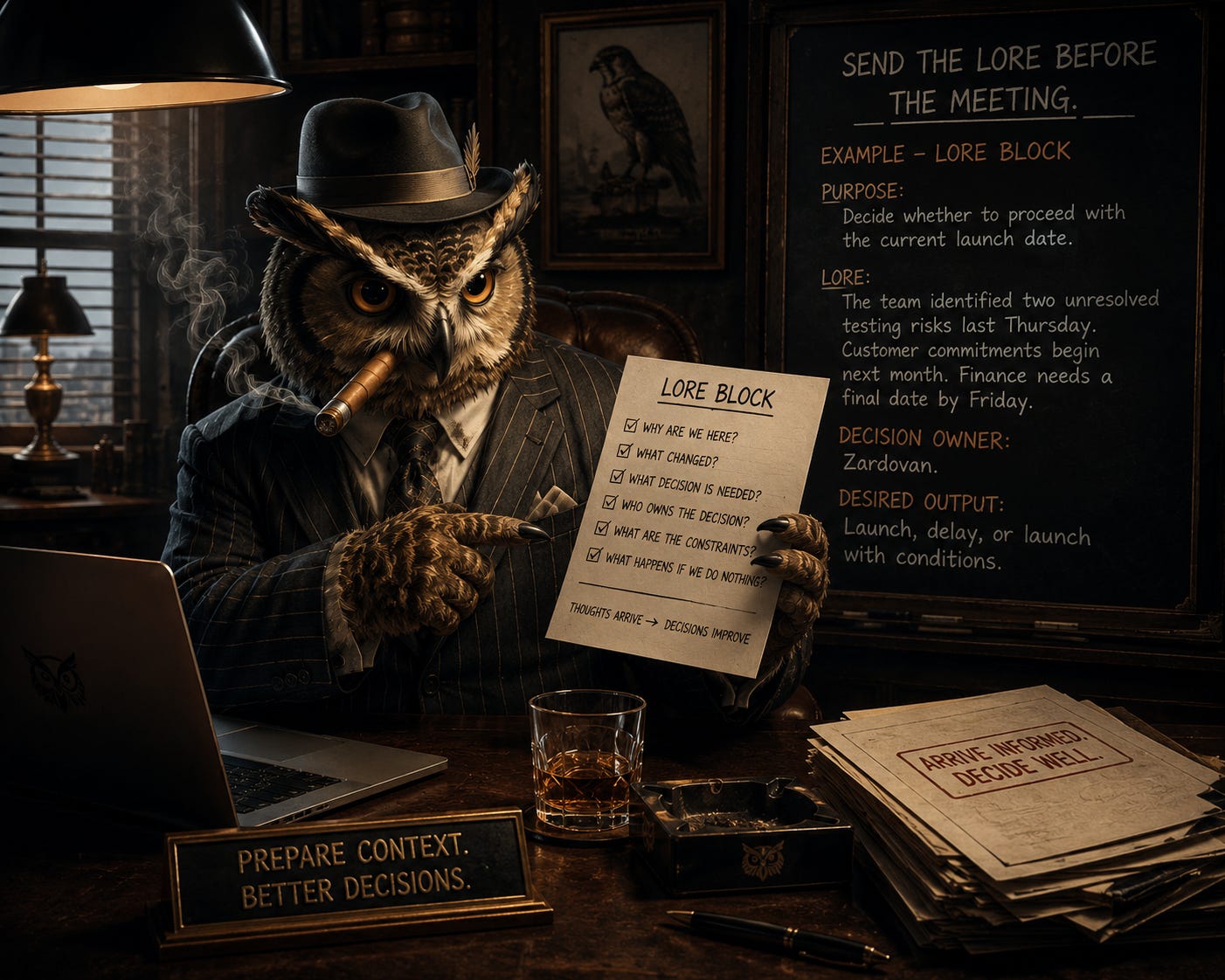
2. Send the lore drop
People make better decisions when they are not forced to reconstruct the entire history of the problem live, while Diva Dave shares his screen and says, “Can everyone see this?” for the fourth time.
Send the lore before the meeting.
The lore is not a 900-page archaeological dig. It is the useful backstory:
Why are we here?
What changed?
What decision is needed?
Who owns the decision?
What are the real constraints?
What happens if we do nothing?
This matters especially when the stakes are high. You do not want people learning the context and making the decision in the same breath. This is precisely how groups end up confidently choosing the organizational equivalent of gas station sushi.
Tool: Add a “lore block” to every serious meeting invite.
Example:
Purpose: Decide whether to proceed with the current launch date.
Lore: The team identified two unresolved testing risks last Thursday. Customer commitments begin next month. Finance needs a final date by Friday.
Decision owner: Zardovan.
Desired output: Launch, delay, or launch with conditions.
Now people arrive with thoughts already thunk.
3. Pre-wire the room
Pre-wiring is what happens before the walls go up.
In meetings, it means talking to key people before the meeting so the actual meeting is not the first time anyone hears the proposal, objection, data, or political landmine.
It sounds shady. It is not shady. It is responsible leadership.
Before a high-stakes decision, talk 1:1 with the people who can block, improve, or detonate the outcome. Ask them what concerns they have. Ask what would make the decision easier. Ask what they need to see.
You are not asking for blind agreement. You are making sure the room does not blow up on you.
Tool: Before the meeting, identify:
Who can say yes?
Who can say no?
Who can say “yes” but later slow-roll it into a swamp?
Who has the missing context?
Who will be affected but not invited?
Pre-wire those people.
If the first serious objection appears during the meeting, that may be bad luck. If the seventh serious objection appears during the meeting, that signals insufficient preparation on your part.
4. Frame the problem before the room frames it for you (yee-ing the haw before the haw yees you)
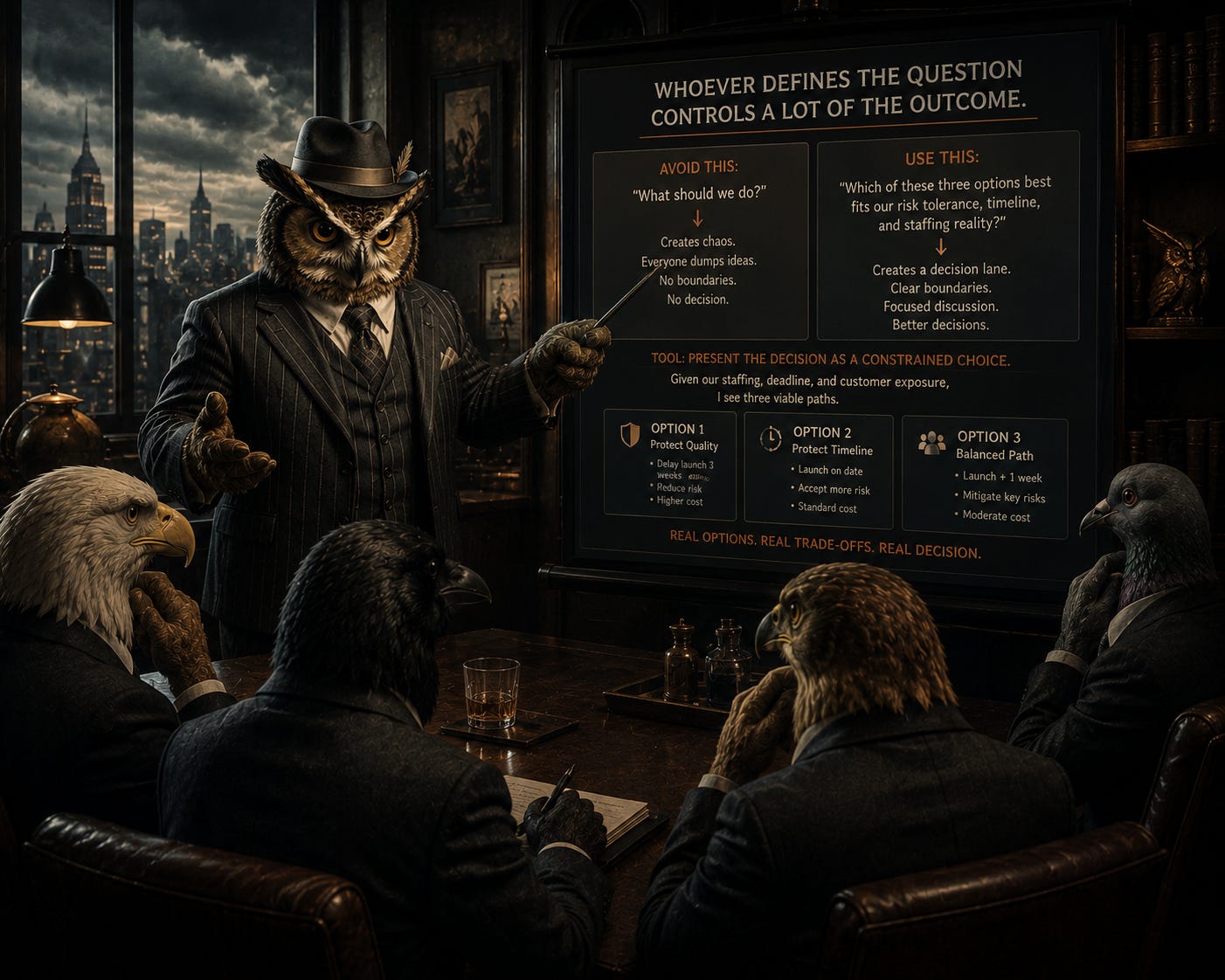
Whoever defines the question controls much of the outcome.
“What should we do?” creates chaos.
“Which of these three options best fits our risk tolerance, timeline, and staffing reality?” creates a decision lane.
The first version invites everybody to dump their favorite pet idea onto the floor.
The second version gives the room boundaries.
Done honestly, this is not manipulation. Your job is not to let every conversation spiral beyond productive bounds.
Tool: Present the decision as a constrained choice.
e.g. “Given our staffing, deadline, and customer exposure, I see three viable paths.”
Then list them. Have them written on your slide already.
Make sure the options are real. Do not create one good option and two scarecrows stuffed with budget dust and b.s. gantt charts. People can smell that. Especially the quiet thinkers in the room. They know.
5. Put your preferred option in daylight
If you have a recommendation, say so.
Too many managers pretend to be neutral while quietly praying folks will decide in their favor after presented a reasonable data set.
“I’m open to anything,” they say, while the deck somehow spends 26 slides explaining why Option B is basically a civic duty.
Just say what you think.
“My recommendation is Option B because it reduces launch risk without blowing up the customer timeline. I welcome alternatives and adjustments.”
That is clean. People know where you stand. They also know disagreement is allowed because you invited them to test it.
Tool: Use this phrase:
“My current recommendation is X. I want us to test whether that holds.”
Guide the room without pretending you floated in as a sweater vest dawned paragon of neutrality.
6. Use time as a pressure dial
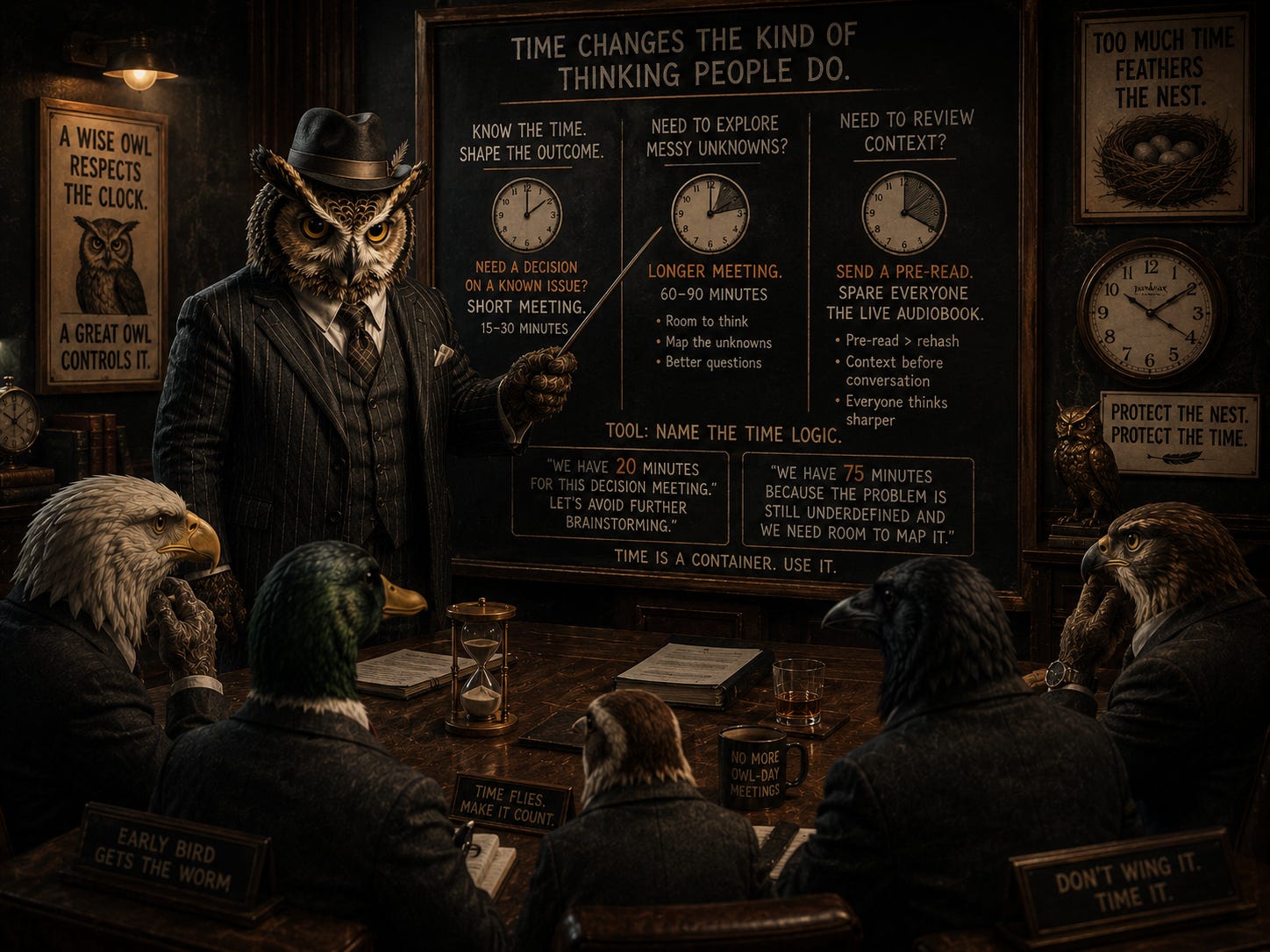
Time changes the kind of thinking people do.
A 15-minute meeting forces prioritization.
A 90-minute meeting invites wandering, throat-clearing, legacy grievances, and someone saying, “Just to piggyback…”
For high-consequence work, do not default to short or long. Choose the time based on the type of thinking required.
Need a decision on a known issue? Short meeting.
Need to explore messy unknowns? Longer meeting.
Need to review context? Send a pre-read and spare everyone the live audiobook.
Tool: Name the time logic.
“We have 20 minutes for this decision meeting. Let’s avoid further brainstorming.”
Or:
“We have 75 minutes because the problem is still underdefined and we need room to map it.”
Time is a container and can be used to your advantage.
7. Manufacture shared understanding, not fake consensus
There is a dangerous little spell people cast in meetings:
“It sounds like we’re aligned.”
Sometimes that is true.
Sometimes that means three loud people agree, two people are confused, one person is silently horrified, and the person with the most relevant expertise is waiting for oxygen.
Unless you’re feeling evil, your job is not to pretend the room agrees. Your job is to find out what kind of agreement you actually have.
Tool: Use alignment checks.
“Before we call this aligned, I want a quick round. Support, oppose, or concerns?”
“Is anyone seeing a risk that would change the decision?”
“Who has to execute this and thinks we’re missing something?”
This is where mature teams separate themselves.
You do not need everyone ecstatic. You need to know whether the decision is understood, owned, and survivable. You need to know what you don’t know.
8. Pull objections into the light early
Unspoken resistance is expensive.
It does not disappear because you avoided eye contact with it. It goes underground, grows mushrooms, and reappears three weeks later as “concerns from the team.”
Ask for objections directly.
Not performatively. Not “any concerns?” while already closing your laptop.
You have to actually ask.
Rool: Try these:
“What would make this fail?”
“What are we not saying?”
“Where are we underestimating the work?”
“If you had to argue against this plan, what would you say?”
“What concern would you raise after the meeting if you didn’t raise it now?”
That last one is a bit spicy. Spicy can be fun. Use responsibly.
Any leader worth their salt knows objections are not disloyalty. Objections are part and parcel with high performance the safety systems that uphold it.
9. Manage the room like it matters
Open discussion is not always noble. Sometimes open discussion is just open mic night for the highest verbal metabolism.
As uncomfortable as it can be asking someone to pipe down or pipe up… you have to manage participation.
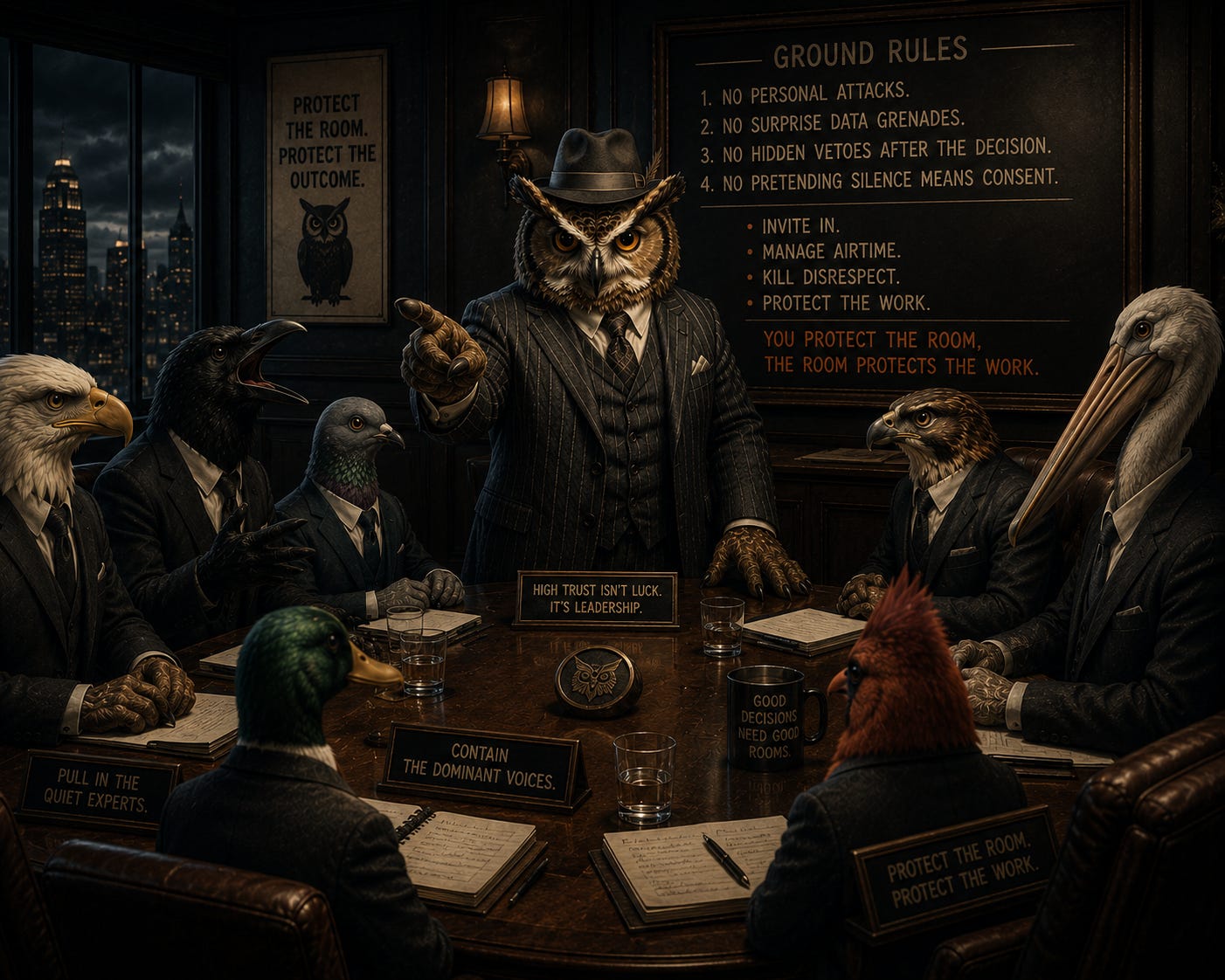
Pull in the quiet experts. Contain the dominant voices. Stop drive-by sarcasm. Kill disrespect early.
If someone has not spoken and they own a key part of the work, invite them in.
“Jordan, you’re closest to implementation. What are we missing?”
If someone is taking too much air:
“That’s useful. I want to pause there and hear from people who haven’t weighed in.”
If someone is being rude:
“That doesn’t fit how we’re going to work this conversation. Rethink and rephrase, or we’re moving on.”
Tool: Decide your ground rules before you need them.
No personal attacks.
No surprise data grenades.
No hidden vetoes after the decision.
No pretending silence means consent.
High-trust rooms do not happen because everyone is nice. They happen because someone protects the room.
10. Write the decision where everyone can see it
There is power in the pen.
If you write the decision live, the room has something to react to, edit, confirm, or challenge.
This reduces the classic meeting disease where everyone leaves with a different movie playing in their head.
Tool: Keep a visible meeting manifest.
Capture:
Decision made
Owner
Due date
Open risks
Follow-up actions
Unresolved questions
Use plain language. No corporate incense.
Bad note:
“Team aligned on next phase enablement.”
Good note:
“Decision: Delay launch by two weeks to complete testing. Gonzobo owns revised timeline by Thursday. Maldorfus owns customer communication draft by Friday.”
One of those can run a team.
The other belongs in a cursed slide deck.
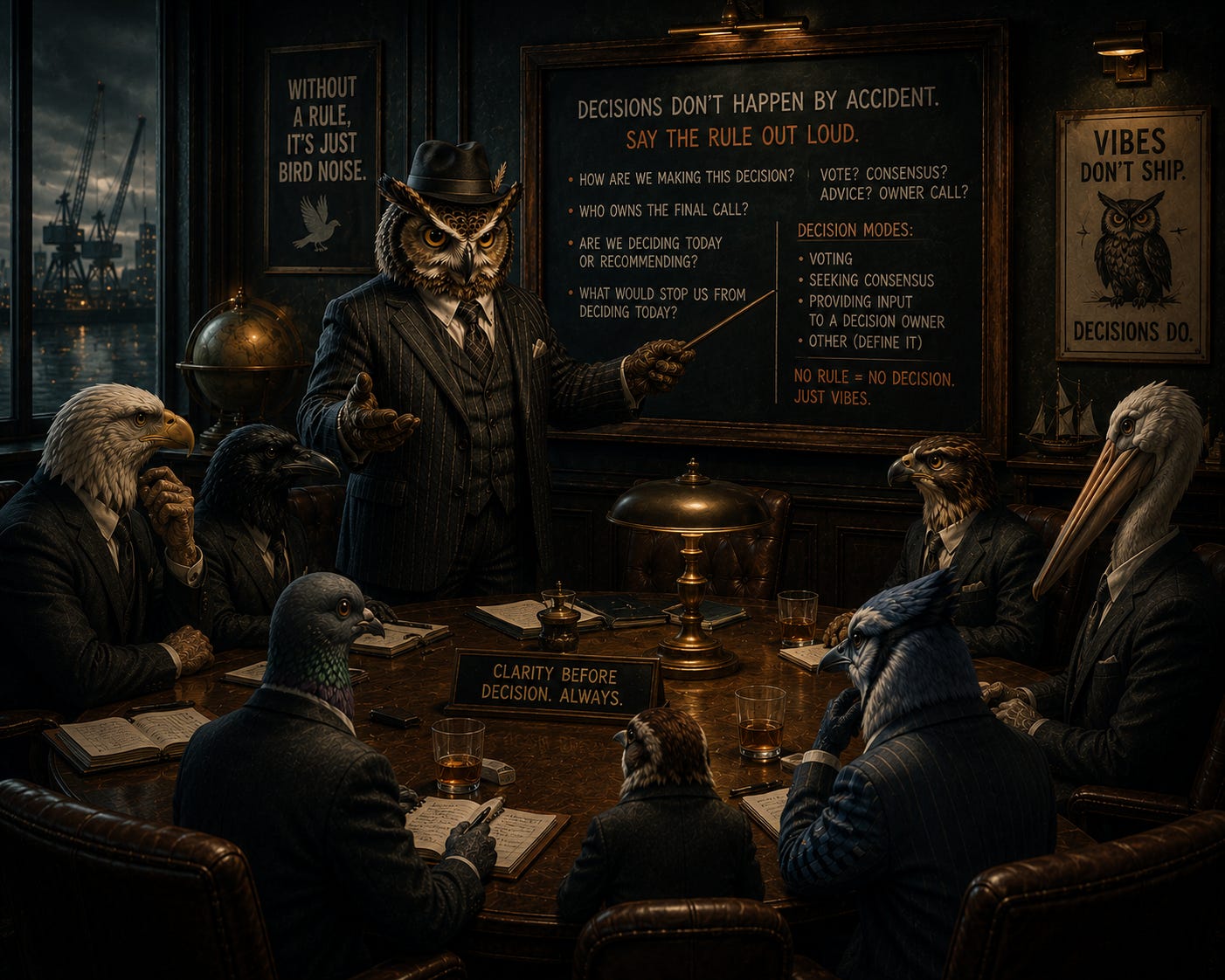
11. Make the decision rule explicit
A lot of meeting weirdness comes from nobody knowing how the decision is being made.
Are we voting?
Advising?
Seeking consensus?
Giving input to one decision owner?
Letting the loudest interrupter slowly absorb the room?
Say the rule out loud.
Tool: Ask:
“How are we making this decision?”
“Who owns the final call?”
“Are we deciding today or recommending?”
“What would stop us from deciding today?”
This prevents quiet power grabs and post-meeting revisionist history.
A decision without a decision rule is usually just vibes.
12. End with the next physical action
Never end a serious meeting with “great discussion.”
That phrase should set off sprinklers.
End with the next physical action. Not a concept. Not a hope. Not “circle back.”
A person doing a thing by a time.
Tool: Close every meeting with:
“What changed because we met?”
“Who owns the next step?”
“By when?”
“What needs to be communicated, and to whom?”
“What are we not deciding yet?”
If nobody owns anything, the meeting produced vapor.
If everyone owns something, nobody does.
If Dave owns it, Godspeed, and please put it in writing.
The line between leadership and dark arts
Yes, you can steer meetings.
You can pre-wire stakeholders. You can frame the decision. You can control the option set. You can use time pressure. You can write the conclusion as it forms. You can pull objections into the light at the right moment.
These tools work.
That is exactly why you need to use them with positive intentions.
The goal is not to trick the room into your preferred outcome. The goal is to help the room make the best available decision with the right people, the right context, and the right amount of pressure.
Sometimes that means pushing.
Sometimes that means slowing everything down.
Sometimes that means saying, “We are not ready to decide.”
That sentence can save millions of dollars, months of rework, and several people’s nervous systems.
A strong manager knows meetings are not about appearing in control. They are about creating the conditions where reality can enter the room without getting tackled by ego, politics, confusion, or Gusko from Finance saying “just playing devil’s advocate” for sport.
Meetings are a leadership instrument.
Play them badly and no one will want to listen.
Play them well and the team leaves sharper than they arrived.
No decision, no meeting.
No owner, no outcome.
No agendy, no attendy.
- Dan
Read Other Favorites from The Updraft


References
Rogelberg, Steven G., Desmond J. Leach, Peter B. Warr, and Jennifer L. Burnfield. “‘Not Another Meeting!’ Are Meeting Time Demands Related to Employee Well-Being?” Journal of Applied Psychology 91, no. 1 (2006): 83–96. https://doi.org/10.1037/0021-9010.91.1.83
Argues that meeting load and meeting quality affect employee well-being, especially when meetings feel like interruptions rather than useful coordination.
Nixon, Carol T., and Glenn E. Littlepage. “Impact of Meeting Procedures on Meeting Effectiveness.” Journal of Business and Psychology 6 (1992): 361–369. https://doi.org/10.1007/BF01126771
Provides claims about agendas, action planning, task focus, timeliness, open communication, and leader impartiality as drivers of effective meetings.
Leach, Desmond J., Steven G. Rogelberg, Peter B. Warr, and Jennifer L. Burnfield. “Perceived Meeting Effectiveness: The Role of Design Characteristics.” Journal of Business and Psychology 24 (2009): 65–76. https://doi.org/10.1007/s10869-009-9092-6
Explores how meeting design matters, especially agenda use, attendee involvement, and practical meeting conditions.
Kauffeld, Simone, and Nale Lehmann-Willenbrock. “Meetings Matter: Effects of Team Meeting Communication on Team and Organizational Success.” Small Group Research 43, no. 2 (2012): 130–158. https://doi.org/10.1177/1046496411429599
Argues that what people actually do in meetings, including problem-solving, action planning, complaining, and criticizing, predicts team and organizational outcomes.
Lehmann-Willenbrock, Nale K., Joseph A. Allen, and Simone Kauffeld. “A Sequential Analysis of Procedural Meeting Communication: How Teams Facilitate Their Meetings.” Journal of Applied Communication Research 41, no. 4 (2013): 365–388. https://doi.org/10.1080/00909882.2013.844847
Presents the idea that good meetings need visible process control: clarifying who will do what, when, and how the group will stay out of dysfunction-swamp.
The Updraft & Kestryl Edge
The Updraft is where I write my personal thoughts and reflections on leadership as I build the company Kestryl Edge. Kestryl Edge is a leadership training company that specializes in teaching emotional intelligence skills to teams working in high consequence technical environments.
We also have writing on our website! There you can read about Burnout, learn about our workshops, and listen to new episodes of our Podcast.
Grammatical edit made 20260706 AM.
Very well written piece! I have so many thoughts and memories of examples you gave. One of the things I like to do with my team is share the idea and instead of saying, “what do you think?”, I say, “here’s the idea, poke holes please.” It helps them start from a place of critical analysis, helping prevent any lazy agreements. I would also add that we need to consider if everyone invited really needs to attend and if the meeting truly could have been an email.