

Self Compassion Pyramid Schemes are for Punk Rock Sigma Winners
Let's make one. Bring paper, journal, your phone, and a writing utensil.

News flash! High performance requires self-compassionate habits.

Promise
A goal pyramid is an evidence-informed self-guided planning tool (completely free btw) that combines three things most goals don’t have, but need to be successful.
Do this activity and you will come away with:
One meaningful direction
One concrete target outcome
Supporting goals and repeatable actions to help you get there
A compassionate plan for restarting after a lapse
This Shit’s Worked My Whole Life.
In high school, I learned this method from an Olympian Nordic Skier and it helped me qualify for the Junior Olympics for Nordic skiing.
In college, this method helped me work a job, never miss a 4 AM rowing practice over four years, and earn an MS in chemistry with perfect marks.
Through this method I have published papers in the quantum dot and polymer field, I have world records to my name for novel solar window technology, and lately I’ve been using it to train for ultramarathons and build my company.
The Data
B.L.U.F. - Goal pyramids work by operationalizing several established principles of successful behavior change.
Research on goal hierarchies shows that we need a mixture of broad goals and supporting goals. (Höchli, Brügger and Messner, 2018)
Superordinate goals - broad and visionary.
Intermediate goals - outcome, strategy, or capability focused.
Subordinate goals - action focused, specific.
A meta-analysis of 94 tests found that implementation intentions produced a meaningful improvement in goal attainment. (Gollwitzer and Sheeran, 2006)
Monitoring progress helps! Another meta-analysis of 138 randomized studies showed that tracking actions and progress improved goal attainment. (Harkin et al., 2016)
Pyramid schemes are a thing for a reason. They work. (Korus, Dan. 2026)
Materials
2 pieces of printer paper A4 or 8.5” x 11”
Writing utensil.
Color, if, like me, you fuck heavy with crayons.
Methods
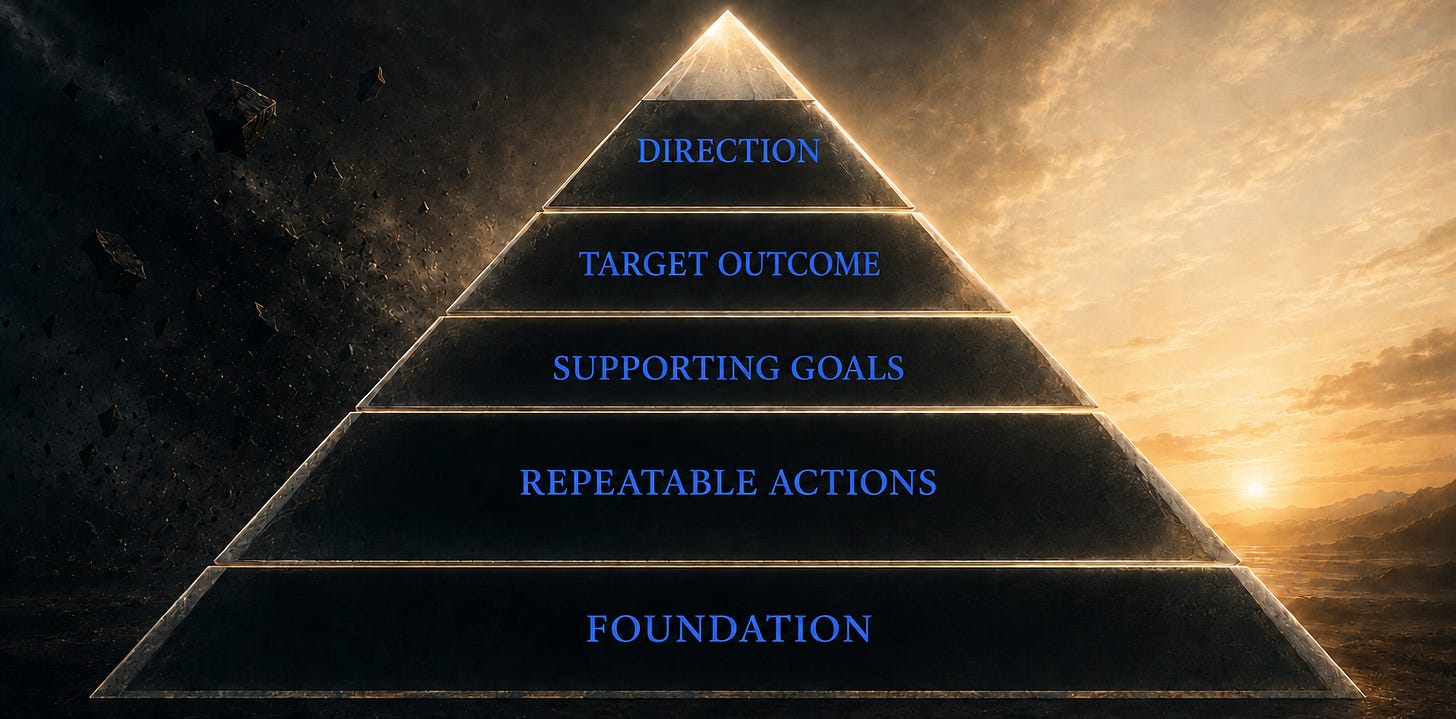
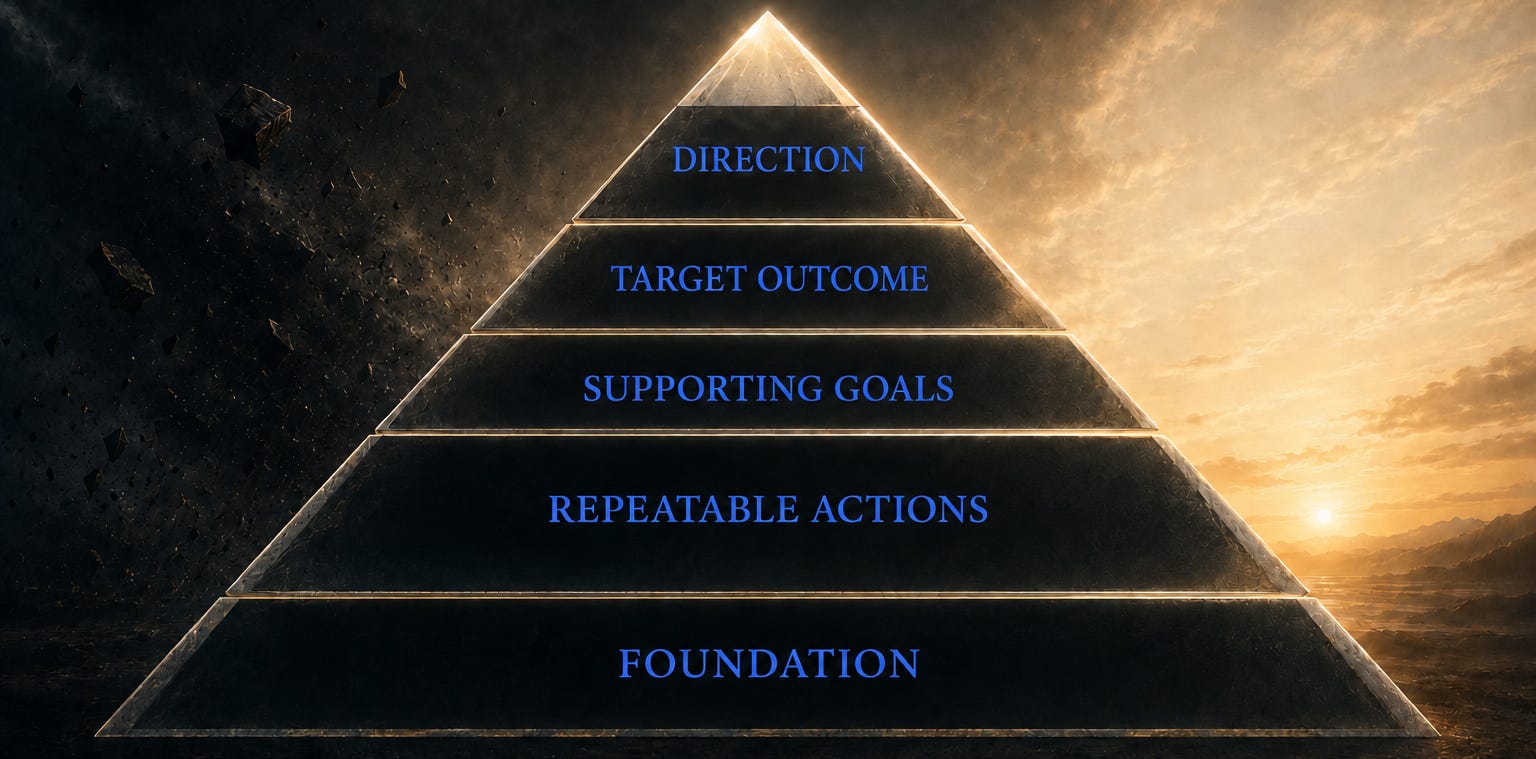
The goal pyramid will connect meaningful direction to the granular actions we need to take in order to make progress. Five levels total. From top to bottom:
Direction - What am I trying to build?
Target Outcome - What result would show me that I am making progress?
Supporting Goals - What conditions, strategies, or capabilities would help produce that result?
Repeatable Actions - What can I do? When do I do it?
Foundation - How do I support the behavior? How do I get back on the wagon when I fall off?
Each level supports the one above it.
The target outcome and supporting goals split the research’s intermediate-goal category into two practical levels: the result you want and the conditions that can help produce it.
Tracking, reviewing, and resetting are not another level. They form the feedback loop that helps you revise the pyramid as you learn.
Interlude - Breaking the Myth
Self compassion sounds pretty soft. It doesn’t sound like something the alphas are getting up to. Bubble baths, candles, and hoping that with this re-read of The Secret we’re going to manifest a promotion and THEN we can finally get that rest we need.
Let’s break that myth right now.
Self compassion is punk rock and the most gangster alpha shit you can get up to.
Self compassion is taking care of yourself when you’re tired. Picking yourself up when you fall in the mosh pit.
Doing the small, inconvenient thing that makes future-you stronger.
Pulling an Irish goodbye from the bar to go sleep.
Ignoring your phone even though people are still texting you.
Saying no because your plate is full.
Prioritizing the unglamorous:
Sleep. Food. Water. Movement. Recovery. Boundaries. Appointments. Repetition.
We live in a culture that constantly offers to sell us solutions to problems we made ourselves by neglecting the fundamentals. We’re sold supplements before sleep, recovery gadgets before stretching and sleep, productivity apps before boundaries, and expensive programs before a walk around the block.
Punk rock leadership means rejecting these norms.
We reject the notion that doing it all and running ourselves into the ground is glamorous.
We protect our well-being even when doing so is inconvenient, unpopular, or invisible.
Uh oh! Self Compassion is starting to look like discipline! ;)
Are you subscribed? Should you be?
Step One: Reflect
In our workshops, we like folks to work on:
Sleep
Transitions and decompression windows after working hours
Structured time for daily movement and exercise
If you’re nailing these three every day, I’d wager you know what you need to be working on next.
I am constantly trying to work on my sleep. Just because you’re working on the basics, is not a reflection of your worth or skill. This is a journey. And we need to work on the aspects that we need help with because life will shift the balance of our pyramids. Some months I’m great with sleep. Other months, my sleep slips and I become an insufferable bitch.
This is for you. Work on what YOU need.
Ponder these:
Write the answers on paper, based on the typical week.
Sleep
On average, how much sleep am I actually getting each night?
Are my sleep and wake times relatively consistent, or do they change dramatically?
What usually delays my bedtime?
When I wake up, do I generally feel rested?
Transitions and Decompression
When does my workday technically end? Mentally?
What happens between finishing work and going to bed?
What currently helps me come down after a demanding day?
Movement and Exercise
How many minutes of moderate/vigorous movement did I get last week?
On how many days did I do something that strengthened my muscles?
What kinds of movement make me feel better?
Attention and Screen Use
Pull out your phone and look at your screen-time report. What is your daily average? Most used app?
How much of your screen use happens during the hour before bed?
Is that time helping me recover and connect, or is it displacing sleep, movement, relationships, or something else I value?
Now, pretend you’re a coach.
Coaches focus on the biggest issue, solve it totally, and work our way down the list. Triage.
Ask:
Which area, if supported a little better, would create the most capacity in my life?
Then ask:
What is working?
What is creating friction?
What is in my influence?
Be curious, specific, and relentless.
Which area has the largest opportunity for improvement?
Step Two: Craft Your Superordinate Goal
At the pyramid top, we need meaningful direction.
A superordinate goal describes what you want to protect, build, or practice.
Examples:
Protect my energy so I can be present.
Build a strong and sustainable relationship with my body.
Use my attention deliberately.
Create meaningful separation between work and rest.
Build a consistent creative practice.
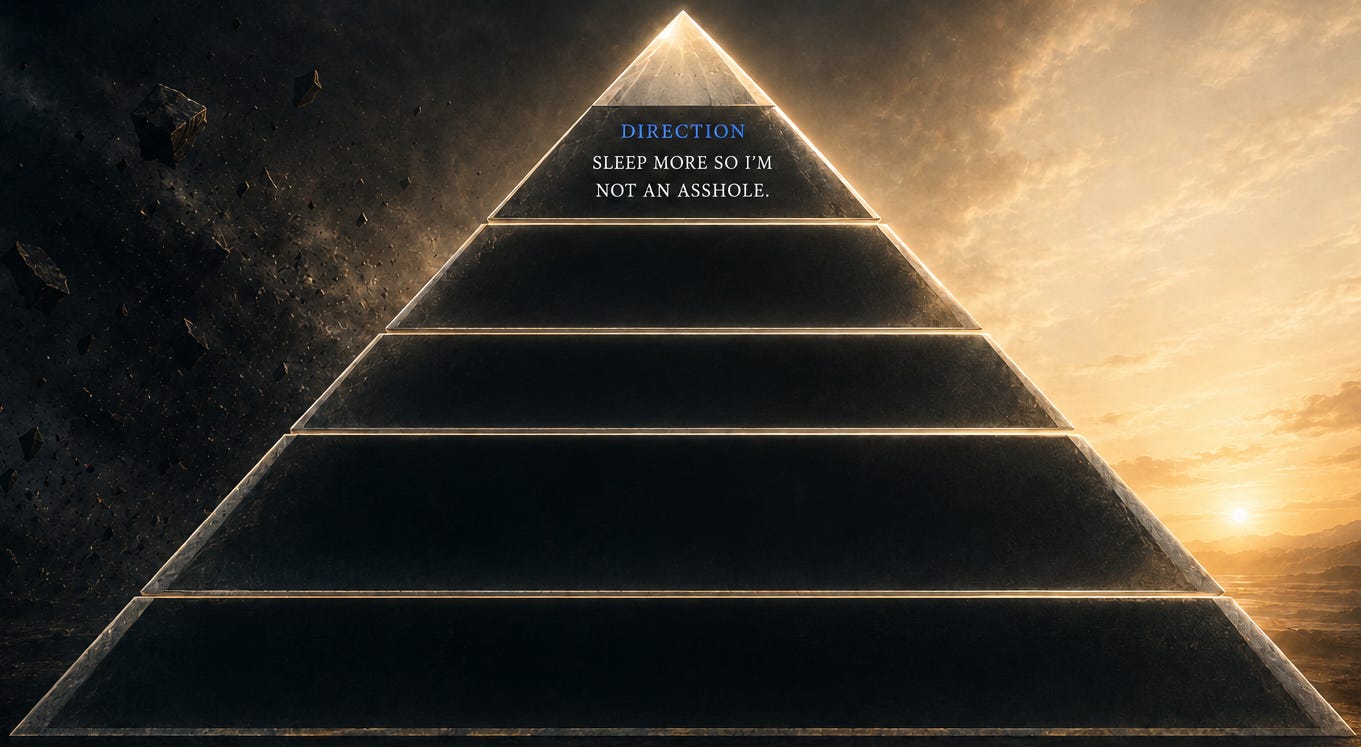
Rest more so I’m not an asshole.
You do not “hit” a superordinate goal. It acts as a compass for choosing the outcome, supporting goals, and actions underneath it.
Find the Deeper Goal
Write down the first goal that comes to mind. It will probably be too specific. Then we refine it.
Then ask:
Why does this matter?
Keep asking until you find the deeper direction.
Example: Sleep
First goal:
Sleep for 7+ hours a night.
Why?
I want more energy.
Why does that matter?
I want to think clearly and be more patient with the people around me.
Superordinate goal:
Protect my rest so I can show up with patience and presence.
Example: Movement
First goal:
Exercise for 30 minutes every day.
Why?
I want to feel stronger and remain physically capable as I age.
Superordinate goal:
Build a strong, capable, and durable body.
Example: Screen Use
First goal:
Use my phone less.
Why?
I want to decide where my attention goes.
Superordinate goal:
Use my attention deliberately instead of giving it away by default.
Share this with a homie who needs to find the deeper goal.
Write Yours
Complete a few of these sentences with a few variations:
I want to protect __________ so that __________.
I want to build a life in which __________.
I want to create more space for __________.
I want to use my __________ more deliberately.
I want to build a sustainable relationship with __________.
Then ask:
Does this actually matter to me?
Would it still be meaningful if my plan changed?
Can it guide more than one behavior?
Does it sound like punk rock care rather than brainwashed grind-bro punishment?
Circle one and write it at the top of your pyramid.
Don’t toss the specific goal you started with. You climbed above it to find your subordinate goal.
In the next step, you will bring it back down, refine it, and use it to define a target outcome.
Step Three: Craft Your Target Outcome
Superordinate goal = direction.
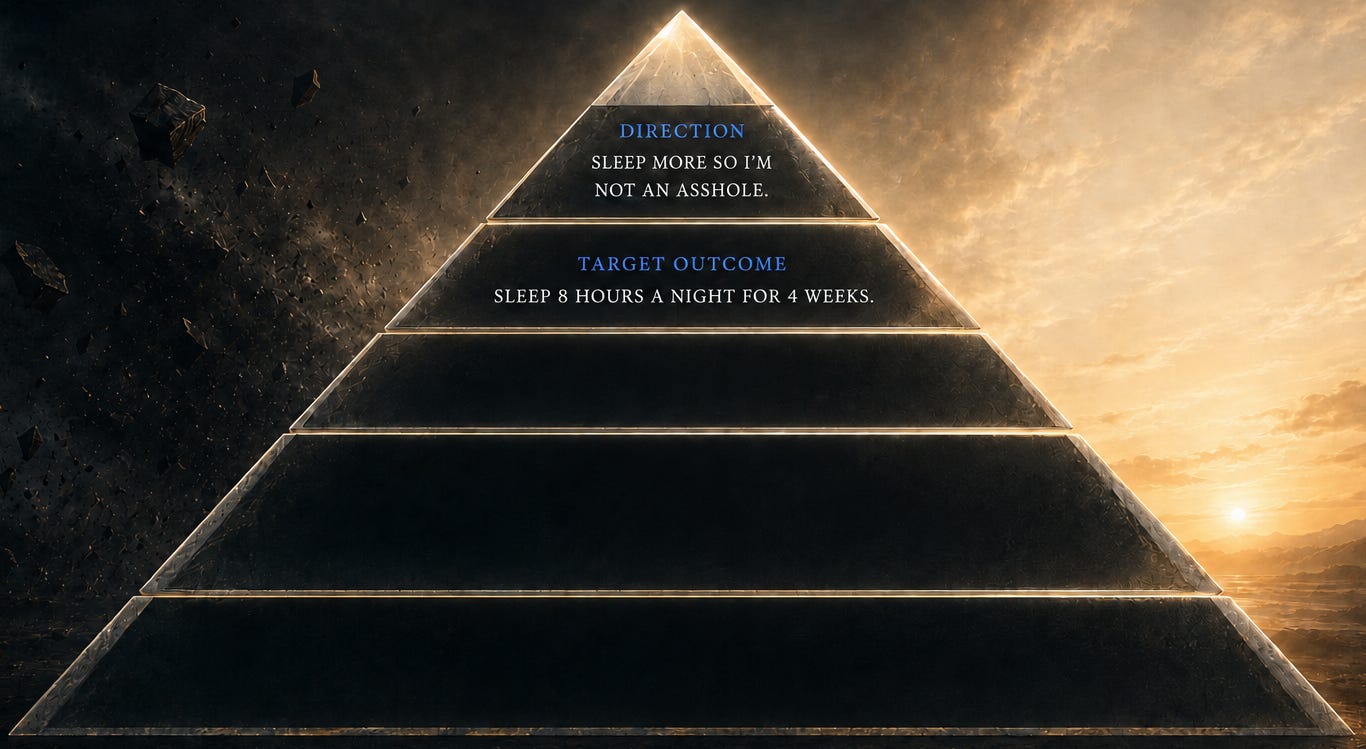
Your target outcome defines what progress would look like during this planning period. Let’s make them.
Ask:
If this direction became more real, what would I be able to observe?
Choose an outcome that is:
Self-referenced
Observable
Bound to a useful period of time
A result, not a recurring action
For example, “finish an ultramarathon” is self-referenced. “Place first” depends on who else shows up.
Do not disguise an action as an outcome:
Outcome: Finish an ultramarathon.
Action: Run on Monday, Wednesday, Friday, and Saturday.
Write Yours
Over the next _________, I want _________ to become true.
I will know I am making progress when _________.
Example:
Over the next four weeks, I want to average at least seven hours of sleep per night.
Write one target outcome beneath your superordinate goal.
Step Four: Identify Constraints and Craft Supporting Goals
Find the main constraints between your current reality and your target outcome.
What is getting in the way? What would need to become more true?
A constraint is the problem you observe. The reasons we don’t do something we know we oughtta. Our supporting goals are the conditions, strategies, or capabilities we will build in response.
For example:
Work follows me into the evening → Create a clearer end to my workday.
My phone is my only decompression → Build a calmer wind-down period.
A health issue may be affecting sleep → Get professional support.
Describe what you want to create. “Create a reliable transition between work and home” gives you more direction than “stop working after hours.”
Supporting goals are not daily instructions:
Supporting goal: Make regular movement easier to begin.
Action: Walk for 10 minutes after lunch.
Choose Two or Three
Draw a section beneath your target outcome and divide it into two or three spaces.
Review your ideas and ask:
Would improving this make my target outcome more likely?
Does it address something I actually observed?
Is it reasonably within my influence?
Can it coexist with the other goals in my real life?
Your supporting goals should also be able to coexist. If they all compete for the same limited time and energy, choose fewer.
Write one supporting goal in each space.
Test each connection:
If I create __________, it will make __________ more likely.
For example:
If I create a reliable transition out of work, averaging seven hours of sleep will become more likely.
Make a few of these constraint solving supporting goals and add them as supporting goals in layer three.
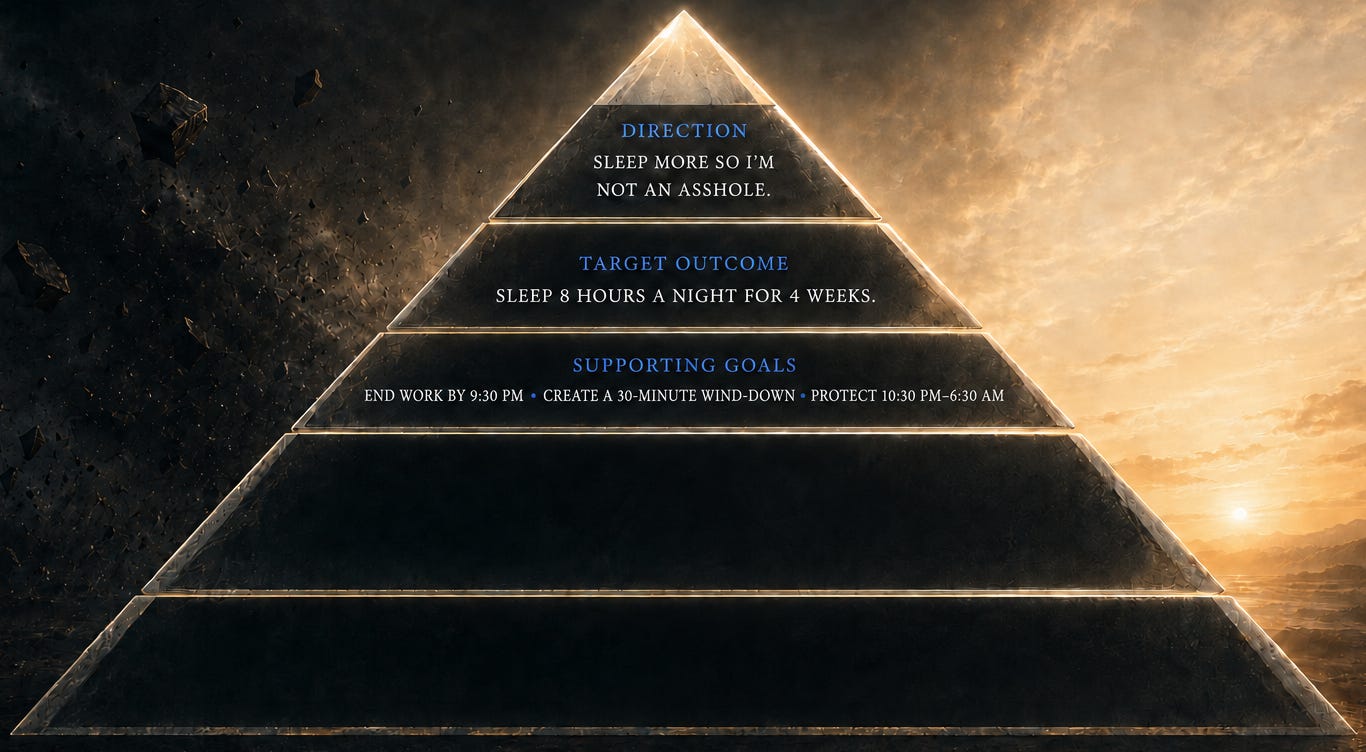
Step Five: Craft Repeatable Actions
Turn each supporting goal into something you can actually do.
Ask:
What can I do repeatedly that would make this supporting goal more true?
A repeatable action has to be:
Within your influence
Easy to measure and know you completed it
Specific enough to begin
Small enough to repeat
Connect each action to a cue:
When __________ happens, I will __________.
Example:
When I close my laptop, I will write down tomorrow’s first task.
Choose one or two actions for each supporting goal.
Do not choose 14 actions and call it ambition. That is how we accidentally build another full-time job.
Write one or two actions beneath each supporting goal.
At 1:00pm I will put my walking shoes on. (for post lunch movement)
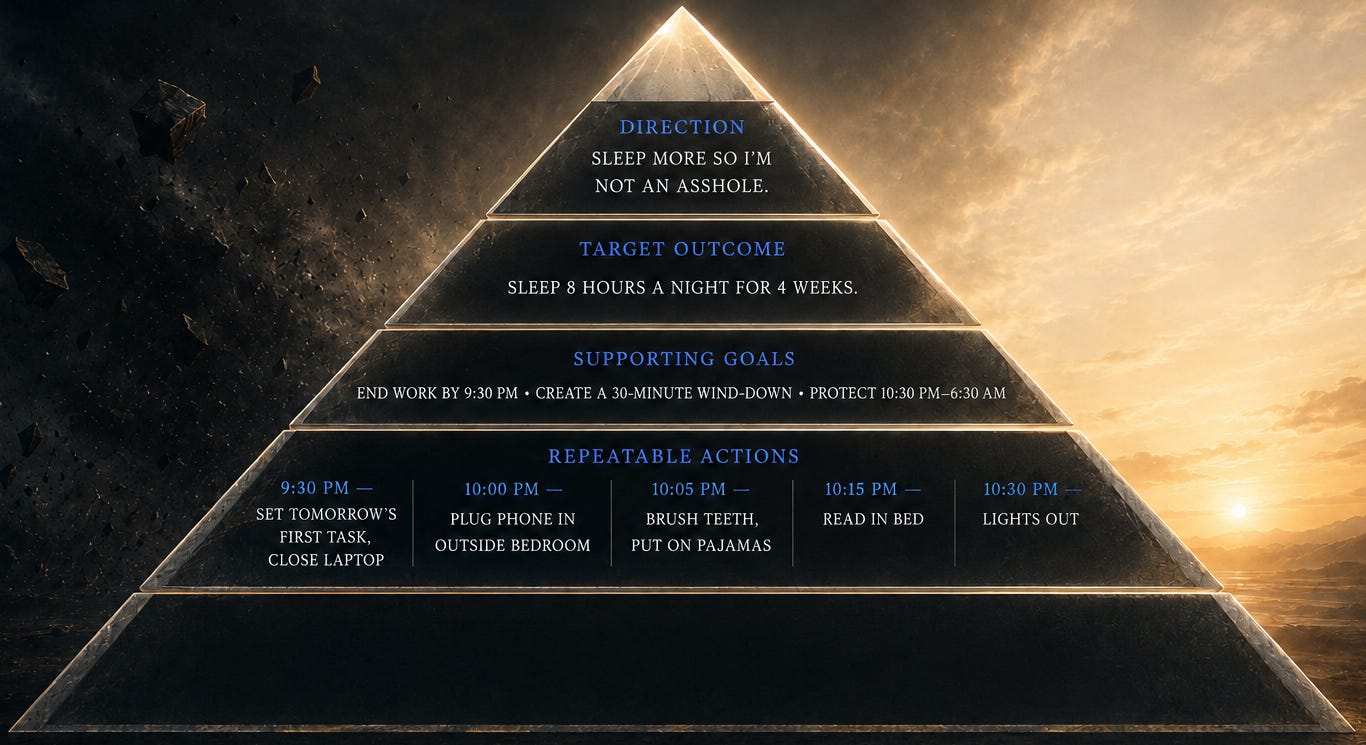
Step Six: Build the Foundation
A good action still needs support.
For each action, complete four fields:
Preparation: What can I set up in advance?
Smallest version: What can I do on a bad day?
Obstacle: What is likely to interfere?
Backup: What will I do instead?
Example:
Action: Walk for 10 minutes after lunch.
Preparation: Put walking shoes beside my desk
Smallest version: Walk for two minutes
Obstacle: Bad weather
Backup: Walk inside the building
The smallest version is not your new maximum. It keeps you connected when the full version is unrealistic.
I am on day 500 something of running at least one mile every day. After an ultra, when I’m sick, or dog tired, I lace up, throw on a good you tube video, and shuffle through one mile. Still counts.
Set the bar wherever you know you can crank it out when push comes to shove.
Write these supports at the bottom of your pyramid. Build something that can survive your actual life.
At 9:30pm I set out my workout clothes for tomorrow. (for a morning workout)
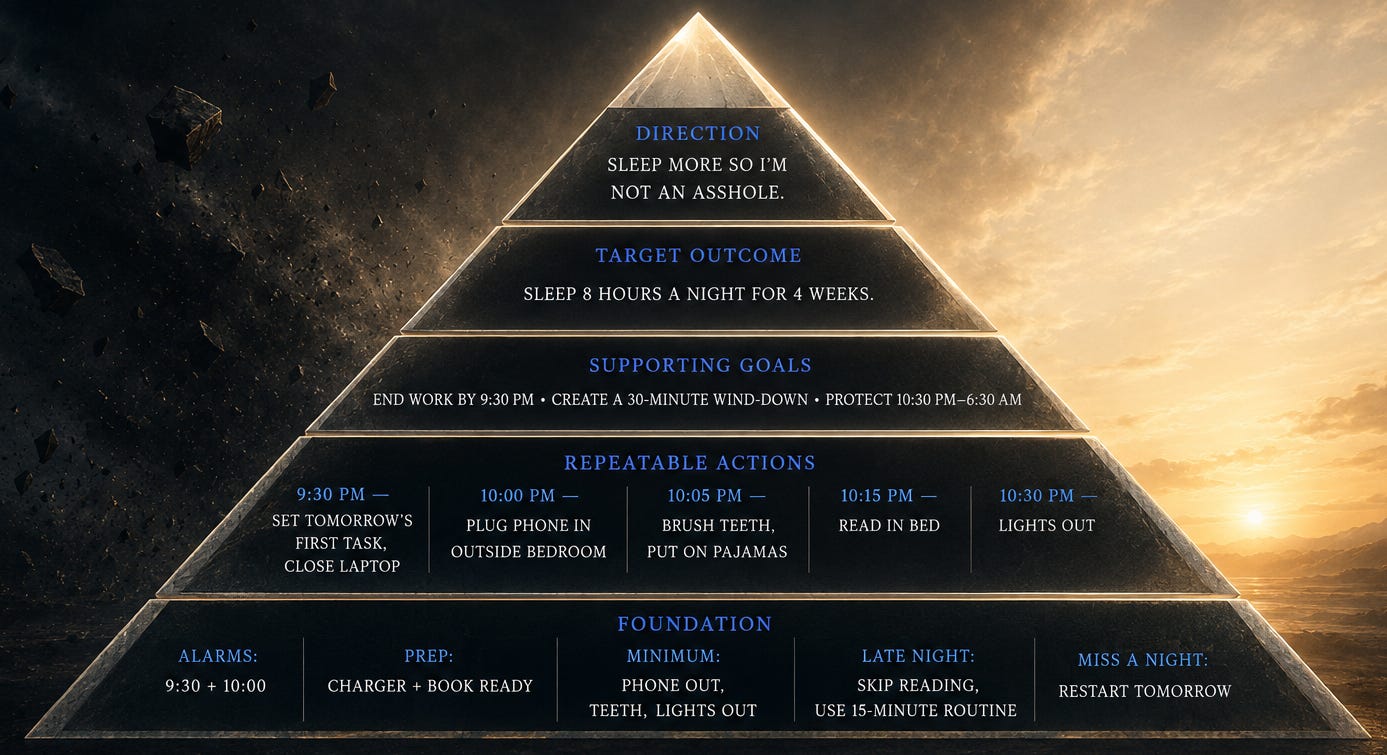
Step Seven: Experiment and Execute
ACTUALLY MAKE A PYRAMID.
Test your pyramid for a few days.
Track it somehow.
Put it on your fridge.
Send a photo to a friend (or me) as a commitment.
At the end of the week, review!:
Did I move toward my target outcome?
Which actions happened consistently?
What created friction?
What should I keep, change, shrink, or remove?
You will miss. I miss. We all miss.
When that happens:
Notice. Normalize. Choose the next kind step.
Notice: What actually happened?
Normalize: Missing an action does not make me lazy, broken, or incapable.
Next kind step: What is the smallest useful action I can take now?
Do not throw out your direction because one action failed.
Adjust and keep going.
Welcome to the self compassion big leagues, fellow sigma.
Comment with a photo of your goal pyramid! Or DM it to me if you don’t want to share. I will be your accountabilibuddy!

The Updraft is research, field notes, and conversations about the parts of leadership no tool can practice for us. Changing the system from within.
I’m Dan Korus, founder of Kestryl Edge. I spent years learning leadership the hard way and this newsletter is so you don’t have to. Also. As well. Like I did.
Subscribe! Every post is one lesson you won’t have to learn by getting burned. Let the lesson finds you before failure does.
References
Gollwitzer, Peter M., and Paschal Sheeran. 2006. “Implementation Intentions and Goal Achievement: A Meta-Analysis of Effects and Processes.” Advances in Experimental Social Psychology 38: 69–119. https://doi.org/10.1016/S0065-2601(06)38002-1.
Harkin, Benjamin, Thomas L. Webb, Betty P. I. Chang, Andrew Prestwich, Mark Conner, Ian Kellar, Yael Benn, and Paschal Sheeran. 2016. “Does Monitoring Goal Progress Promote Goal Attainment? A Meta-Analysis of the Experimental Evidence.” Psychological Bulletin 142 (2): 198–229. https://doi.org/10.1037/bul0000025.
Höchli, Bettina, Adrian Brügger, and Claude Messner. 2018. “How Focusing on Superordinate Goals Motivates Broad, Long-Term Goal Pursuit: A Theoretical Perspective.” Frontiers in Psychology 9: 1879. https://doi.org/10.3389/fpsyg.2018.01879.