
Oh Fu*k. Authenticity Is A Luxury Good Paid For With Privilege!
Authenticity is not equally safe.

Authenticity is not equally safe.
The more power, status, and cultural familiarity you have, the more of your “true self” you can bring to work without paying for it. Everyone else learns to codeswitch, mask, and edit. We change the clothes, conceal the history, and calculate which version of ourselves the boardroom is prepared to accept.
That does not make authenticity useless. It makes it conditional.
My argument is not that leaders should be fake. It is that “be yourself” is an incomplete and sometimes dangerous leadership prescription.
Leaders owe people honesty, consistency, fairness, and accountability.
Leaders do not owe people an unfiltered performance of the self.
The Lore
Authentic Leadership is a relationship-focused approach centered on genuine, ethical behavior, self-awareness, and transparency, rather than just authority or hierarchy.
The dominant model defines authentic leadership through four dimensions: self-awareness, relational transparency, balanced processing of information, and an internalized moral perspective.1
If you’re curious about Authentic Leadership in a broader context, the full history and evolution of leadership theory and how it stitches into the conceptual fabric, see my further reading list below and check out the annotated references section. If you don’t want to miss out again, the button below is for you. <3
Meta-analytic evidence associates perceived authentic leadership with favorable follower attitudes, leader outcomes, and performance-related outcomes:2
Authentic leaders make ethical decisions, have high psychological well-being, and show role modeling positive behaviors.
Followers feel empowered, identify with their leader, and report higher job performance, satisfaction, trust, and engagement.
Organizations are associated with stronger ethical climates, greater psychological safety, and, in some studies, improved financial performance.
Much of the evidence relies on followers rating both the leader’s authenticity and the quality of their own work experience. That makes it difficult to separate leadership behavior from follower approval, organizational climate, and halo effects. 3
Leadership books and keynote speakers have increasingly encouraged leaders to communicate purpose, values, and personal conviction as a means of inspiring trust and commitment.4
Generally, authenticity is ingrained in what we think of as a proper modern leader.
In Whither Authentic Leadership?, Jon Billsberry examined 45 empirical studies published in 2024 and 2025, finding that the field often continued its established methodological habits despite major critiques. 5
His review crystallized a concern I've been wrestling with.
The “True Self” Privilege
Authentic Leadership encourages leaders to cultivate self-awareness, transparency, and alignment with what it describes as their "true self."6
The framework encourages leaders to identify their values and bring them into their professional relationships.
The language surrounding authentic leadership often carries an implicit moral hierarchy. We begin describing authentic leaders not only as more trustworthy, but as better people. The implication is subtle but powerful: authenticity becomes evidence of moral superiority.
For anyone who isn’t the typical white, cisgender male leader, being “real” can cost you credibility. A study of LGBTQ leaders showed how corporate expectations to be “authentic” was often exhausting, invasive, and coercive.7
Typical leaders are more likely to have their mannerisms read as natural leadership. Atypical leaders are more likely to have the same mannerisms inspected as identity, politics, aggression, weakness, or deviation.
Atypical leaders often end up feeling pressured to wear a costume. 8
Employees sometimes create “facades of conformity,” concealing personal values or identities to appear aligned with the organization. Minority status and nonparticipative work environments can increase that pressure.9
You perform “leader” in a way that reads as acceptable.
You’re allowed to be vulnerable, but only if it doesn’t make you seem weak.
Instead of liberating the self, “authenticity” can become another form of corporate control, binding people even tighter to the emotional labor demands of fitting the mold. 10
Authenticity as a Label, Not a Trait
One suggestion is to look at authenticity as a follower label put onto the leader, not a style a leader can embody through personal decision. 11
Think about it this way: if someone says, “I’m cool,” that instantly makes them uncool.
Coolness is a trait decided by the onlooker; authenticity is in the eye of the beholder.
When a follower describes a leader as authentic, they are expressing comfort, trust, and alignment. A lack of authenticity is related to feelings of betrayal or unmet expectations. Authentic leadership is therefore not a style per se, but a cultural idiom followers use to judge moral legitimacy.
Authenticity is not something leaders possess.
It is something followers perceive.
In this way, the leader’s role becomes surprisingly modest.
You cannot declare yourself authentic any more than you can declare yourself funny, trustworthy, or charismatic. Those are judgments other people make after watching your behavior over time.
Your responsibility is simply to act with consistency, explain your intent, tell the truth about difficult decisions, and align your actions with your stated values. Whether others experience that as authenticity is ultimately their decision.
Supporting atypical leaders, then, becomes less about encouraging everyone to “be themselves” and more about examining the filters through which we evaluate people. We should ask whether we are rewarding integrity or merely rewarding familiarity. Are we calling someone authentic because they are principled, or because they happen to look, sound, and behave like the leaders we have always expected?
“I’m just direct…”
The academic construct is more disciplined than the corporate slogan it produced. In practice, relational transparency, vulnerability, “bringing your whole self,” and unfiltered candor are routinely mashed into one.
So we confuse authenticity with immediacy.
Social context and status change the name we give behavior. 12
A powerful person is “direct.”
A junior employee is “difficult.”
A man is “assertive.”
A woman is “emotional.”
A familiar leader is “authentic.”
An atypical leader is “political.”
Privilege does not merely permit expression. It helps decide how expression will be translated.
Direct language does not excuse rude behavior.
Your first impulse is not automatically your truest self. Authenticity is not unfiltered transparency.
People still experience regulated emotions as authentic.13
Authenticity is not a free pass excusing the human duty of filtering your own poisonous thoughts before sharing them with others.
You do not control every interpretation of your words. You are still responsible for their foreseeable impact.
Subscribe if someone has ever been a bully to you and justified it with “I’m just direct.”
Steep Luxury Tax
If I came to work and was my “true self” in any of my past roles, I’d likely have been fired from all of them. I have grown into a very… open and questioning person, and I put on a veil of manners, restraint, patience, and the physical uniform of a corporate professional.
My favorite clothes to wear are cotton shirts washed so many times they are soft and have holes in them along with Carhartt pants. Clothes for relaxing, chopping wood, gardening, cooking, living a life with some dirt in it. The best life.
Yet here I am in my business casual monkey suit so my boss knows I care and so people see me as put together.
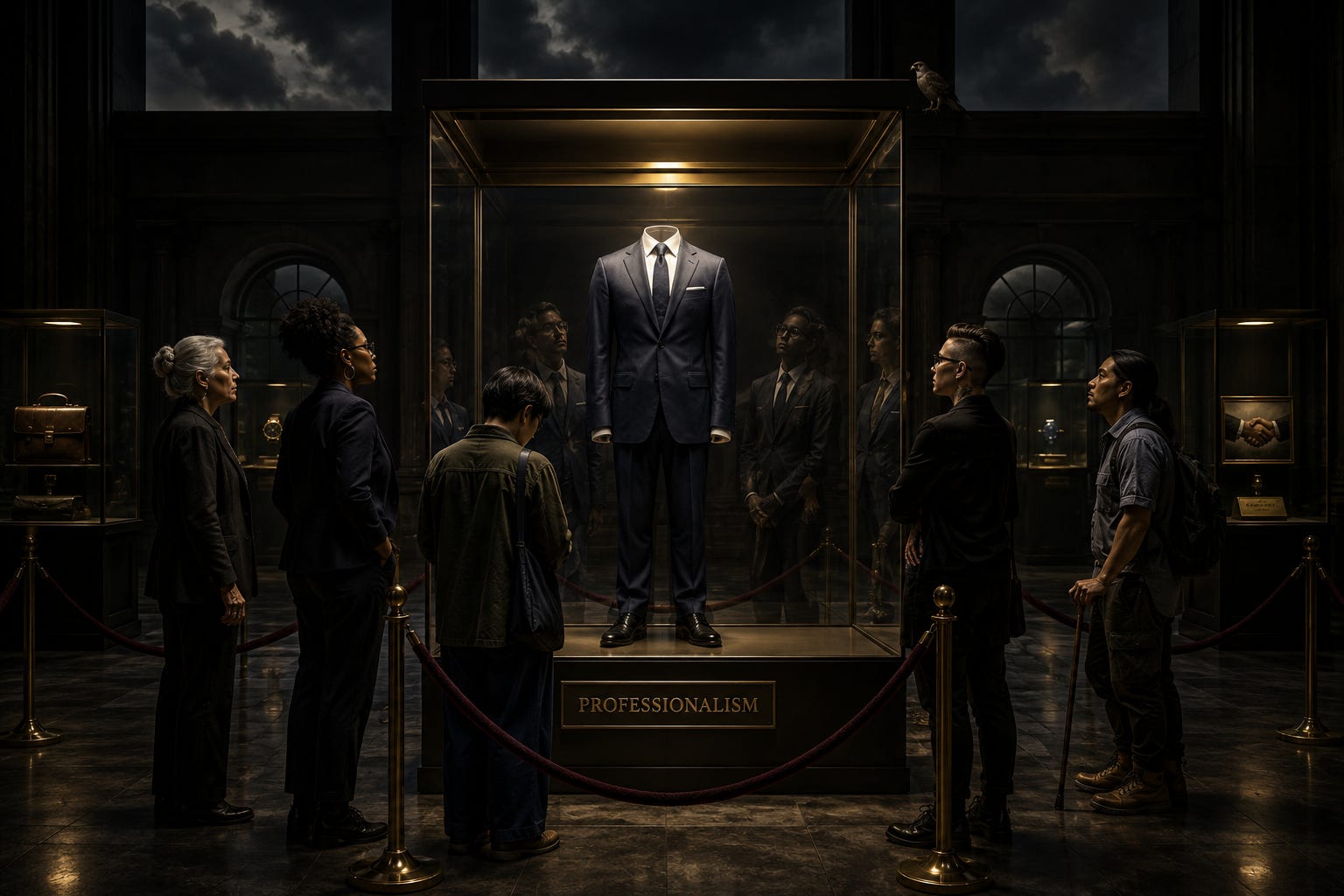
Professionalism is a construct. Sometimes it's useful. Sometimes it's exclusionary. Often it's both.
It is not always inclusive or innately diverse, and it’s rarely neutral. It is often a performative ritual.
Is a contextual self necessarily a false self?
A filter is not always dishonesty. Sometimes it is discipline. Sometimes it is respect. Sometimes it is survival.14
The problem is not that everyone adapts. The problem is that some people must adapt far more, while others mistake never having to adapt for moral courage.
Leaders don’t earn trust by being themselves and saying everything they think.
They earn it by making sure what they choose to say consistently reflects who they are trying to become.
That is a far higher bar than simply “being yourself.”
It’s also a more equitable one.
It asks every leader to practice integrity instead of rewarding only those who can safely afford authenticity.
~d
Have you always felt like calls for authenticity were veiled attempts at corporate control? You’re in good company. Share this with other birds of a feather.
The Updraft
The Updraft is a leadership newsletter meant for aspiring leaders, current leaders, and particularly leaders in high consequence environments. It’s where I get my thoughts on paper and practical tools and reflections to the many while building Kestryl Edge, LLC.
Subscribing guarantees you 1-2 leadership essays each week. I ensure these essays are useful, and I often take input from my audience for future topics.
Further Reading


References
Walumbwa, Fred O., Bruce J. Avolio, William L. Gardner, Tara S. Wernsing, and Suzanne J. Peterson. “Authentic Leadership: Development and Validation of a Theory-Based Measure.” Journal of Management 34, no. 1 (2008): 89–126. https://doi.org/10.1177/0149206307308913.
Using five samples from China, Kenya, and the United States, the authors developed the Authentic Leadership Questionnaire around self-awareness, relational transparency, balanced processing, and an internalized moral perspective.
Zhang, Yucheng, Yongxing Guo, Meng Zhang, Shan Xu, Xin Liu, and Alexander Newman. “Antecedents and Outcomes of Authentic Leadership across Culture: A Meta-Analytic Review.” Asia Pacific Journal of Management 39 (2022): 1399–1435. https://doi.org/10.1007/s10490-021-09762-0.
This meta-analysis of 214 studies and 196,300 participants found significant associations between perceived authentic leadership and numerous follower, leader, and performance outcomes, while also finding that culture and study design altered some relationships.
Gardner, William L., Elizabeth P. Karam, Mats Alvesson, and Katja Einola. “Authentic Leadership Theory: The Case for and Against.” The Leadership Quarterly 32, no. 6 (2021): 101495. https://doi.org/10.1016/j.leaqua.2021.101495.
This scholarly exchange presents both the defense and critique of authentic leadership, identifying some common ground while leaving major disagreements about its definition, measurement, theoretical value, and practical usefulness unresolved.
Simon Sinek, Start with Why: How Great Leaders Inspire Everyone to Take Action (New York: Portfolio, 2009).
Sinek argues that leaders and organizations inspire lasting commitment by clearly communicating their underlying purpose ("why") before explaining what they do or how they do it, proposing the "Golden Circle" as a framework for inspirational leadership.
Billsberry, Jon. “Whither Authentic Leadership? From Essentialist Essence to Constructionist Reconstruction.” Management Review Quarterly. Published online December 26, 2025. https://doi.org/10.1007/s11301-025-00579-5.
Billsberry reviews 45 empirical studies published in 2024 and 2025 and concludes that authentic leadership is better understood as a socially constructed judgment followers make about leaders, rather than a stable quality residing inside the leader.
Ford, Jackie, and Nancy Harding. “The Impossibility of the ‘True Self’ of Authentic Leadership.” Leadership 7, no. 4 (2011): 463–479. https://doi.org/10.1177/1742715011416894.
Ford and Harding use psychoanalytic theory to challenge the idea of an identifiable, stable “true self,” arguing that attempts to implement this ideal can suppress individual complexity and produce destructive organizational dynamics.
O’Rourke, Shannon. “What We Ask of Authenticity: How LGBQ Experiences Illuminate the Possibilities, Constraints, and Expectations of Being an Authentic Leader.” Leadership 20, no. 5 (2024): 279–288. https://doi.org/10.1177/17427150241249842.
Interviews with 30 LGBQ leaders in the United Kingdom found that participants made pragmatic decisions about when to disclose or express their identities and sometimes felt pressured to perform authenticity for organizational diversity and inclusion goals.
Hewlin, Patricia Faison. “Wearing the Cloak: Antecedents and Consequences of Creating Facades of Conformity.” Journal of Applied Psychology 94, no. 3 (2009): 727–741. https://doi.org/10.1037/a0015228.
A study of 238 employees found that minority status and nonparticipative environments were associated with concealing personal values, while these facades contributed to emotional exhaustion and intentions to leave.
Hewlin, Patricia Faison, Tracy L. Dumas, and Meredith Flowers Burnett. “To Thine Own Self Be True? Facades of Conformity, Values Incongruence, and the Moderating Impact of Leader Integrity.” Academy of Management Journal 60, no. 1 (2017): 178–199. https://doi.org/10.5465/amj.2013.0404.
Across an experiment and a two-wave employee survey, the researchers found that values incongruence increased facade creation and that highly consistent leaders could paradoxically intensify that pressure by making employees feel organizational values were fixed and nonnegotiable.
Iszatt-White, Marian, Valerie Stead, and Carole Elliott. “Impossible or Just Irrelevant? Unravelling the ‘Authentic Leadership’ Paradox through the Lens of Emotional Labour.” Leadership 17, no. 4 (2021): 464–482. https://doi.org/10.1177/1742715021996928.
Examining authenticity through emotional labor, the authors find that practicing leaders routinely regulate their emotions while still experiencing themselves as authentic, challenging the assumption that authenticity requires unfiltered transparency.
Gardner, William L., Elizabeth P. Karam, Farzaneh Noghani, Claudia C. Cogliser, Daniel P. Gullifor, Ketan Mhatre, Shucheng Ge, Ran Bi, Zhen Yan, and Dara Dahunsi. “‘Let’s Get Real’ … When We Lead: A Systematic Review, Critical Assessment, and Agenda for Authentic Leadership Theory and Research.” Journal of Management & Organization 30, no. 6 (2024): 1642–1668. https://doi.org/10.1017/jmo.2024.68.
This systematic review evaluates 303 articles published from 2010 through 2023 and concludes that much of the literature falls short of research-design and analytical best practices, recommending that authenticity be studied through observable signals rather than broad follower impressions.
Eagly, Alice H., and Steven J. Karau. “Role Congruity Theory of Prejudice toward Female Leaders.” Psychological Review 109, no. 3 (2002): 573–598. https://doi.org/10.1037/0033-295X.109.3.573.
This review develops role congruity theory and concludes that women can be penalized both for not matching conventional leadership expectations and for displaying leader-like behavior that conflicts with gender expectations.
Iszatt-White, Marian, Valerie Stead, and Carole Elliott. “Impossible or Just Irrelevant? Unravelling the ‘Authentic Leadership’ Paradox through the Lens of Emotional Labour.” Leadership 17, no. 4 (2021): 464–482. https://doi.org/10.1177/1742715021996928.
Examining authenticity through emotional labor, the authors find that practicing leaders routinely regulate their emotions while still experiencing themselves as authentic, challenging the assumption that authenticity requires unfiltered transparency.
Kark, Ronit, and Ben Shalom Cohen. “The Crown Must Always Win: Rethinking Authentic Leadership through ‘The Crown’ Series.” Journal of Management & Organization 30, no. 6 (2024): 1699–1727. https://doi.org/10.1017/jmo.2024.70.
Through a qualitative analysis of portrayals of Queen Elizabeth II, Princess Diana, and Margaret Thatcher, the authors develop “bounded authenticity,” in which leaders balance genuine expression against ethical duties, role constraints, context, and public responsibility.
Important topic for sure. Still processing what you've shared. I've worked in leadership development within organizations and the cliche of "bring your full self to work" is certainly popular, as well an undefined and still cliche.
I will for now just say this--I'm not sure it's authenticity we're even after, as much as honesty, integrity and transparency. Lots of us believe that the current president of the US is authentically being himself, e.g., not faking or masking anything. I'm not sure, this is what we want from leaders and although we can debate the definition of a leader, I don't consider this man a leader, but a tyrant and maybe it's time for us to make those distinctions.
I think it's fair to say that no one wants a leader who lacks basic human decency and more advanced social-emotional skills, real emotional intelligence, not the fake it until you make it brand.
A quote from Brene Brown comes to mind, "vulnerability has to be earned." I support this concept. When I know you well enough to discern that you're someone who can be trusted with my vulnerability, I'll share it with you. And, in any event, you'll always get my integrity, honesty and transparency --in matters that concern you.
As Goffee and Jones once said “Be yourself more, with skill”