Literature Review - Disconnectedness in the Workplace
Employees who feel connected have 56% higher in-role performance.

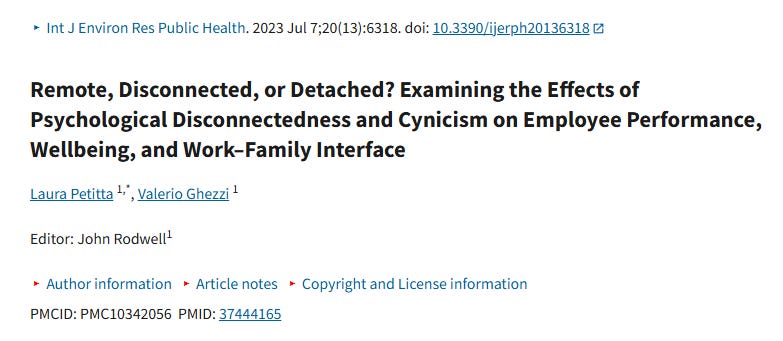
This is one of my favorite papers I’ve read in 2026.
It was published in the International Journal of Environmental Research and Public Health in 2023. The reference frame of the paper is the global attention to the workplace, burnout, “quiet quitting,” and the tide of discontented and cynical workers.
The pandemic woke people up to their mental health conditions, and researchers wrote papers about how we can do better. Learning about how we can do better and improve is one silver lining from the tragedy. Mental health at work determines safety, productivity, and error precursors.
The paper highlights a known truth: as leaders, we have the largest influence on the experience of our employees. Two terms are made distinct in the paper: “Workplace Disconnectedness” and “Work Cynicism.”
Workplace Disconnectedness
Disconnectedness comes from an unfulfilled desire to belong. It is when an employee feels a lack of unity and connectedness with their organizational community. This involves not feeling understood, feeling different and distant from other people, and struggling to fit in.
Work Cynicism
Cynicism is a self-protection method against further harm. It is a state of psychological detachment and a negative attitude about one’s workplace. When overwhelming demands become chronic, it depletes emotional resources. Cynicism is a negative reaction to the stressors of work.
I appreciated the distinction between disconnectedness and cynicism and also how cynicism is a protection mechanism from toxic work elements and burnout. The mechanism is explained like this: As one becomes burned out over time, they get worn down. If no leader is there to protect their health, then they will subconsciously begin to develop protection in the form of detachment, cognitive and emotional distancing, and eventually cynicism.
The data was gathered from 204 Italian organizations polling over 1,066 individuals. There were many findings explored in the paper, and the paper is worth reading, but one of the key findings I’ll share is that workplace disconnectedness is correlated with cynicism. The reciprocal was also found true.
Why does this matter to us as leaders and managers?
There are real and toxic effects of workplace disconnectedness that are detrimental to performance, safety, and error reduction. As leaders, it is our job to ensure people get home safe. We must ensure they can work in an environment that supports minimizing error precursors while supporting their performance.
Performance is 56% higher: When employees are filled with connectedness, performance is 56% higher. Here is a real number for the results-oriented leaders out there. Listen up! How your people are at work affects their performance. Ensure a connected culture and thereby ensure results.
Employer promoter score is 167% higher: The promoter score is positive employee referrals. If your employees feel connected, then you get promoted much more strongly than if people are disconnected. You want to be known as a good place to work; it is critical to business.
Cynicism is shown to spread: It spreads top-down quickly and laterally slower. This is important because if you, as a leader, are burnt out, your entire team is likely going to be affected by your resulting mental and emotional decline.
You need to be on top of how you are doing and build systems and habits that support your long-term health. You also need to be humble enough to be able to pull the eject button if you need to take time to recuperate. Being gone for a week is better than dragging your team down into a spiral of negativity. Furthermore, help your team do the same.
Would you let yourself come into work sick, coughing uncontrollably, sneezing everywhere, feverish, and miserable? This is the same; we just can’t always see it. Stay tuned for some future writing on this. I’m working on a scientific compilation of the negative health effects of being in a toxic work environment.
Where do we go from here?
An authentic, transformational, or servant leadership style has positive effects on employees’ psychological resources and is related to lower burnout levels. (Petitta et al. 2019) If you don’t know what those are, check out my reading list and get going. Or, cut to the front of the learning line by reaching out to us at Kestryl Edge.
Leadership performance and behaviors should be regularly evaluated so that potentially adverse aspects may be identified in a timely manner. (Molero et al. 2019) Know thyself! Take care of yourself. If you can’t be there for yourself, you can’t be there for others. Get some trusted advisors to check you on your work and let you know when you’re slipping off the rails. Then listen and act.
Leaders need to prioritize activities that boost interconnectedness and inclusivity:
Social occasions with coworkers.
Be mindful of your team by asking questions, making small talk, self-disclosing, and active listening.
Practicing acceptance by acknowledging that coworkers are different than oneself and focusing on similarities and desired shared outcomes.
Appreciating coworkers’ efforts to seek contact that helps in building the sense of connectedness.
Remember, your employees’ actions are theirs to own. But the environment they have to work in, the support they have to do the right thing, and the foundations of the culture they have to build upon are all in the hands of their leadership.
9.6/10 Great Read.
Cheers all,
Dan
Be a part of the solution: www.kestryledge.com
Learn more about Dan: www.dankorus.com
References
Molero, F., M. Mikulincer, P. R. Shaver, A. Laguía, and J. A. Moriano. “The Development and Validation of the Leader as Security Provider Scale.” Journal of Work and Organizational Psychology 35, no. 3 (2019): 183–193.
Petitta, L., T. M. Probst, V. Ghezzi, and C. Barbaranelli. “Cognitive Failures in Response to Emotional Contagion: Their Effects on Workplace Accidents.” Accident Analysis & Prevention 125 (2019): 165–173.