


On Crosswinds I bring you written interviews from leaders worth learning from.
Neela is our guest and she writes WorkmanShit, an operators column with the following philosophies:
Fix the system before blaming individuals.
Accountability belongs with the decision-maker.
Human beings are not optimization projects.
Expertise should be valued by impact not elapsed time.
Leadership requires pre-decided values.

Neela is from Trinidad.
She’s on the west coast (best coast), loves french fries. Coffee, black - no milk - 2 sugars. She types on a logitech keyboard she’s had since 2014.
Neela is an executive with 25+ years across tech, fashion, interior design, civil engineering, manufacturing, and other operational environments.
She’s a writer whose subjects includes work, identity, politics, tech, immigration, family, and where these domains collide.
She calls herself a “Spicy Leadership” voice.
One think you’ll see about Neela is that she’s a role model in reading others work and in sharing it. Her feed is more other people’s work than it is hers. You will find her essays are well received and expertly crafted. Neela brings the best of herself to the table and finds the best in others to share, too.
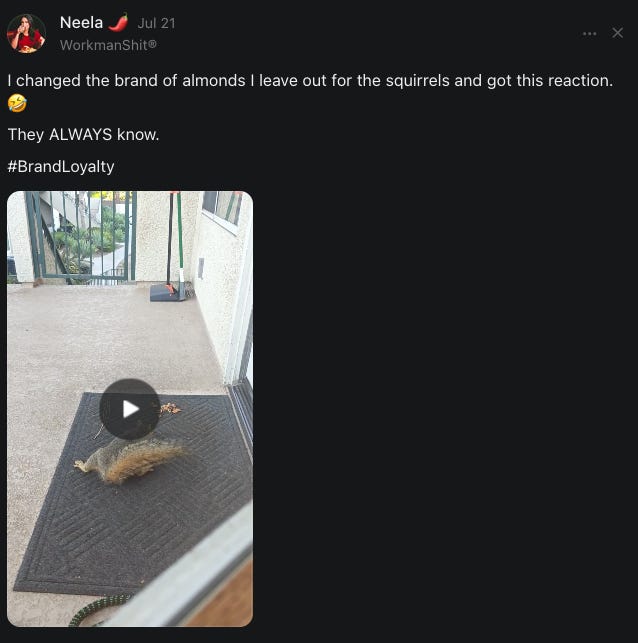
Her essays rock. Each one is a journey and is so fun to read. Neela does this thing where she starts with a small critter (squirrels, etc), a story, a memory, she lulls us into relaxation, and the story is really about power, burnout, org design, immigration, gender, or democracy. It’s fantastic, gets me every time.
Neela has an operators eye. She argues for upstream accountability. Her writing explores moral complexities and she has the cross-contextual perspectives to bring new light to any room of thinkers.
I hope that you learn from Neela. Just as I did.
Welcome to Crosswinds.
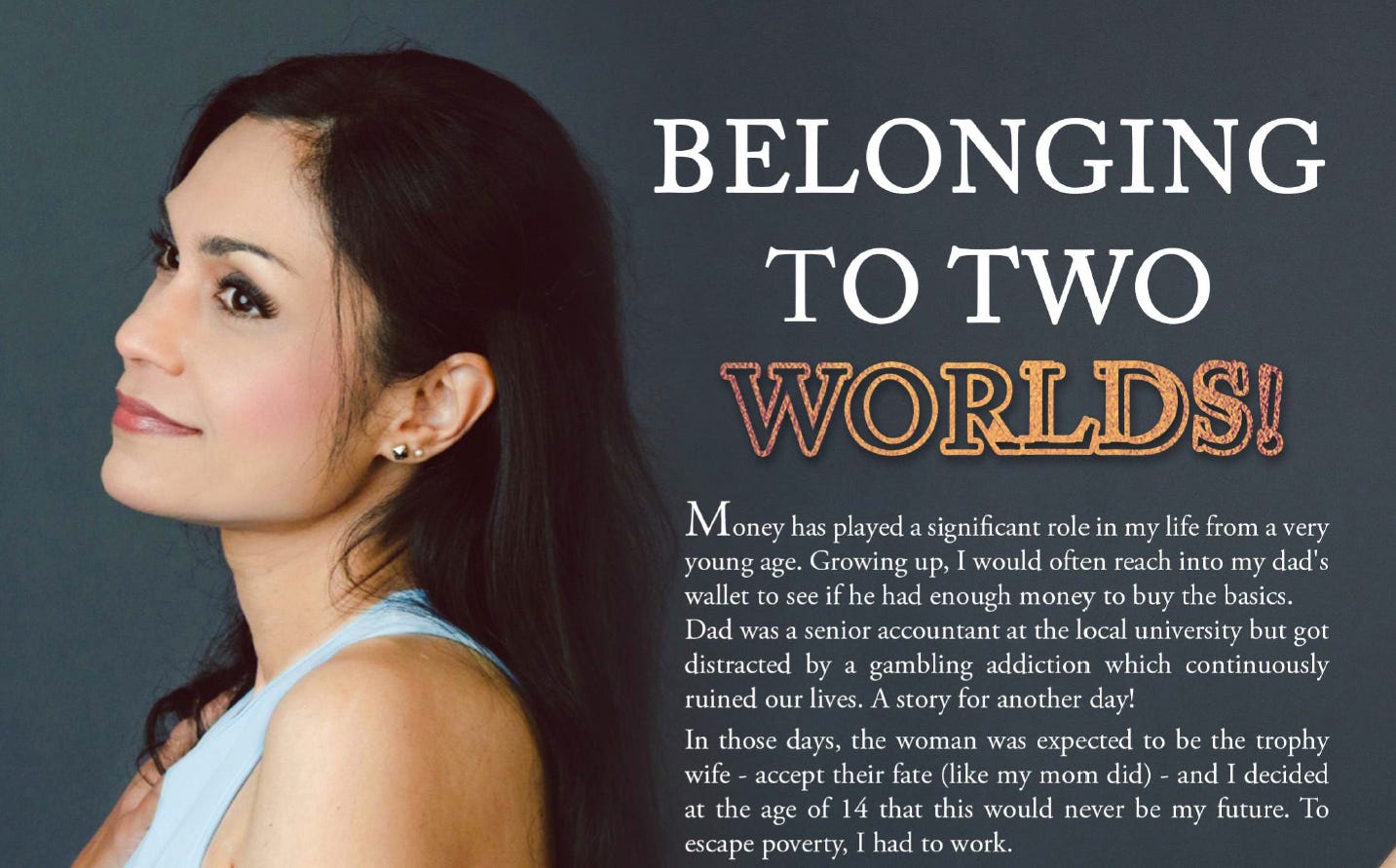
Who are you today?
I’m forty-nine, and I feel like I’m just getting started.
My mother seemed done by forty. She raised her kids, survived my dad, and paid a price for it. Her dreams? She folded them up, tucked them away, and never looked back.
For years, I thought that’s just what happened to women. I saw my aunties do the same. But that’s not some unchangeable law. That was their story—not mine.
By the end of 2026, I’ll be stepping away from a very lucrative career in tech that’s made sense for the past decade. What am I heading toward?
No fucking idea.
And I’m okay with that.
Ten years ago, I would have wanted to know what came next. I don’t need that anymore. I’ve spent enough of my life knowing what comes next. Now, I’d quite like to see what happens when I don’t.
Tell us your story of how you got here.
I migrated from Trinidad in 2003, landing in NYC that March.
My resume listed me as a business communication teacher and office manager. But my first job? Selling vacuum cleaners to Upper East Siders. Electrolux. Sales. I got my feet wet—soaked, really.
My next gig was at a tech company on Wall Street. I stayed there for two years, long enough to learn two things: I wasn’t cut out for that place yet, and I wasn’t ready to admit why. People often talk about “culture fit” as if the person who doesn’t fit must be the problem.
Eventually, I realized I wasn’t. But that didn’t mean I was ready for that environment either. I wasn’t strong enough yet to hold my own in those rooms. So, I spent the next eleven years in the Garment District.
The folks there teach you a lot about hustle. Patience? You learn that the hard way. Everything moved by season. You learned to talk fast and read a room. For a decade, I watched people sell things to others. I saw some make it, while others vanished after a couple of seasons. I started paying attention to why. What made someone good at it? What made people trust them? Why did one person survive when someone with a better product didn’t?
That was my real education.
In 2016, I struck out on my own, starting my consulting firm and building my client base. I had reached the point where working on someone else’s idea felt physically uncomfortable. For the next two years, I worked with some well-known interior designers and met some interesting politicians. Eventually, I ended up in Irvine, California, where tech chooses you more than you choose it.
The second time around, I saw the work differently. In California, tech spaces mostly embraced my quirks as an asset. It was the same work I’d been doing all along. The difference was me. I was more prepared and confident. I knew how to hold my own in the room this time.
I had fifteen years of scar tissue to prove it.
How did you learn emotional intelligence?
By being underestimated early and often. I spent years in rooms where I was the youngest and the least credentialed. I didn’t have the Ivy League pedigree that seemed to come standard with everyone else.
When people decide you don’t matter, they stop pretending. That’s the gift. They say what they think. They argue in front of you like you’re a sofa. You hear the real opinion, the real reason the project is failing, because nobody is bothering to clean it up for your benefit. I was the immigrant woman with a Trini accent. Still, mine was always the best seat in the house. I listened. I watched. I learned how power actually moved through a room, which was rarely the way the org chart suggested it did.
How would you change the workplace if you could change anything?
I would burn the title ladder…

I have watched more talented people lose to less talented people because of the isms.
Nepotism. Favoritism. Titles make people comfortable, and comfortable people stop being curious, and incurious people build boring things and then blame the market.
What is leadership to you?
Leadership is firing someone well.
Now, before you get all riled up, hear me out.
Hiring’s the easy part, right? It’s firing that really puts your skills to the test. Imagine sitting across from someone who’s counting on this job to pay the mortgage. Can you face them and be honest, without retreating behind a wall of legal mumbo-jumbo? Can you let them vent their frustration while keeping your cool? The way you manage the hardest day of someone’s career speaks volumes about you, more than any speech ever could.
When do you feel you became a leader?
I don’t think you become a leader. I think you become someone people trust, and then the word leader gets applied to that retroactively by people. I have never woken up and thought of myself as a leader.
I am a problem solver.
What’s a funny, ridiculous, embarrassing, or wild story from your life?
Do you have time? I have so many stories. Here is one of them. I once showed up to a job interview on the wrong day.
This was back in 2006. I was a whole day early. The receptionist told me. I told her that I just wanted to see the office first. She looked at me. I looked at her. We both knew I was lying.
She offered me water. I drank the water. I sat in the lobby for a respectable amount of time so the lie would hold, and then I left. I didn’t get the job, but it made for great conversation the actual day of the interview.
What emotions do you read from people? What do you do about it?
Loneliness and sadness—I can spot those two a mile away. Maybe it’s because I’ve seen what they look like when someone’s trying desperately not to show it.
It’s usually not the person sobbing in the corner. More often, it’s the one lingering after everyone else has gone. I don’t call attention to it, of course. Last thing anyone needs is someone pointing out their vulnerability when they’re barely holding on.
Instead, I hang around a bit longer. Ask another question. Really listen to what they say. Later, I send a text that’s as normal as can be. Sometimes, people just need you to be there, not fix what’s wrong.
I know I hate it when folks try to fix my feelings, so I make sure not to do that to others.
How does power affect you?
I hold it all in my jaw. Funny thing is, I had no idea until my dentist pointed out my teeth grinding and asked if I was stressed. I said no, genuinely believing it. To me, power feels like being the last person awake in a silent house. Everyone else is tucked in, fast asleep, while you’re still up with the lights on, because someone has to be.
Eventually, you don’t even notice your teeth are clenched anymore.
What decision looked reasonable at the time but troubles you now?
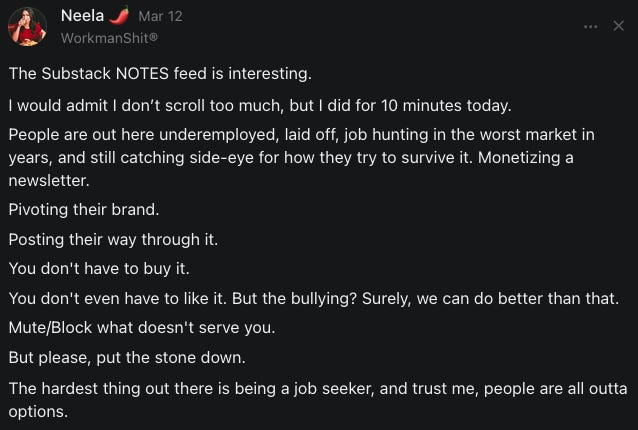
Our early footprint in AI troubles me sometimes. This was four years ago.
Sometimes, I get a bit uneasy thinking about our early steps in the AI world. It was four years back when we were this renegade legal and compliance skunkworks team. We were diving into projects before there were many rules to follow, so the main question we faced was pretty straightforward: Is this illegal?
If the answer was no, we could usually find a reason to forge ahead, and there was a paycheck in it.
At the time, that seemed perfectly reasonable. The tricky part is, you don’t lose control all at once. It’s more like giving a bit here, making an exception there, and promising yourself that you’ll set better boundaries for the next venture. Everything was moving so fast, we fancied ourselves as standing in front of the train, trying to hit the brakes.
But we weren’t. We were right there on the damn train.
Feels like a lifetime ago.
What feedback has followed you through more than one job or chapter of your life? Why has it been difficult to change?
“You’re hard to read.”
That one. I got that feedback from bosses, from colleagues, and from clients. And I know exactly what they mean.
My face doesn’t always do what my feelings are doing. At work, anyway. Put me around my family or friends, and this problem mysteriously disappears.
That was normal behavior growing up in my house. You don’t show emotions to strangers. You keep your face, and you handle your business. Most things have a solution, so losing your shit before you’ve looked for one always seemed like a waste of perfectly good energy.
The reason it’s hard to change is that I don’t actually believe it should. That face has got me through some difficult rooms and some very difficult personalities. When somebody else is losing theirs, I’m usually the person still thinking. That has served me well.
Besides, every time I try to be warmer on purpose, I feel like I’m faking it. And faking makes me worse at my job.
What do the gurus tell you on LinkedIn?
Be authentic…Just be yourself!
What do you wish you learned earlier?
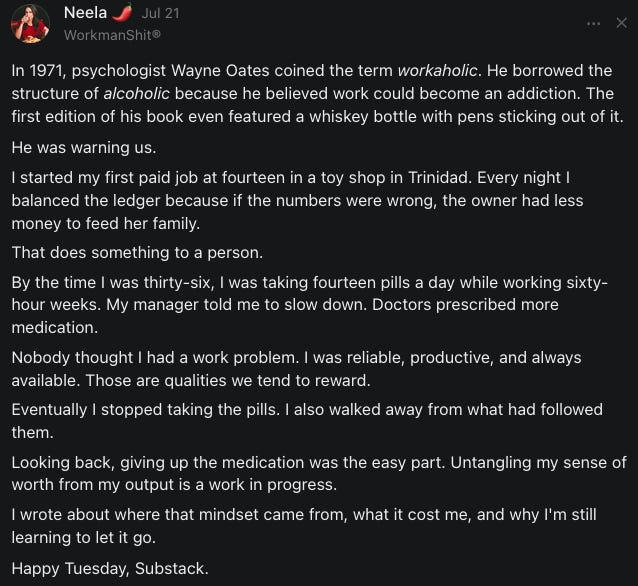
I once believed I could outwork everything—stress, grief, exhaustion. My body, however, had other plans, silently tallying each ignored emotion and sleepless night.
“Just push through, Neela,” I’d tell myself.
But one afternoon, it hit me like a ton of bricks. Turns out your body doesn’t forget; it sends you a bill for everything your mind chooses to overlook. Trust me, take care of your health before it decides to remind you.
What’s an underrated skill to develop as a leader? How would you coach someone to learn it?
Restraint.
The higher you climb, the more tempting it is to interfere. Someone comes to you with a problem, and because you’ve got the title and the big red button, you feel like you’ve got to press it. Resist that urge.
Some problems just need a day to sort themselves out. This approach isn’t the most popular, and it’s especially tricky when you’re a woman. People might confuse hesitation with weakness. But you know what? I’ve never regretted taking my time with the big decisions.
My coaching style? I’d get folks to think about decisions that don’t need an immediate answer.
What’s a hill you will die on without regrets?
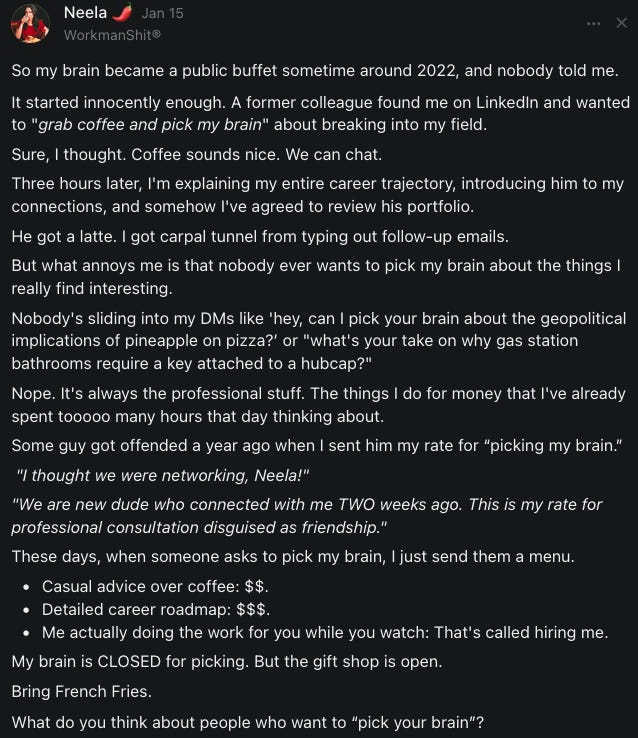
Everyone should have to live in a country that is not their own for at least six months.
Also…pineapple just doesn’t belong on pizza.
What advice do you have for someone starting their first day of work?
Head out on time, seriously. Don’t linger after hours on your first day trying to make an impression. All you’re really showing is that you’re willing to work for free. It’s important to establish your boundaries right from the start. Put in the effort, deliver quality work, and then clock out. Those who start off staying late usually end up doing the same on day 300, eventually burning out, quitting, and making way for the next person to fall into the same trap. It’s a never-ending cycle, destined to continue until the end of time.
You’ll have plenty of opportunities to devote yourself to that place. But today?
Today isn’t the day for that.
What advice do you have for the messy middle? The middle managers, the team leads, the senior contributors?
You’re the unsung hero of the building—the one everyone forgets to thank. When things go south, you’re the first to bear the brunt.
Your worth lies in your decisions about what to let slide and what to take on. You’re the ultimate filter. Those at the top might believe they’re running the show, and those below might think they’re the ones doing all the heavy lifting. But you know the real story: without you, nothing gets done.
What advice do you have for senior leaders? The rain makers, the C-Suite, the people at the top?
I work in the tech space, and I need to say this. You make too much money.

I know you don’t think so. I know you can justify it. I know the comp study says you’re at market salary or whatever. I’m saying that when you make considerably more money than the person actually doing the work, you should probably spend a little time asking yourself why. It has a lot to do with character. I know plenty of tech leaders who don’t do this, but too many who do.
From others, we learn.
If you’re not already subscribed, consider doing so, or following, in order to stay involved in The Updraft.
The Updraft is a publication for writing on leadership and emotional intelligence.
I’m Dan Korus, writer, interviewer, milk dud devourer, dog walker, cat snuggler, and founder of Kestryl Edge. A company dedicated to bringing emotional intelligence skills to leaders in the workplace.
Weekly essays, podcasts, lives, and interviews all free, all on striving towards being a better leader.


@Neela 🌶️ I just want to say thank you again for being on crosswinds and sharing your story and leadership thoughts with me.
I learned a lot. I hope others do too.
Thank you.
Dan
Woohoo 🎉🙌🙌
So exciting Dan.
This is my third written interview.
I'm glad we connected Dan and I look forward to future collabs
Thank you for putting this together.